What is a Manx cat? Tailless breed, coat and history
What is a Manx cat? It is a round, heavy, thick coated cat from the Isle of Man that is best known for having no tail. The Cat Fanciers' Association (CFA), a cat breed registry, describes it as quiet and gentle. This guide follows the CFA's own breed page, opened for this post, and then shows how Cat Go handles the question "Which breed is it?"
What is a Manx cat? The short answer
The CFA lists the Manx as a "tailless cat from the Isle of Man; thick, dense coat; heavy cat; many colors and patterns are available". Its coat length is listed as both longhair and shorthair, and its personality as quiet and gentle.
The CFA's description of the build is the one people remember. A Manx at rest is so round and cobby that it is jokingly called a "bowling ball with fur". The CFA adds a warning that bowling balls roll: these cats are quiet, devoted companions most of the time, but have a streak that can prompt them to start chasing invisible objects at 10 p.m.
Where the breed comes from
The CFA calls the Manx an ancient breed that began on the Isle of Man, an island in the Irish Sea. The tailless cats were first recorded in the sixteenth century by visiting sailors.
There is a charming story that the Manx was so late boarding Noah's Ark that the closing door cut off its tail. The CFA says it seems likelier that the missing tail comes from a mutation among the island's native shorthair cats. It was an incomplete dominant gene, and it then spread to the other cats on the island.
The CFA's history also explains the longhaired kind. It says the longhair gene was probably brought in during the long rule of the Vikings, when ancestors of today's Norwegian Forest Cats mixed with the native cats. Our post on the Norwegian Forest Cat covers that breed from the same registry.
The Manx also turned up early in cat shows. The CFA says they were at the first cat shows in Great Britain, that they are one of the oldest breeds of show cat, and that they were included when the CFA began registering cats in 1906.
Build, coat and the tail
The CFA describes a robust, rounded cat with great depth of flank. The body is shorter than average and surprisingly heavy when lifted. Its breed standard, the written description judges use, gives the same overall impression: roundness.
- Head: very round, with rounded cheeks that give a jowly look.
- Legs and back: the back legs are longer than the forelegs, the rump is higher than the shoulders, and the short back makes a continuous arch from shoulders to rump.
- Eyes and ears: large, round eyes and medium sized ears with a characteristic "rocker" set.
- Coat: both short-haired and long-haired Manx have thick, plush coats with a well padded feel, designed to protect against the elements.
- Size: the CFA says males average between 10 and 12 pounds, with females slightly smaller.
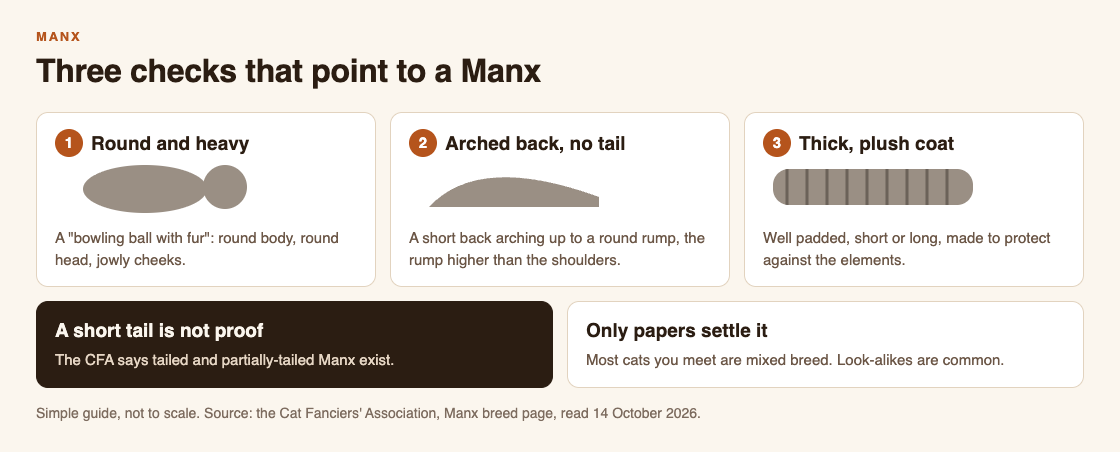
Three checks that point to a Manx, from the CFA's description.
Colour is no help here. The CFA says many colors and patterns are available, so a Manx can look like many other cats from the front.
No. The CFA says tailed and partially-tailed Manx do occur, but only the completely tailless cats can be shown. So a cat with a short tail or a tail stub might have Manx in its family, but the tail alone settles nothing.
If you are curious about a particular cat, a vet or a breeder can tell you far more than a glance across the street.
Temperament
The CFA describes an affectionate and intelligent cat with a strong bond to its people.
- Bonding: Manx tend to attach themselves mainly to one or two family members. The bond is strong enough that they may take a while to settle with newcomers in the home.
- Play: they are fond of playing fetch and other interactive games, so the CFA says they are often called "doglike". They will politely seek you out with an object they want you to throw.
- Company: they tend to get along well with dogs and other family pets, including other cats.
- Children: the CFA calls them patient and tolerant with children of all ages. A Manx held a bit too tight will most likely squirm free with its powerful back legs and make a quick escape, rather than respond aggressively.
- Voice: talkative but not loud. They tell you about their day with chirps, trills, purrs and the occasional head bump.
The CFA also says the Manx may spend most of its time curled on the couch or in your lap, and then leap to the top of the refrigerator in a single bound. These are the CFA's words about the breed in general. Each cat is its own cat, and a rescued or mixed breed cat may act quite differently.
Grooming and health, as the CFA describes them
The CFA says a Manx should be groomed regularly to control shedding, and that its coat is not prone to matting, so grooming should not be a challenge.
- Longhair Manx: a wide-toothed comb is best. Pay attention to the areas under the legs and on the sides of the face, where mats often start. The CFA recommends weekly combing.
- Shorthair Manx: a comb or a brush, two or three times a month.
- Baths: most Manx do not need regular bathing unless they are being shown.
On health, the CFA gives one clear piece of advice: if you are considering a Manx, talk to your breeder about any possibility of Manx syndrome in the lines. It says the term refers to an array of problems involving the function of the hind legs, urinary bladder and colon of a tailless cat.
The CFA says this is typically found before kittens reach four months of age, so breeders may wait to place kittens until their health can be assured. It adds that testing and monitoring kittens, and the regular use of tailed Manx cats in breeding programs, have helped maintain a healthy, diverse gene pool. For anything about your own cat, ask your vet.
How to check a round, tailless cat you meet
Here is a worked example. You see a heavy-looking, round cat with no visible tail sitting on a wall on your walk, and you wonder whether it is a Manx.
- Look at the shape. Is the whole cat round and cobby, with a rounded head and jowly cheeks? A long, slim cat points away from the breed.
- Look at the back end. The CFA describes a short back that arches up to a round rump, with the rump higher than the shoulders. Can you see that line?
- Look at the tail. A completely tailless cat fits the CFA's picture. A short tail is not proof either way, because tailed and partially-tailed Manx exist.
- Look at the coat. A thick, plush coat that looks well padded fits. You can only judge how it looks from a distance.
- Do not use colour. The CFA says many colors and patterns are available.
- Leave the cat alone. Look from a distance and let it go about its day. Our post on telling whether a cat is mixed breed gives the longer checklist.
At the end, you have a guess, not an answer. A cat with no tail can still be a mixed breed cat, and only papers can settle it. If you want to meet the breed for real, the CFA says visiting a show is the best way to connect with a breeder. It also suggests that if cost is an issue, you might adopt a Manx with a full or partial tail, which it says has all the personality traits of a show quality Manx but may be more affordable.
Cat Go and breeds
Cat Go is a game you play in your web browser. You walk anywhere, photograph a real cat, lure it with food and catch it. After a cat is spotted, the game asks "Which breed is it?" and gives you a list with a search box, so you can type something like "Siamese" or "curly".
The game also says "Most cats you meet are mixed breed" and "Mixed breed is always a safe pick." That fits what you just read. A cat with a short tail or none can still be a mixed breed cat, and you choose the breed yourself. The game counts 34 breeds in total, and every catch is saved to your Catdex with its breed and the place you found it.

Cat Go's map. The game needs your location to record where each cat was caught.
Cat Go needs the camera and location allowed in your browser. When you take the photo, the game says to fit the whole cat in the frame.
Frequently asked questions
Is every Manx cat tailless?
No. The CFA says tailed and partially-tailed Manx do occur, but only completely tailless cats can be shown.
Are Manx cats good with children?
The CFA calls them patient and tolerant with children of all ages, and says a Manx held too tight will usually squirm free rather than respond aggressively. That is a description of the breed, so meet the individual cat first.
Does a Manx need a lot of grooming?
The CFA says its coat is not prone to matting. It recommends weekly combing for a longhair Manx and a comb or brush two or three times a month for a shorthair.
What is Manx syndrome?
The CFA says it refers to an array of problems involving the hind legs, urinary bladder and colon of a tailless cat. It advises talking to your breeder about any possibility of it in the lines, and asking your vet about your own cat.
Where does the Manx come from?
The CFA says it began on the Isle of Man in the Irish Sea, where visiting sailors first recorded the tailless cats in the sixteenth century.
Get started
Ready to try the "Which breed is it?" question on a real cat? Play Cat Go in your browser: walk anywhere, photograph a real cat, lure it with food and catch it.
Comments
No comments yet.
Sign in or make an account to comment.