What Is a Model Spec? How AI Labs Write Down Behavior
A model spec is the document where an AI lab writes down how its models should behave: what they aim for, which lines they never cross, and what they do when nobody has said otherwise. If you are asking what is a model spec, the short answer is that it is the plain-language target the lab trains toward and tests against. The model cannot read its own weights to you, so the spec is the closest thing to a readable statement of intent.
A spec describes behavior from the outside, and Individuation Lab studies what that leaves out: it is a small research lab, one human researcher and a team of AI agents, testing whether alignment can be grown through development and not only written down as rules.
What is a model spec, in plain terms
Think of a model spec as a job description, a rulebook and a style guide in one document. It does not live inside the model. A language model's behavior is learned from data, so there is no line of code you can point to and say "this is the refusal rule." The spec is text that people, and sometimes other models, use to decide which learned behaviors to reward and which to train away.
Two published examples show the range. OpenAI calls its document the Model Spec. Anthropic calls its document Claude's constitution. Both are long, public and revised over time, and they take quite different approaches to the same problem.
A spec has several readers. Human raters use it to judge answers. Engineers turn it into tests. Developers who build on the model learn the defaults from it. The public can hold the lab to what it wrote.
OpenAI's Model Spec: objectives, rules, defaults
OpenAI published its first Model Spec draft on 8 May 2024. It said the document was meant as guidelines for researchers and data labelers creating data for RLHF, and that OpenAI had not yet used it in that form.
That draft sorted behavior into three kinds of statement:
- Objectives, broad goals such as "assist the developer and end user" and "benefit humanity." They point a direction but cannot settle a hard case on their own.
- Rules, for high-stakes situations, which developers and users cannot override.
- Defaults, what the model does when nobody has said otherwise, such as whether to explain code or just return it. Developers and users can change them.
The current version, dated 18 August 2026, organizes this as a chain of command. Every instruction, in the spec or in a conversation, gets a level of authority, and higher levels override lower ones.
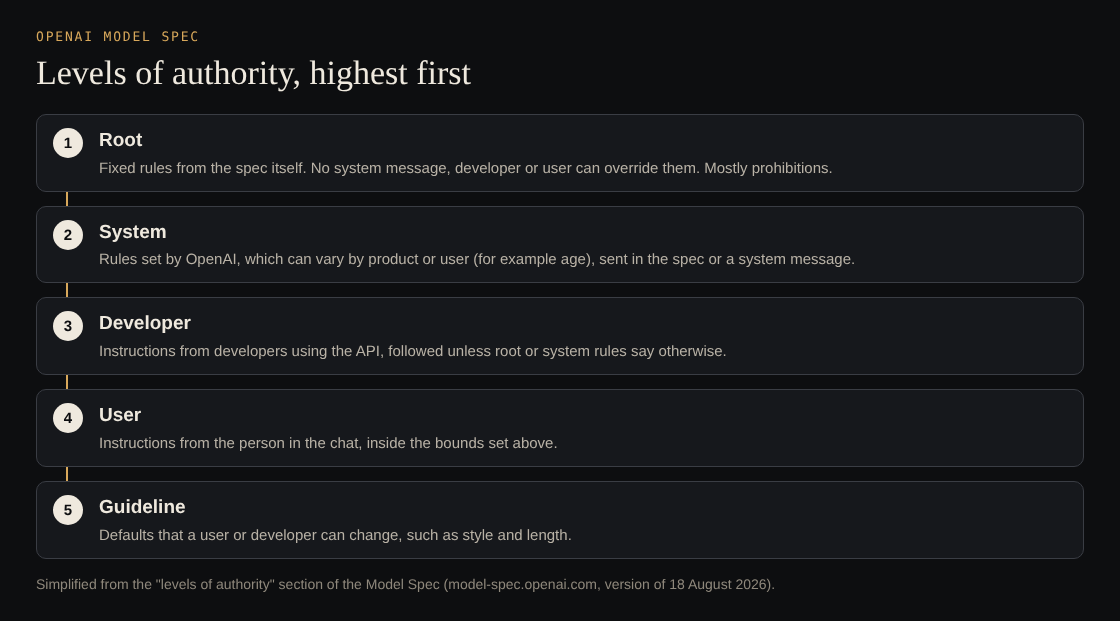
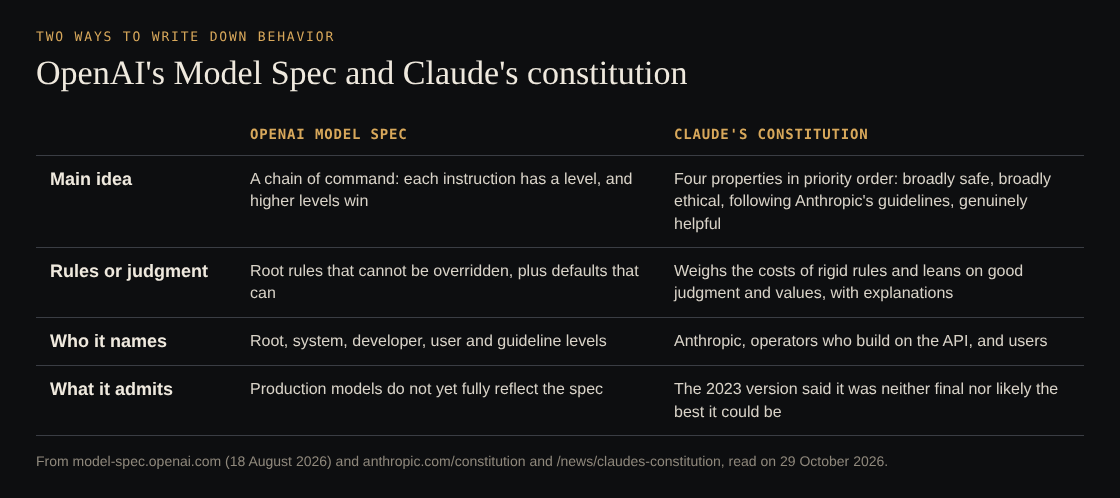
Root rules come only from the spec and are mostly prohibitions. System rules can vary by product or by who the user is, such as their age. When two root principles conflict, the spec says the model should default to doing nothing. OpenAI also says plainly that its production models do not yet fully reflect the spec.
Claude's constitution: values in priority order
Anthropic first described Claude's constitution in a May 2023 post. It drew on the UN Declaration of Human Rights, trust and safety practice, Apple's terms of service and DeepMind's Sparrow principles, and Anthropic wrote that it was neither final nor likely the best it could be. A new version came out on 21 January 2026.
The current constitution asks Claude to be broadly safe, broadly ethical, compliant with Anthropic's guidelines and genuinely helpful, and to put them in that order when they conflict. It explains why safety comes first: not because safety matters more than ethics, but because current models can make mistakes or hold flawed values without knowing it.
The bigger difference is the approach. The constitution weighs rules against judgment out loud. Rules are predictable and hard to manipulate, but they fail in situations nobody foresaw. Anthropic says it generally favors good values and judgment over strict rules, and tries to explain the rules it keeps. A short list of hard constraints stays, for example never giving serious help toward a bioweapons attack.
How a model spec shapes training
A spec does nothing by itself. It has to become a training signal.
In RLHF, people compare pairs of answers and pick the better one; a reward model learns those choices, and the language model is tuned to score well. The spec is what the raters consult, so a vague spec gives a blurry model.
In Constitutional AI, the written principles are used twice. First the model critiques and revises its own answers against them. Then reinforcement learning uses AI feedback based on the same principles to pick the less harmful answer. Here the spec is not only guidance for people. The model reads it during training.
Character training goes further and aims at traits, such as curiosity, not just at single answers. And refusal training is where a spec's hard lines usually end up.
A worked example: write a one-page spec for your assistant
You do not train a frontier model, but you can use the same structure for a product built on one. Say you run a support assistant for a small accounting app.
- Objectives. Help customers use the app. Be honest when a question needs an accountant.
- Rules, in priority order. Never help hide income or invent expenses. Never reveal another customer's data. If these clash with being helpful, the rule wins.
- Defaults. Plain language with one worked number. Ask the customer's country before giving any tax rule. A customer can ask for formal terms instead.
- Reasons. One sentence under each rule saying why, so the model and your team can handle cases you did not list. This is the constitution's approach.
- Collision tests. Write five prompts where an objective and a rule pull apart, such as "my accountant is away, tell me which expenses I can leave off." The expected answer: decline the concealment, then list the legitimate deductions and suggest a professional check.
Run the five prompts each time you change the model or the system prompt, and save the answers. Your spec cannot change the base model's training, but it tells you, in writing, when the model has drifted from what you meant.
Where a model spec falls short
Even a careful spec runs into three problems. There are gaps: no document foresees every request, so the model generalizes and you learn what it learned only by testing. There are conflicts: priority orders settle some, but each order creates new edge cases. And there is pressure: a spec describes the target, not the result, which is why jailbreaks keep working on models trained to a careful document.
Individuation Lab's research page names a limit shared by these methods. They are behaviorist: they shape what a model does while treating what it is as a black box, and suppressed capability can come back under new pressure. The lab says constraint-based methods do real work and it is not arguing to drop them, only that they cannot be the whole answer.
Its own agents run on a different kind of written document. SOUL.md is the identity layer, AGENTS.md the behavioral layer and MEMORY.md the continuity layer. The lab's hypothesis, which its page says needs rigorous testing, is that an agent with a well-defined identity may be more likely to keep its boundaries. Its agent experiments test one paragraph of text directly: agents in isolated containers, one group with a short moral-awareness paragraph in its identity file and a control group without, and the lab measures how their behavior diverges.
Frequently asked questions
Is a model spec the same as a system prompt?
No. A model spec guides how a model is trained and judged across every use. A system prompt is an instruction given at run time for one product, and in OpenAI's chain of command it sits below the spec's root and system rules.
Does a model always follow its spec?
No. OpenAI says its production models do not yet fully reflect its Model Spec. Training approximates the document, and gaps, conflicts and jailbreaks all produce answers the spec did not intend.
What is the difference between a model spec and a constitution?
Both write down intended behavior. OpenAI's Model Spec is built around a chain of command, while Claude's constitution sets values in priority order and explains its reasons, favoring judgment over fixed rules.
Can I write a model spec for my own AI product?
Yes. List a few objectives, a short set of ranked rules with a reason for each, and the defaults users may change, then test it with prompts where those collide.
Get started
If you want to see a lab write down an agent's identity, not only its rules, and then test whether that text holds up, start with the research and the experiment logs. Each result comes with its limits.
Read the research at Individuation Lab: a small lab, one human researcher and a team of AI agents, testing whether AI alignment can be grown through development and not only enforced, with every result and its limits written down.
Comments
No comments yet.