What is a Norwegian Forest Cat? Size, coat and history
What is a Norwegian Forest Cat? It is a large, long haired breed with a triangle shaped head, a thick double coat and a long bushy tail. The Cat Fanciers' Association (CFA), a cat breed registry, calls it stocky and hardy with a heavy coat. This post sticks to what the CFA's own Norwegian Forest Cat page says, so you can tell the facts from the folk tales.
What is a Norwegian Forest Cat, exactly?
The CFA lists the breed as a longhair, with a personality it describes as "active and sweet". It describes the "Forest Cat or Wegie" expression (Wegie is a nickname for the breed). The CFA says the expression, with its "riveting glance and dramatic triangular head", is what draws people in.
An adult is large and sturdy. The CFA describes a thick double coat with a silky, water repellent overcoat, and a ruff of fur around the neck and chest.
Three things set it apart from other fluffy cats:
- A triangle head. The CFA standard says the head forms an equilateral triangle, with a straight profile from the brow ridge to the tip of the nose.
- A double coat. A dense undercoat under long, glossy, water resistant guard hairs.
- Size. Large, with a long bushy tail and tufted paws.
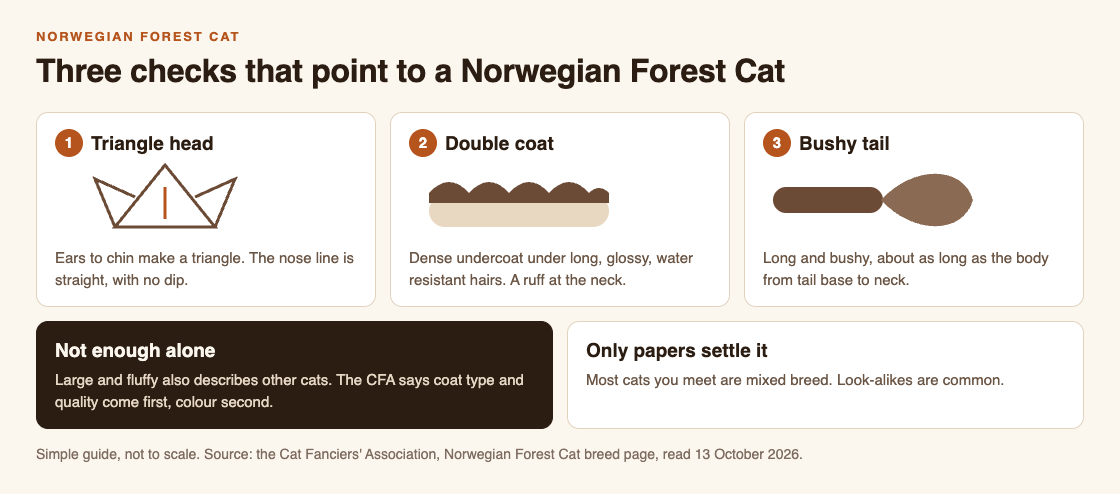
Three checks that point to a Norwegian Forest Cat, from the CFA's description.
Where the breed comes from
The CFA is frank that "the exact origins of the breed are not clear". It says the breed is thought to have emerged from the forest some 4,000 years ago, and then to have lived as a working farm cat and rodent control specialist.
Folklore fills the gap. The CFA says Norse mythology tells of Freya, the goddess of love, beauty, fertility and health. Her favorite cats were the breed, and two gigantic "Skogkatts" drew her chariot. The CFA also says it "seems likely" that Viking explorers brought a few forest cats on their ships to keep rodents away. Treat both as stories, not records.
What the CFA gives as plain dates is later. The first breeding pair came to the United States in 1979. The breed achieved CFA championship status in 1993.
The CFA says the Norwegian Forest Cat was almost lost as a distinct breed. Cats were interbreeding with shorthair strays.
The rescue started in the mid 1970s, when the first breed club was formed in Norway. Its members began a breeding program based on carefully selected cats that had no papers. A panel of judges then certified those cats for registration.
Size, shape and how long it takes to grow
The CFA calls this a slow maturing breed. It says a cat can take up to five years to reach full growth. A young one can look small next to what it will become.
At full growth the CFA gives weights for a male of 12 to 16 pounds and a female of 9 to 12 pounds. The standard asks for a solid, well balanced body of moderate length. It wants a broad chest "without being fat".
The standard also describes some details you can look for on a real cat:
- Ears. Medium to large, rounded at the tip, set as much on the side of the head as on top. They are heavily furnished with fur. Lynx tips (small tufts) are desirable but not required.
- Eyes. Large, almond shaped and set at a slight angle, with the outer corner higher than the inner.
- Legs. The hind legs are longer than the front legs, so the rump sits higher than the shoulders.
- Paws. Large and round, with heavy tufting between the toes.
- Tail. Long and bushy. The standard's wanted length is equal to the body from the base of the tail to the base of the neck.
Coat and colours
The CFA says the coat may be fuller in winter than in summer, because the undercoat develops fully in the cold months. The guard hairs hang down the sides. The "bib" has three parts: a short collar, side "mutton chops" and a frontal ruff. The "britches" are full on the hind legs.
The standard says type and quality of coat is of primary importance. Colour and pattern are secondary. So colour is a poor way to spot the breed.
On colour, the CFA says every colour and pattern is allowed, with exceptions. The exceptions are the colours that show hybridization: chocolate, sable, lavender, lilac, cinnamon, fawn, point restricted (Himalayan type) markings, or those colours with white.
Eye colour should be shades of green, gold, greengold or copper. White cats and cats with white may have blue or odd eyes.
Temperament
The CFA describes an independent, intelligent breed, in keeping with its long history of self sufficiency. It says they are not clingy, but they will go looking for company if left alone too long.
On laps, the CFA is clear: they can be lap cats, "but it will always be THEIR decision" when to get on or off.
It calls them moderately active, sensitive, friendly and adaptable, and says they enjoy being part of the family's daily activities. They get along well with other cats, dogs and children, says the CFA.
They have random bursts of energy. They can entertain themselves with toys, running, hiding and then ambushing them like prey. The CFA says the noises range from a soft purr to bird like chirps when they are excited.
The CFA adds that these cats are fond of high places. It suggests tall scratching posts or cat trees, or your cat may decide its favorite spot is on top of the kitchen cabinet.
Coat care and health
Surprisingly, says the CFA, the thick coat does not need much upkeep. Regular combing with a stainless steel comb helps with tangles. The CFA says the coat is generally tangle free compared with other long haired breeds.
Spring needs more attention, when the winter coat gives way to a lighter one. The CFA also says some coat textures may be more prone to matting and need more frequent care.
If you plan to bathe your cat, the CFA says to ask the breeder for the right products and methods. The water repellent coat takes a long time to get wet and even longer to dry.
On health, the CFA says hypertrophic cardiomyopathy (a heart muscle disease) and glycogen storage disease have occurred in the breed. Breeders now routinely test for them and are working to remove carrier cats from the gene pool. It gives no figures, so this post gives none.
If you are thinking about the breed, ask the breeder what screening the parents had. Ask your vet about anything specific to your own cat.
A worked example: checking a fluffy cat you meet
You see a large cat with a thick, long coat. Is it a Norwegian Forest Cat? Work through four steps, in order.
- Head. Look from the front. Do the outer edges of the ears and the chin make a triangle? In profile, is the nose line straight, with no dip?
- Back end. Do the hind legs look longer than the front, so the rump sits a little high? Are there tufts between the toes?
- Tail. Is it long and bushy, and about as long as the body from tail base to neck?
- Coat. Is there a glossy outer layer over a dense undercoat, with a ruff at the neck and full britches?
Even four yeses are only a look. A pedigree and a registry settle it, not a glance from across the road. Many cats are long haired and fluffy without the papers. See how to tell if a cat is a mixed breed for the honest limits of looking.
If you want to compare with another large, long haired breed, read our plain guide to the Maine Coon.
Frequently asked questions
How big does a Norwegian Forest Cat get?
The CFA gives 12 to 16 pounds for a male and 9 to 12 pounds for a female at full growth. It adds that the breed can take up to five years to get there.
Do Norwegian Forest Cats need a lot of grooming?
The CFA says the double coat does not need a lot of upkeep, and that regular combing with a stainless steel comb helps with tangles. Spring needs more attention, when the winter coat is replaced.
Are Norwegian Forest Cats friendly?
The CFA calls them friendly, adaptable and good with other cats, dogs and children. It also calls them independent, so a lap visit is the cat's choice.
Is a Norwegian Forest Cat the same as a Maine Coon?
No. They are separate breeds with separate CFA pages and standards. Both are large and long haired, so a look alike is easy to mistake, and only papers settle it.
Can Cat Go tell me if a cat is a Norwegian Forest Cat?
No. In Cat Go you choose the breed yourself from a list. The game does not tell you.
Get started
A breed guide helps most when you can practise on real cats. Cat Go is a game that plays in your web browser. You walk, collect kibble and tuna at treat stops on a map, and photograph a cat you meet. Then it asks "Which breed is it?" and you pick from a list of 34 breeds, with a search box.
The screen says "Most cats you meet are mixed breed", and "Mixed breed is always a safe pick". That fits what you read above: a fluffy, large look is not proof of a Norwegian Forest Cat. Pick what you honestly see, and keep every catch in your Catdex with its breed and where you found it.

Cat Go's map. The game needs your location to record where each cat was caught.
Cat Go needs the camera and location allowed in your browser. Whether it is worth a walk is up to you.
Play Cat Go in your browser: walk anywhere, photograph a real cat, lure it with food and catch it.
Comments
No comments yet.
Sign in or make an account to comment.