What is a Persian cat? Round face, long coat, calm nature
What is a Persian cat? It is a longhaired pedigree breed known for a long, flowing coat and a round look all over: a round head, big round eyes, a short nose and a stocky body. The Cat Fanciers' Association (the CFA, a cat breed registry) says that coat has stood for feline beauty for well over 100 years. This guide covers the breed's history, looks, colours, personality, grooming and health, all from the CFA's own Persian page.
Everything about the breed here comes from the CFA's Persian page and breed standard, opened for this article. A breed standard is the written description judges use at cat shows.
What is a Persian cat? The short answer
The CFA says that while the coat gets the attention, judges and experienced breeders know the build underneath matters most. It must be symmetrical, solid, refined and, above all, round. The eyes, head, muzzle, body and even the ear tips should all give the impression of a circle, with large round eyes set in the centre of the face and, in the CFA's words, an expression that is "the epitome of sweetness".
Where the Persian cat came from
The breed is named after its presumed country of origin, Persia, but the CFA says nobody knows exactly how it reached western Europe. Here is what it does say:
- 1626: Pietro della Valle, an Italian trader, came back from Persia with a heavily coated longhaired cat that was clearly different from the Turkish Angora, which reached Europe at about the same time.
- After that: the two breeds were combined to produce a sturdy, short-nosed cat with a silky but dense, full coat.
- Late 1880s: the first Persians were imported into the United States.
- Early 1900s: when cat shows began, these Persians became the dominant breed.
- 1906: the Persian was one of the six foundation breeds of the CFA when it started.
The CFA adds that Persians have been among its top ten breeds, ranked by registrations, for as long as those rankings have existed.
What does a Persian cat look like?
The CFA calls the Persian the classic "cobby" body type: solidly built, with a broad chest and a muscular body, low on the legs. The short, heavily boned legs are often described as miniature "tree trunks", and the fully plumed tail is short too.
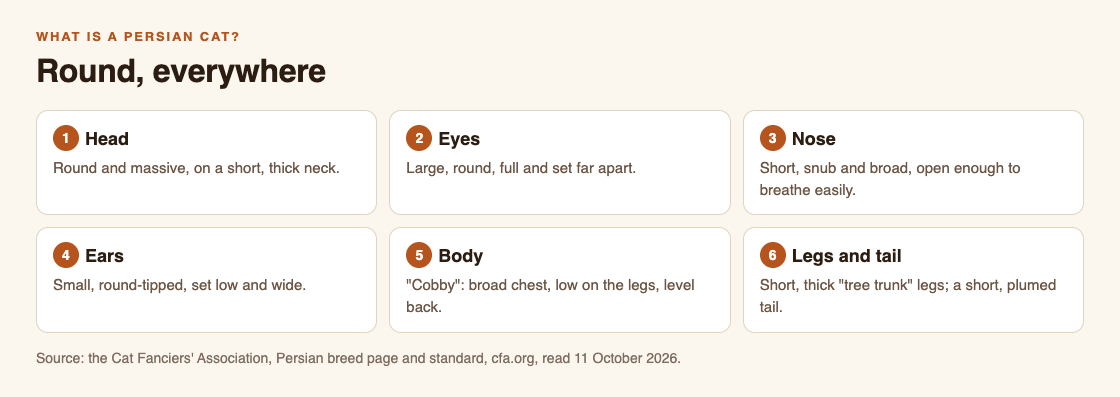
The Persian's round look, as the CFA standard describes it.
The standard asks for a round, massive head on a short, thick neck, and a short, snub, broad nose, with nostrils open enough for the cat to breathe easily. The ears should be small, round-tipped, tilted forward and set far apart and low on the head. The eyes should be large, round, full and brilliant in colour, set level and far apart. The long, thick coat softens the cat's lines and adds to its round look.
Persian colours: seven divisions
Colour matters a lot in the show ring. The CFA says the Persian comes in so many colours that it is split into seven divisions for competition:
- Solids
- Tabbies
- Silver and goldens
- Shaded and smokes
- Parti-colors
- Calicos and bi-colors
- Himalayans, the Persians with the pointed pattern
Several of these patterns have their own guides here: chinchilla cats, smoke cats and colorpoint cats.
What is a Persian cat like to live with?
The CFA describes Persians as playful yet placid: easygoing and mellow. They can be persuaded to chase a toy, but are happier simply getting attention and affection from their people. It says this is not a cat likely to jump on the kitchen counter or climb the curtains; Persians prefer to keep their feet on the ground.
Because Persians need so much grooming, the CFA says kittens must be taught to accept it from an early age, and so the breed is considered one of the easiest to train. Persians quickly learn what "no" means, and many learn to respond to their names. Their calm, even temper and devotion to their people, the CFA says, make them good with children of all ages and able to live peacefully with other pets.
Persian grooming and health
The CFA is plain about it: owning a Persian means a serious commitment to regular grooming, and to regular vacuuming. Its advice:
- Comb often: a steel or Teflon-coated comb with long teeth, both coarse and fine, keeps the coat free of mats and tangles.
- Clean the eyes: the large eyes may stain, and need cleaning with a soft, damp cloth.
- Bathe occasionally: only after a thorough combing and nail clipping.
- Get help if needed: many Persian owners rely on professional groomers.
On health, the CFA says that some years ago the focus on refined features led to cats with smaller than average nostrils, which caused breathing problems. Breeders responded by removing cats prone to these problems from their breeding programmes. Polycystic kidney disease, which shortened the lives of many Persians in the early 2000s, is now being controlled with genetic testing and by spaying or neutering affected cats.
Is the longhaired cat you meet a Persian? A plain check
A long coat alone does not make a Persian. The CFA's guide "A Pattern Does Not a Breed Make" says only about five percent of domestic cats belong to any recognised breed, and that unless a cat is known to come from a breeder of pedigreed cats, it will almost certainly not be of a specific breed. From a distance, you can still compare:
- The face: is it round and flat-looking in profile, with a short, snub nose?
- The eyes: large, round and set far apart?
- The ears: small and set low and wide?
- The build: stocky and low, with short, thick legs?
- Decide honestly: if you are not sure, it is most likely a longhaired cat of mixed breed. Our guide "Is my cat a mixed breed?" explains more.
Cat Go is a game that plays in your web browser: "Walk anywhere, photograph a real cat, lure it with food and catch it." After you photograph a cat, it asks "Which breed is it?" and you pick from a list with a search box. You choose; the game does not decide for you. It reminds you that "Most cats you meet are mixed breed. Rarer breeds are warier." and that "Mixed breed is always a safe pick."
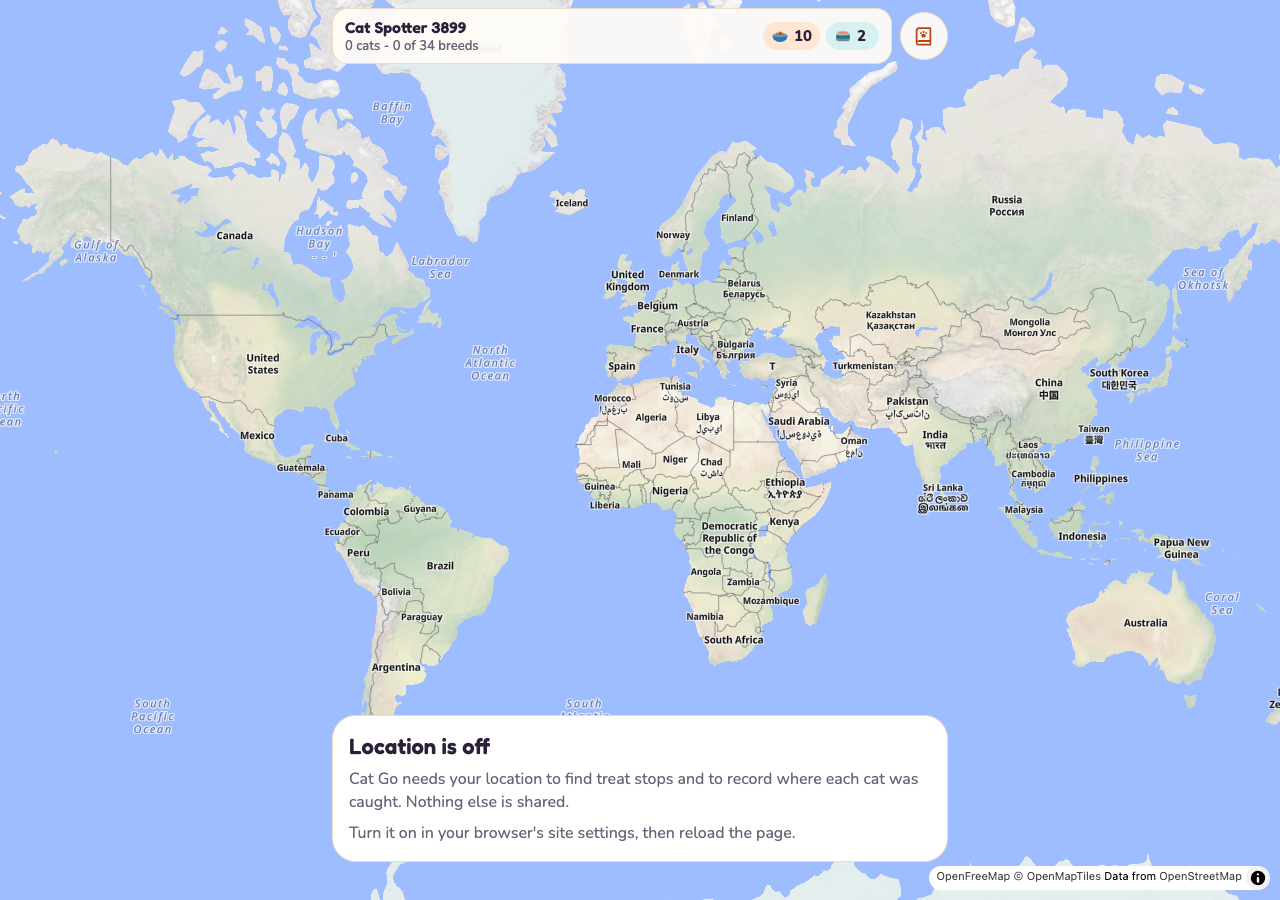
Cat Go's map, where each catch keeps its breed and the place you found it.
Frequently asked questions
Where do Persian cats come from?
The name comes from the breed's presumed origin in Persia. The CFA says an Italian trader brought a longhaired cat back from Persia in 1626, though exactly how the breed reached western Europe is not known.
Do Persian cats need a lot of grooming?
Yes. The CFA says owning one means a serious commitment to regular combing, cleaning the eyes with a soft, damp cloth and occasional baths.
Is a Himalayan cat a Persian?
The CFA lists Himalayans, the Persians with the pointed pattern, as one of the Persian's seven colour divisions.
Are Persian cats good with children?
The CFA says their calm, even-tempered nature makes them compatible with children of all ages and able to live peacefully with other pets.
Get started
Next time you see a fluffy cat on a walk, run the five-step check from where you stand, and remember that most longhaired cats are not Persians.
Play Cat Go in your browser: walk anywhere, photograph a real cat, pick its breed and keep it in your Catdex.
Comments
No comments yet.
Sign in or make an account to comment.