What Is a Power-Up in Video Games? A Simple Guide
So, what is a power-up in video games? It is an object in the game that gives your character a benefit or an extra ability, usually for a short time, as soon as you touch it. It might make you faster, give you a shield, boost your weapon, or clear the screen. This guide explains how power-ups work, why designers add them, and what they look like inside a real game, using the pickups in Tank City Reboot as a worked example.
What is a power-up in video games? The short answer
Wikipedia's power-up page defines it as an object that adds temporary benefits or extra abilities to the player character. It sets it apart from an item, which may last and which you can often use whenever you choose. A power-up takes effect at once. You do not buy it in a menu. You earn it, chase it, or get lucky with it in the middle of the action.
Most power-ups share three traits:
- They are visible. You see the item on the field, usually blinking or glowing so it stands out.
- They are a choice. You have to decide whether to go get it, often while enemies are shooting at you.
- They change the rules for a moment. For a few seconds, or until you lose a life, you play a slightly different game.
A quick history: from maze pellets to modern pickups
The same Wikipedia page credits a 1980 arcade maze game, Pac-Man, as the first video game with a power-up mechanic. Every maze holds four power pellets. Eating one lets you chase and eat the ghosts that were chasing you, for a short time. That reversal is still the clearest way to understand power-ups. For a few seconds, the hunted becomes the hunter.
The idea spread fast. The page lists flowers in a 1984 game, Sabre Wulf, that gave speed or invincibility, and the Super Mushroom of 1985, which it calls "the quintessential power-up". Today, it says, power-ups are mostly found in action games: maze games, run and guns, shoot 'em ups, first-person shooters and platform games.
Common types of power-ups: speed, shields, firepower, and more
Most power-ups fall into a handful of families. Once you know them, you will spot them in almost any action game.
- Firepower. Faster shots, more shots, or shots that break things they normally could not.
- Defense. A shield that blocks damage for a set time, or a barrier around something you protect.
- Speed. You move or attack faster.
- Control. Enemies freeze or slow down, giving you breathing room.
- Screen clears. Every enemy on screen is wiped out at once.
- Extra lives. One more chance before the game ends.
How power-ups work behind the scenes: spawning, timers, and stacking
Under the hood, a power-up is a few rules working together. Here are the main ones.
Spawning: where and when they appear
The game needs a rule for when a power-up shows up. Wikipedia lists the usual ways: placed in the level from the start, spawned at random, dropped by beaten enemies, or found inside containers you open or smash. The location might be fixed or random. Random spots keep you moving, because you cannot plan a safe route in advance.
Timers: how long they last
Many effects run on a countdown. A good game warns you before the effect ends, often by making the item or effect flicker. That warning matters. Without it, a shield vanishing feels unfair. With it, you get a moment to back off.
Pickups that wait on the field often have their own timer too. If you take too long, the item disappears. That forces a quick decision.
Stacking: what happens when you collect more
Some power-ups stack, getting stronger each time you collect them. Others just refresh the timer. Stacking pickups often come with a catch, such as losing all your levels when you lose a life. That catch is what makes careful play worth it.
Why game designers use power-ups: pacing, risk, and comebacks
Power-ups are not just treats. They are tools designers use to shape how a game feels.
- Pacing. A stage that never changes gets dull. A pickup in the middle breaks the rhythm and creates a new burst of action. This fits into the wider difficulty curve of the game.
- Risk and reward. If the item lands in a dangerous spot, you have to weigh the bonus against the danger. That decision is where a lot of the fun lives.
- Comebacks. A shield or screen clear can turn a losing moment around. Players remember those saves.
- Feedback. Grabbing a pickup should feel good. Sound, flashes, and sometimes a little screen shake tell you something important just happened.
Power-ups also interact with enemy behaviour. A freeze only matters if enemies were a threat. A shield only matters if they were aiming at you. The pickup and the enemy rules are designed together.
Power-ups in action: how pickups change a tank battle in Tank City Reboot
Tank City Reboot is a free browser game where your antivirus tank guards the CPU core at the bottom of a circuit board. Twenty malware tanks attack each stage, and you win the stage by destroying all twenty before any of them hits the core. Its power-ups follow every rule above, and each one is named for a real computing idea. This section shows how they work in play; for a closer look at each one, see tank game power-ups: what each one does.
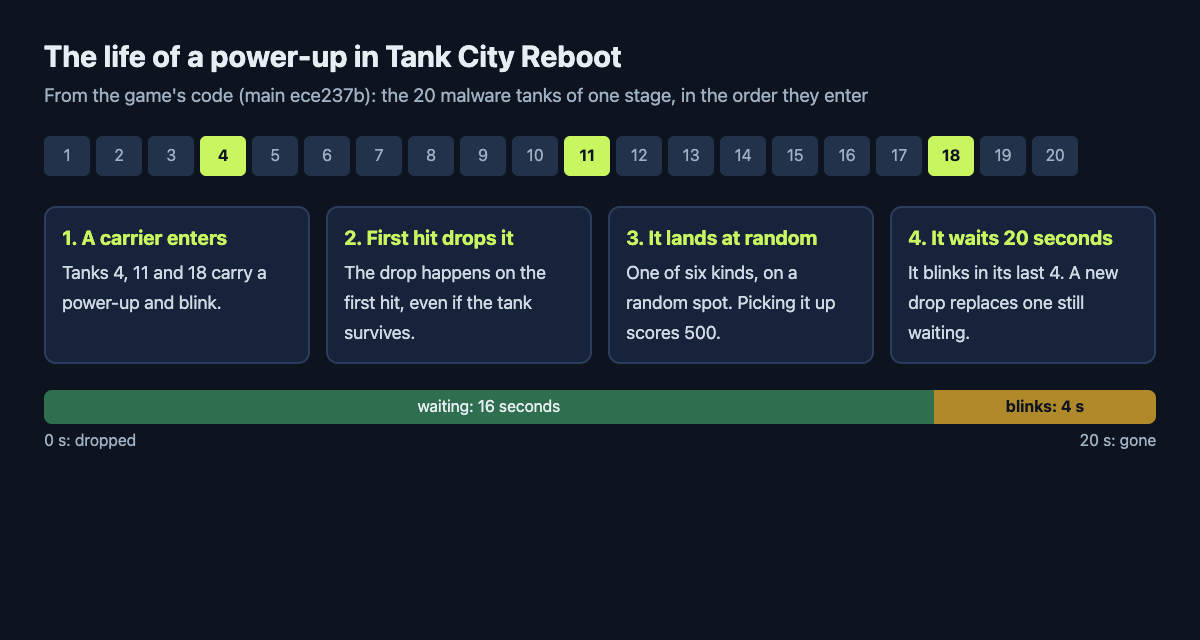
From the game's code: which tanks carry a power-up, and how long a dropped one waits.
How a power-up appears
Power-ups ride on certain enemies. In each stage, the 4th, 11th and 18th tank carry one, and those tanks blink so you can spot them. Your first hit on a carrier knocks the power-up loose, even if the tank survives. The kind is picked at random from six, and it lands on a random spot on the map.
Then the clock starts. The item waits 20 seconds and blinks during its last 4. If a new drop appears while an old one is still waiting, the new one replaces it. Picking one up scores 500 points.
The six power-ups
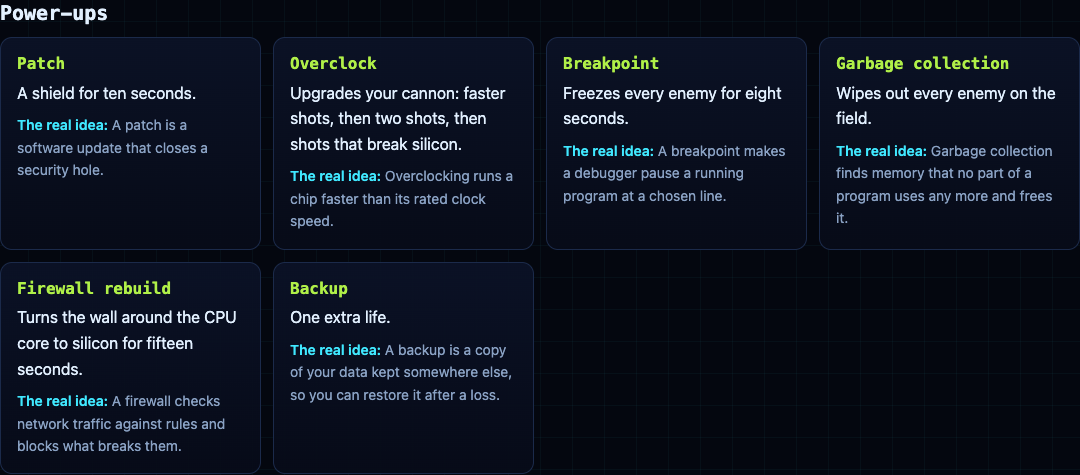
- Patch: a shield for ten seconds. In real life, a patch is a software update that closes a security hole.
- Overclock: upgrades your cannon in three levels. First faster shots, then two shots on the field at once, then shots that break silicon. Your tank even changes shape at levels 2 and 3.
- Breakpoint: every enemy stops moving and stops firing for eight seconds, just as a debugger pauses a program at a chosen line.
- Garbage collection: wipes out every enemy on the field.
- Firewall rebuild: turns the wall around the CPU core into silicon for fifteen seconds. It flickers back to firewall in its last 3 seconds.
- Backup: one extra life.
A worked example
Say you are on stage 3 and the 11th tank appears, blinking. You hit it once. A power-up pops out near the left edge, close to two enemy tanks. Do you go for it?
Think about which one it is. If it is Overclock, the reward lasts. Your level carries between stages and only goes back to 0 when you lose a life. That makes it worth a careful approach. If it is Garbage collection, note the trade: the destroyed tanks count toward the stage's 20 but score no points, and a carrier destroyed this way drops nothing. So if a blinking carrier is already on the field and you have not hit it yet, using Garbage collection wipes out its pickup too. Land one hit on the carrier first, then clear the field.
Breakpoint is a timing tool. Grab it when three enemies are bearing down on the core, and you get eight seconds to pick them off while they cannot shoot back. Firewall rebuild is pure defense for the core, and the flicker in its last 3 seconds is your cue to get back in position.
The second game, Tank City Zero Day, takes the other route. Instead of field pickups, after each wave you choose one of three upgrades, and they last until the run ends. Playing both is an easy way to feel the difference between a power-up and an upgrade.
Frequently asked questions
What is the difference between a power-up and an upgrade?
A power-up is usually picked up on the field and often lasts a short time or until you lose a life. An upgrade is usually chosen in a menu and lasts for the rest of the run, like the cards you pick between waves in Tank City Zero Day.
Why are power-ups usually temporary?
A permanent boost would make the rest of the game too easy. A timer keeps the effect exciting and pushes you to use it well before it runs out.
What was the first power-up in a video game?
Wikipedia credits Pac-Man, from 1980, as the first video game with a power-up mechanic: its power pellets briefly let the player eat the ghosts.
Do power-ups make games unfair?
They can if they are too strong or land with no warning. Good designs make pickups visible, give clear timers, and add a cost, such as losing stacked levels when you lose a life, so skill still matters. Fairness also comes from layout, as explained in this guide to symmetrical maps.
Get started: grab your first power-up in Tank City Reboot
The best way to understand power-ups is to chase one. Open the game, start stage 1, and watch for the 4th tank. When it blinks, hit it, then decide in under 20 seconds whether the pickup is worth the risk. Move with the arrow keys or WASD and fire with Space, or use the touch pad on a phone.
Play Tank City Reboot: it is free, plays in your browser on a computer or a phone, and needs no account.
Comments
No comments yet.
Sign in or make an account to comment.