What is a Ragdoll cat? Blue eyes, four patterns, plainly
What is a Ragdoll cat? It is a large, long-haired breed with a pale body, darker points and vivid blue eyes. The Cat Fanciers' Association (CFA), a large pedigreed cat registry, sums up its personality in three words: docile, placid and affectionate. It also says that, by its own registration statistics, the Ragdoll has become the most popular cat breed in the world.
Everything in this guide comes from the CFA's own Ragdoll page and breed standard: where the breed and its name came from, how to recognise one, its four patterns, what it is like to live with, and why a fluffy pointed cat on your street may not be one.
What is a Ragdoll cat? The short answer
The CFA's breed card describes a large cat with colour at the points. Its page says every Ragdoll carries the colorpoint gene, so the body is always lighter than the head, legs and tail. Three of the breed's four patterns also carry the bicolor gene, which adds white.
The standard asks for a well-balanced cat with no extreme features: medium to large, moderately longhaired, blue-eyed and pointed. It calls the Ragdoll a very laid-back cat.
Where the Ragdoll came from, and its name
The CFA says Ragdolls were developed in the 1960s by Ann Baker, a breeder in Riverside, California, from a chosen group of domestic longhairs. The foundation cat, Josephine, was a white domestic longhair carrying the colorpoint gene.
The name comes from a claim. Baker said Josephine was so placid that she went limp when held. The CFA says this is not typical of most Ragdolls today, but it gave the breed its name. The CFA accepted the breed for registration in 1993 and advanced it to championship status in 2000.
How to recognise a Ragdoll
The CFA describes one of the larger cat breeds, with a broad chest, a long, muscular body and sturdy bones. Its standard adds these marks:
- The eyes: large, vivid blue ovals, set wide. Eyes of any other colour disqualify a show cat.
- The head: a large, broad, modified wedge, with medium ears set wide and tilted forward.
- The body: large, long and rectangular, with heavy bones. The hind legs are longer than the front, with full, feathery fur on the back legs.
- The paws and tail: large, round, tufted paws, and a long tail with a full plume.
- The coat: moderately long, mostly guard hairs with little woolly undercoat, which the CFA says makes it soft and silky. A ruff is preferred.
The four Ragdoll patterns
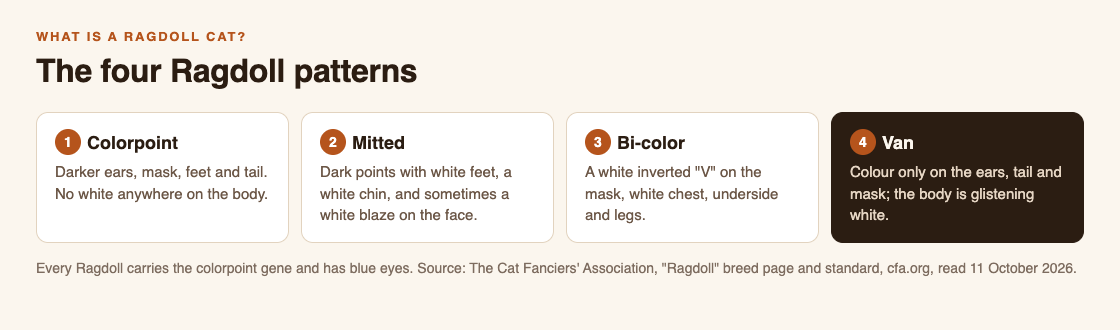
The four Ragdoll patterns, from the CFA's breed standard.
- Colorpoint: darker ears, mask, feet and tail, with no white spot anywhere on the body.
- Mitted: well-defined points with white "mittens" on both front feet, white on the back legs up to the hocks, a white chin running into a white belly stripe, and sometimes a white blaze on the face.
- Bi-color: a white inverted "V" on the mask, with a white chin, chest and underside, and legs that are preferably all white.
- Van: colour only on the ears, tail and mask, with a pure, glistening white body.
Our guide to colorpoint cats explains the pointed pattern itself, and our Siamese guide covers the slim, short-haired breed that shares it.
How big does a Ragdoll get?
Big, and slowly. The CFA says it is not unusual for a mature male to reach or exceed 20 pounds, while females are usually smaller.
Its breed page says Ragdolls reach their full coat colour at two years and their full size and weight at four. Its standard puts full coat and colour at about three years. Either way, a young Ragdoll is still changing for a long time.
What a Ragdoll is like to live with
The CFA describes a gentle, easy companion.
- Affection: loving without being demanding. A Ragdoll will greet you when you come home and stay close, and many sleep with their owners.
- Play: moderately active. It enjoys play sessions but does not insist on them. The CFA says Ragdolls are very trainable and can learn to fetch and come when called.
- Family: rarely aggressive, so good with children and other animals. Because it is so trusting, the CFA says to introduce it with extra care to existing cats or dogs, who may be less gentle.
- Voice: not a talkative cat, though it may greet you with a soft mew. Our guide to why cats meow covers what that can mean.
For grooming, the CFA says combing once or twice a week with a steel comb removes loose hair and tangles. Ragdolls shed, usually as the seasons change, but the lack of a thick undercoat means less shedding and matting. On health, it calls them relatively healthy; hypertrophic cardiomyopathy, a heart condition, has been found in the breed, and breeders now routinely test for it. Ragdolls also love food, so the CFA suggests watching portion sizes.
Is that fluffy pointed cat a Ragdoll?
Maybe not. The CFA's coat and color descriptions make the point that a coat's colour and pattern do not tell you the breed. A long-haired cat with dark points could be a Ragdoll, another pointed breed, or a mixed-breed cat.
Cat Go is a game that plays in your web browser, where that question comes up on every catch: "Walk anywhere, photograph a real cat, lure it with food and catch it."

The bar at the top counts your cats and breeds out of the game's 34.
- Stay where you are and tap the camera. The screen says "Fit the whole cat in the frame", so the feet, chest and plumed tail are all in view.
- The game asks "Which breed is it?" and gives you a list with a search box. You pick; the game does not decide for you.
- Check the blue eyes, the size and where the white falls. If you cannot be sure, the game says "Mixed breed is always a safe pick."
- Toss in-game treats to win it over. Rarer breeds are warier, and tuna works much better on wary cats.
Frequently asked questions
Why is it called a Ragdoll?
The breed's founder, Ann Baker, said her foundation cat Josephine went limp when held. The CFA says that is not typical of most Ragdolls today, but it gave the breed its name.
Do all Ragdolls have blue eyes?
Yes, in the CFA standard: large, vivid blue ovals. Eyes of any other colour disqualify a show cat.
How big do Ragdolls get?
The CFA says a mature male can reach or exceed 20 pounds, females are usually smaller, and full size comes at about four years.
What are the Ragdoll patterns?
Four, in the CFA standard: colorpoint, mitted, bi-color and van.
Get started
Next time you see a big, blue-eyed cat with dark points, check where the white falls. Then take a walk and see who you meet.
Play Cat Go in your browser: walk anywhere, photograph a real cat, lure it with food and catch it.
Comments
No comments yet.
Sign in or make an account to comment.