What is a Russian Blue cat? Silver tips and green eyes, plainly
What is a Russian Blue cat? It is a slim, graceful shorthair with a dense blue-grey coat tipped in silver and vivid green eyes. The Cat Fanciers' Association (CFA), a large pedigreed cat registry, calls it one of the cleverest of all cat breeds, and describes its personality as graceful, playful and quiet.
Everything in this guide comes from the CFA's own Russian Blue page and breed standard: where the breed came from, how to recognise one, how it differs from the other famous blue cat, and why the grey cat on your street may be neither.
What is a Russian Blue cat? The short answer
The CFA's breed card says it in a line: a short, dense, silver-tipped blue coat. Its page adds emerald-green eyes and a face that seems to be smiling at some secret joke.
It also says the breed is easy to care for and easy to live with, and does not need a lot of space to be content. A Russian Blue may seem shy when you first meet, but the CFA says it quickly becomes a friendly, affectionate companion once it knows you.
Where the Russian Blue came from
The CFA says the breed is believed to have come from the Archangel Isles in northern Russia, though there is very little written history before the late 1800s. Russian folklore tells of these cats as good-luck charms, and other stories say they were pets of Russian royalty.
Sailors are thought to have brought them to England. There they appeared at the early cat shows as "Archangel Cats", competing against every other solid blue cat. From the early 20th century until World War II, Scandinavian breeders led the breed's development. After the war, US breeders imported cats from Europe and combined the English and Scandinavian lines into the Russian Blue of today.
How to recognise a Russian Blue
The CFA says the coat usually catches your eye first, especially in sunlight, when the silver tips seem to glisten. Here is what its standard asks for:
- The coat: short, dense, fine and plush. It is a double coat that stands out from the body, soft and silky to the touch. Run your fingers through it and they leave little "footprints".
- The colour: an even, bright blue all over, with lighter shades preferred. The guard hairs are distinctly silver-tipped, which gives the cat its silvery sheen. There should be no tabby markings, and any colour other than blue disqualifies a show cat.
- The eyes: set wide apart, rounded in shape, and vivid green. The CFA says the green usually deepens with age.
- The head: a smooth, medium wedge, neither long and tapering nor short and massive. The face looks broad across the eyes because of the wide eye-set and thick fur.
- The ears: rather large, wide at the base, with tips more pointed than rounded, set far apart.
- The body: fine-boned, long, firm and lithe, on long, fine-boned legs.
The CFA calls these medium-sized cats. Males rarely exceed 10 pounds, and females range from 5 to 8 pounds.
Russian Blue or British Shorthair?
Both are well-known blue breeds, and both have dense coats. But the CFA's standards describe two quite different cats.
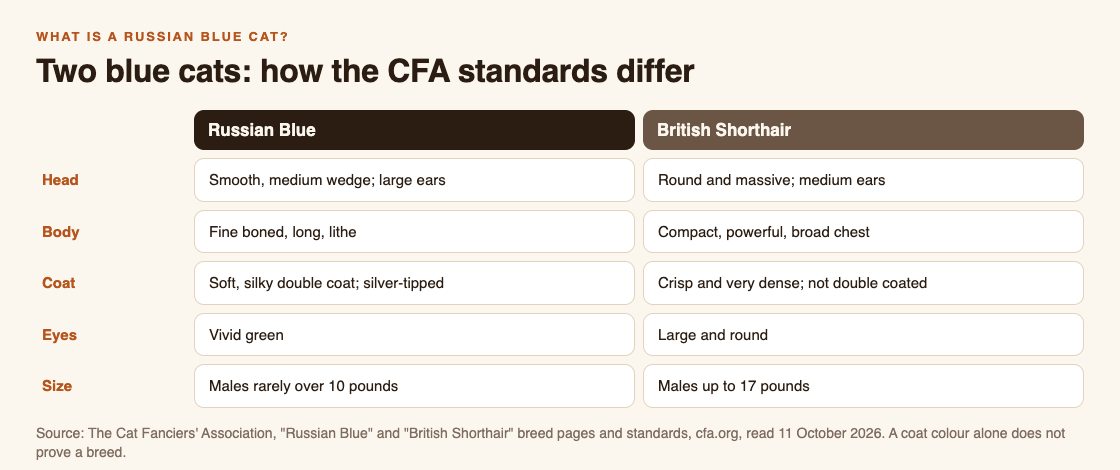
How the CFA's Russian Blue and British Shorthair standards differ.
The British Shorthair is compact and powerful, with a round, massive head, a broad chest and a crisp coat that the standard says is not double coated. Its males may reach 17 pounds. The Russian Blue is the slimmer, longer-legged cat, with a wedge-shaped head, a soft double coat with silver tips, green eyes, and males that rarely pass 10 pounds.
What a Russian Blue is like to live with
The CFA describes a clever cat with a soft side.
- Brains: it says few breeds can match the Russian Blue for intelligence, and it tops the list for working things out. A closed cabinet, a shut drawer or even a sealed jar is a challenge, so owners should not be surprised to find one open. The CFA suggests puzzle toys and interactive games to keep it busy.
- Affection: it will look for a spot on your lap, or even ride through the house on your shoulder.
- Guests: it is typical for a Russian Blue to hide under the sofa when a guest arrives, until curiosity brings it out to investigate.
- Moods: the CFA says it is very sensitive to its owners' moods, and may clown around to cheer you up.
- Home: it is best suited to quieter homes, though many do well in noisier ones, and it suits older children who let it take its time.
Grooming is light. The CFA says Russian Blues are clean cats: combing two or three times a month controls shedding, plus trimmed claws and clean eyes and ears.
On health, it calls the Russian Blue a healthy, natural breed with no known specific genetic problems, though some believe its small gene pool may leave it more open to certain diseases. It adds that Russian Blues have large appetites and can become overweight without frequent, interactive exercise, so food intake should be watched.
Is that grey cat a Russian Blue?
Maybe not. The CFA's coat and color descriptions make the point that a coat's colour does not tell you the breed. A grey cat on a fence could be a Russian Blue, a British Shorthair, or a mixed-breed cat. Our guide on whether a cat is a mixed breed helps you weigh it.
Cat Go is a game that plays in your web browser, where that question comes up on every catch: "Walk anywhere, photograph a real cat, lure it with food and catch it."

The bar at the top counts your cats and breeds out of the game's 34.
- Stay where you are and tap the camera. The screen says "Fit the whole cat in the frame", so you can check the body shape and tail later.
- The game asks "Which breed is it?" and gives you a list with a search box. You pick; the game does not decide for you.
- Look at the eyes, the head and the build. Green eyes and a slim body point one way; a round head and a broad chest the other. If you cannot tell, the game says "Mixed breed is always a safe pick."
- Toss in-game treats to win it over. Rarer breeds are warier, and tuna works much better on wary cats.
Frequently asked questions
What colour eyes does a Russian Blue have?
Vivid green, in the CFA standard. The CFA says the green usually deepens with age.
How big is a Russian Blue?
Medium-sized. The CFA says males rarely exceed 10 pounds and females range from 5 to 8 pounds.
Are Russian Blues shy?
They can seem shy at first. The CFA says one will often hide under the sofa when a guest arrives, then come out to investigate.
How is a Russian Blue different from a British Shorthair?
In the CFA standards, the Russian Blue is slimmer, with a wedge-shaped head, a soft silver-tipped double coat and green eyes; the British Shorthair is compact, with a round head and a crisp coat.
Get started
Next time you see a silvery grey cat in the sun, look at its eyes and the shape of its head. Then take a walk and see who you meet.
Play Cat Go in your browser: walk anywhere, photograph a real cat, lure it with food and catch it.
Comments
No comments yet.
Sign in or make an account to comment.