What is a Singapura cat? Look, history and temperament
What is a Singapura cat? It is one of the smallest of all pedigreed cats: a shorthaired, ticked brown cat from Singapore with large eyes and ears and plenty of curiosity. This guide follows the Cat Fanciers' Association's Singapura page and its breed standard, then shows how to check a brown ticked cat you meet, and how that fits the "Which breed is it?" question in Cat Go.
What is a Singapura cat? The short answer
The CFA lists the Singapura as a shorthair with a warm beige, ticked coat, large expressive eyes and a small size. It gives the personality as sweet, demanding, affectionate and occasionally bossy.
The CFA's page calls it "one of the smallest of all pedigreed cats" and describes it as active and affectionate. It says owners describe the look in the cat's large eyes as imploring, as if it were saying "please", and that Singapuras have a low-key way of getting exactly what they want.
Where the breed comes from
The CFA classes the Singapura as a natural breed, and says it is considered a "living national monument" in Singapore. The brown cats with ticked-tabby coats are believed to have started as street cats, and are called "Kucinta, the Love Cat" in their homeland. "Singapura" is the Malay name for the Anglicized "Singapore".
The CFA names the founders of the breed as Hal and Tommy Meadow, Americans who had been working in Singapore. When they returned to the United States in 1975, five Singapuras came with them. A sixth was imported from Singapore in 1980, and the CFA says a breed was born from that small beginning. It accepted the cats for registration in 1981, and the breed reached championship status in 1988.
Coat, eyes and head
The CFA's page and standard give the same picture, and a few details make it easy to check.
- Coat. Fine, very short and silky, lying very close to the body. The only color registered and shown is sepia agouti: dark brown ticking on a warm old ivory ground. Each hair has at least two bands of dark ticking separated by light bands, which the CFA says makes the coat appear to sparkle in the sunlight.
- Underside. The muzzle, chin, chest and underside are the color of unbleached muslin, and the tail has a dark tip.
- Eyes. Large and almond shaped, held wide open, in hazel, green or yellow. The standard calls small eyes a serious fault and disqualifies blue eyes.
- Ears. Large, slightly pointed, wide open at the base with a deep cup. The standard calls small ears a serious fault.
- Face. Dark lines from the brows and the outside corners of the eyes, cheekbone shading, and the "cheetah lines" that run down from the inner corner of each eye alongside the nose bridge. The standard calls these desirable.
- Body. Small to medium, moderately stocky and muscular. The CFA says that although small, these cats are solid, muscular and strong.
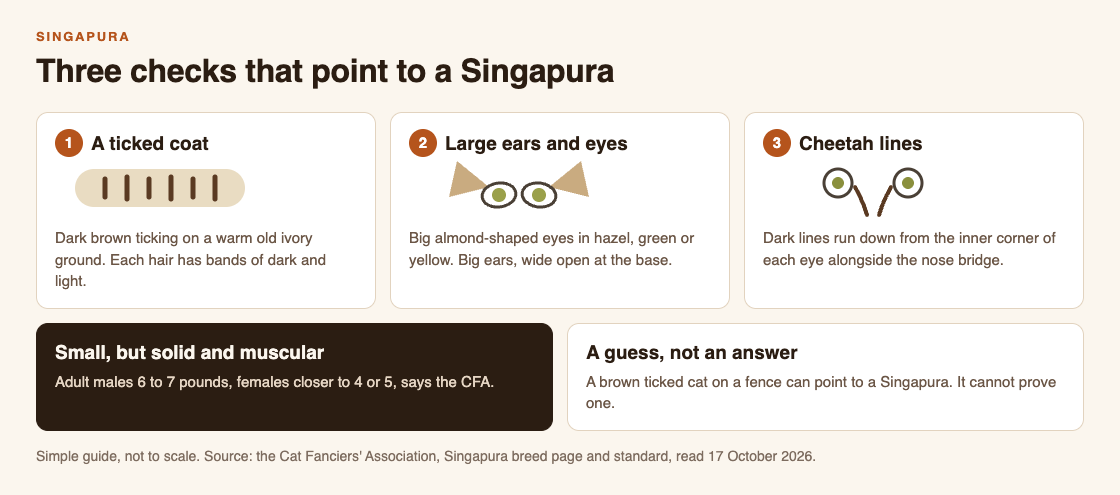
Three checks that point to a Singapura, from the CFA's page and standard.
The standard also lists nose leather as pale to dark salmon and paw pads as rosy brown. It says to allow for undeveloped ticking in kittens.
On size, the CFA says adult males range from 6 to 7 pounds, with females closer to 4 or 5 pounds.
Temperament: curious, playful and people-oriented
The CFA calls the Singapura extroverted, curious and very playful, and says it is an intelligent cat that feels compelled to investigate every part of its environment, especially whatever is taking up your attention. Its example: your Singapura will be there to help you cook dinner, type on the computer and make the bed, and then cuddle under the covers with you.
It says this is an active, people-oriented cat that does not lie on the couch and look decorative, and that the love of play continues well into adulthood, with energy and activity that rarely flag with age.
On noise and change, the CFA says Singapuras are relatively quiet cats who do best in a quiet environment, but that when one decides to speak up, its voice can be surprisingly loud. It describes the cat as confident and outgoing in familiar territory, but possibly wary if something substantial changes. Its advice is to give the cat time to adapt and gently reassure it that everything is still okay.
As with any cat, one animal can differ from the breed description. Read these lines as what the CFA says about the breed, not a promise about a single cat.
Grooming and health, as the CFA describes them
The CFA says the short, close-lying coat does not shed heavily and needs only minimal grooming. It recommends a weekly combing to remove dead hair and help condition the coat, and says the combing can be a bonding experience for you and the cat. Bathing should not be needed unless you plan to show the cat, and in that case the CFA says to ask the breeder about products, because human shampoos should not be used on cats.
On health, the CFA says that given their street-cat ancestry, most Singapuras are vigorous and healthy, and very few health problems have been recorded. It says breeders regularly perform genetic testing to screen for problems that might be passed on, and remove carrier cats from the breeding program. Not all conditions can be detected this way, so it suggests asking the breeder about any history of progressive retinal atrophy, which can cause blindness, in the lines.
For anything about one particular cat, ask your vet. A breed page cannot speak for a single animal.
How to check a brown ticked cat you meet
Here is a worked example. You see a small brown cat on a wall during your walk, and you wonder whether it is a Singapura.
- Look from a distance. Let the cat go about its day, and do not approach or touch it. Our post on telling whether a cat is mixed breed gives the longer checklist.
- Look at the coat. The standard wants dark brown ticking on a warm old ivory ground, with light bands between the dark ones on each hair. A cat in any other color does not fit, since the standard disqualifies any color other than sepia agouti.
- Look for markings. Barring on the tail, or a top of the head with no ticking, are disqualifying in the standard. Some barring on the inner front legs is expected.
- Look at the face. Large ears and large almond-shaped eyes, with dark lines running down beside the nose from the inner corner of each eye, are what the standard calls desirable.
- Look at the size. A small cat that still looks solid and muscular fits the CFA's description. Size from a distance is hard to judge, so do not lean on it.
- Do not stop at the color. Plenty of ordinary brown tabbies have ticked fur and bright eyes. A coat alone cannot tell you the breed.
At the end, you have a guess, not an answer. A small brown cat with big eyes can still be a mixed breed cat.
If you would like to meet the breed for real, the CFA says Singapuras are a minority breed that are occasionally seen at CFA cat shows, and that visiting a show is the best way to connect with a breeder. It says the number of breeders is rather small, so you may have a wait for a kitten. For another breed the CFA describes by its coat and eyes, see what a Korat cat is, or what a Bombay cat is.
Cat Go and breeds
Cat Go is a game you play in your web browser. You walk anywhere, photograph a real cat, lure it with food and catch it. After a cat is spotted, the game asks "Which breed is it?" and gives you a list with a search box, so you can type something like "Siamese" or "curly".
The game also says "Most cats you meet are mixed breed" and "Mixed breed is always a safe pick." That fits what you just read. A small brown cat with bright eyes can still be a mixed breed cat, and you choose the breed yourself. The game counts 34 breeds in total, and every catch is saved to your Catdex with its breed and the place you found it.
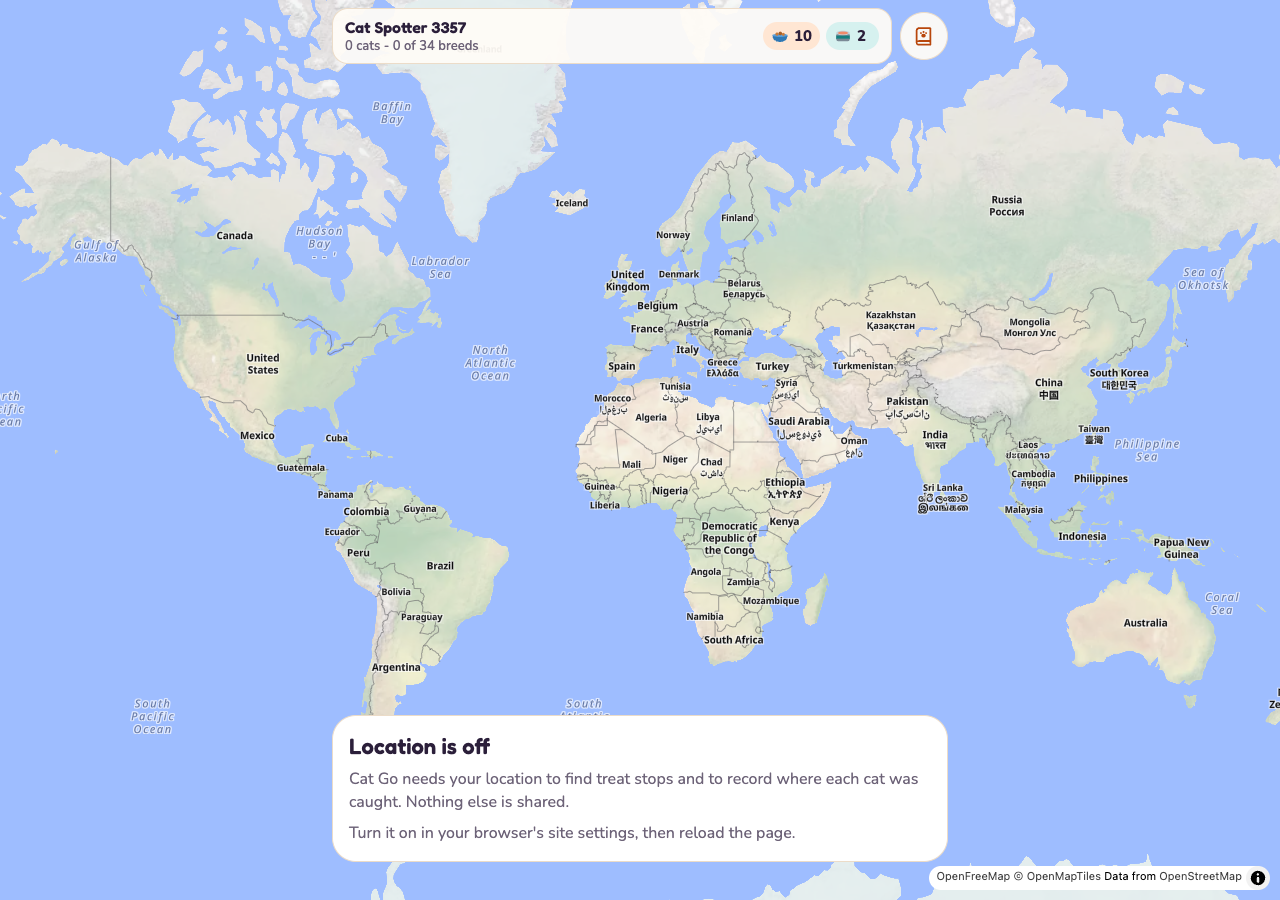
Cat Go's map. The game needs your location to record where each cat was caught.
Cat Go needs the camera and location allowed in your browser. When you take the photo, the game says to fit the whole cat in the frame.
Frequently asked questions
Where does the Singapura come from?
Singapore. The CFA says the brown ticked cats are believed to have originated from street cats there, and that "Singapura" is the Malay name for Singapore. Five Singapuras came to the United States in 1975, and a sixth in 1980.
How big is a Singapura?
The CFA calls it one of the smallest of all pedigreed cats. Adult males range from 6 to 7 pounds, and females are closer to 4 or 5 pounds.
What color is a Singapura?
Sepia agouti only: dark brown ticking on a warm old ivory ground color. The CFA standard disqualifies any other color.
Does a Singapura need a lot of grooming?
No. The CFA says the coat does not shed heavily and needs only minimal grooming, with a weekly combing recommended.
Does Cat Go tell me if a cat is a Singapura?
No. After you take a photo, you pick the breed yourself from a list, and "Mixed breed is always a safe pick."
Get started
Ready to try the "Which breed is it?" question on a real cat? Play Cat Go in your browser: walk anywhere, photograph a real cat, lure it with food and catch it.
Comments
No comments yet.
Sign in or make an account to comment.