What is a Somali cat? Fox-like tail and a ticked coat
What is a Somali cat? It is the longhaired version of the Abyssinian: a medium-sized cat with a silky coat, a plumed tail and a very busy mind. The Cat Fanciers' Association (CFA), a cat registry, says people often compare it to a fox. This guide uses the CFA's Somali page and breed standard to show where the Somali came from, what to look for, and what the CFA says about its nature, coat and health.
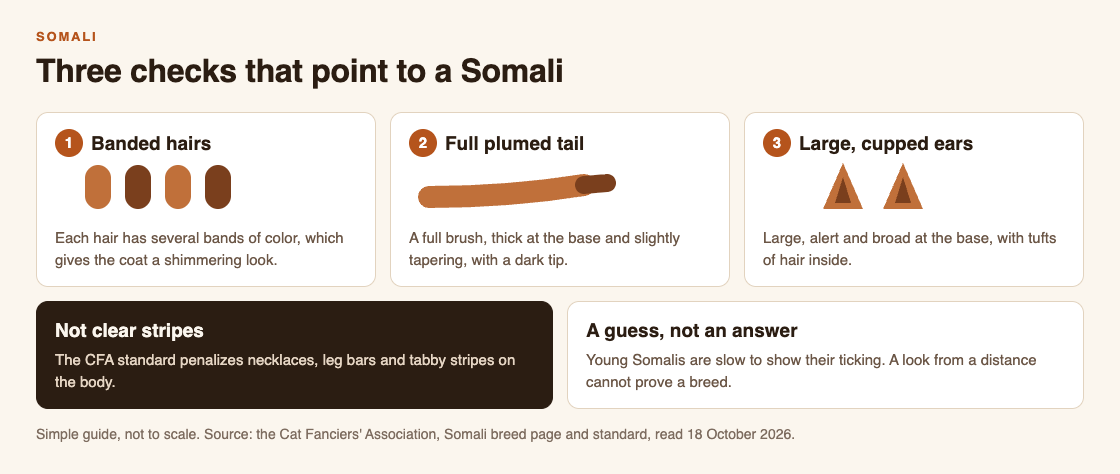
Three checks that point to a Somali, from the CFA's page and standard.
What is a Somali cat, in one picture?
The CFA lists the Somali's coat as longhair, and its main trait as "longhaired variety of the Abyssinian and available in the same colors". Its personality is given as "busy, active, agenda-driven and affectionate".
The picture above gives the three checks that help most. Each hair is banded with several colors. The tail is a full plume. The ears are large. None of the three proves a breed on its own, but together they point to a Somali.
The CFA paints the picture this way: the vibrant color and high-energy spirit of an Abyssinian, a full ruff, a soft silky coat and a dramatic, bushy tail. It adds that Somalis move swiftly, on tiptoe, with plumy tails held high, and that the prey is more likely to be a feather toy.
Where the Somali came from
The CFA says nobody documented how the recessive longhair gene entered the Abyssinian gene pool. It notes that some estimates say barely a dozen Abyssinians survived after World War II, and that many litters from that time included cats of unknown parentage. So the gene may have come in then.
As longhaired kittens appeared, they were quickly petted out, which means placed as pets and not bred on. Most breeders would not admit to producing them. A stubborn, isolated few were fascinated by the longhairs and began to work with them.
In the mid-1960s, Evelyn Mague produced "George", one of the first documented longhair Abyssinians. She christened the developing breed the "Somali", after Somalia, the country that borders Abyssinia (now Ethiopia). The CFA calls acceptance in the show ring a long struggle. It began registering Somalis in 1976, and they reached championship status in 1979.
How to recognize a Somali
The CFA describes a medium-sized cat that is well-proportioned, solid and muscular. Its standard calls the overall impression a medium to large cat that is lithe, alert and lively. The head is a modified wedge, slightly rounded, with gentle contours.
The banded hairs
The CFA says each hair has multiple bands of color. That is what gives the coat a shimmering look. The standard calls the coat very soft, extremely fine and double coated, and says the denser the coat, the better. It is longer around the ruff, tummy and britches, and longest on the plumed tail.
The tail, ears and eyes
- Tail: the standard asks for a full brush, thick at the base and slightly tapering.
- Ears: large, alert, moderately pointed, broad and cupped at the base. Horizontal tufts of hair inside the ear are desirable.
- Eyes: almond shaped and large, with dark lidskin and a short dark pencil stroke above each eye. The CFA says eye color ranges from intense green to rich copper.
Four colors
The CFA standard accepts four colors: ruddy, cinnamon, blue and fawn. Ruddy is a burnt-sienna ground ticked with darker brown or black. The tail is tipped with the ticking color.
The CFA warns that the Somali is extremely slow to show mature ticking, so allowances are made for kittens and young cats. A young Somali may look plainer than the adult it will become.
Somali personality: the busy cat
The CFA calls Somalis active, curious and bold. It says they are intrigued by the challenge of a closed cupboard door and are so intelligent that they may learn how to unlatch it. With plenty of toys they can amuse themselves for hours, but they are happiest in interactive play with another pet or a person.
There is a gentle side too. The CFA says they show affection with head butts, kneading and sometimes by rearranging your hairstyle. They follow their people from room to room, often matching moods, and they may settle in to purr and knead at your feet while you work.
Two details from the CFA are worth knowing. Somalis tend to be fascinated with water, and may turn on a faucet to watch it drip. And they are good at communicating with people, but not always by voice: the CFA says their body language makes it clear when they want attention, play or food.
Coat care, health and finding a Somali
The CFA says that despite the longer coat, Somalis are not a challenge to groom. The coat is relatively tangle-free and resists matting. It recommends weekly combing to remove dead hair and control shedding.
Bathing is generally only for show cats. The CFA adds that some cats have oilier coats, which can make the hair clump, especially around the base of the tail and up the spine. A cat like that would benefit from a bath, and the CFA suggests asking the breeder for products and tips.
On health, the CFA says genetic testing now lets breeders remove carriers of inherited diseases that once caused anemia and blindness. Some other heritable issues cannot be screened, so it suggests asking a breeder about any history of renal amyloidosis in the lines. For a question about one cat, a vet is the right person.
The CFA calls the Somali a minority breed, but says Somalis are being seen more often at CFA cat shows. It calls a show the best way to meet a breeder. Since the number of breeders is small, it says you may have to wait for a kitten.
If you like the look of long, silky cats with a story, our guides to the Abyssinian and the Balinese sit nicely beside this one. You can read the breed page itself on the CFA's Somali page.
A worked example: is that ticked cat a Somali?
Say you meet a reddish-brown cat on a walk. Keep your distance and let the cat decide how close to come. Then use five looks, taking no more than a minute.
- Coat length. Is it medium-length and silky, with a fuller ruff and britches? A short, close coat points to an Abyssinian, which the CFA lists as the parent breed.
- Bands. If the cat is close enough, do the hairs look banded, with darker tips? That ticked look is the heart of the Somali.
- Tail. Is it a full brush, thick at the base, with a dark tip?
- Ears. Are they large and cupped, with tufts inside?
- Stripes. The CFA standard penalizes necklaces, leg bars and tabby stripes on the body. Clear stripes or spots suggest another cat, such as a tabby or an Ocicat.
Even with five matches, you have a guess. A cat with a ticked, reddish coat is not automatically a Somali, and the CFA notes that young cats can look plain. If you have a pet cat and wonder about its breed, our post on how to tell if a cat is a mixed breed sets out the checks.
Naming a cat in Cat Go
If you like trying to name the cats you meet, Cat Go turns it into a game. It plays in your browser: you walk anywhere, photograph a real cat, lure it with in-game food and catch it. Every catch keeps its breed and where you found it.
The camera screen says "Fit the whole cat in the frame". After the cat is spotted, the game asks "Which breed is it?" and you pick from a list. There is a search box with the hint "Search breeds, like Siamese or curly". The player makes the call, not the game.
The screen also says "Most cats you meet are mixed breed" and "Mixed breed is always a safe pick". That is a good rule for a reddish, ticked cat too, since a photo rarely settles a breed.
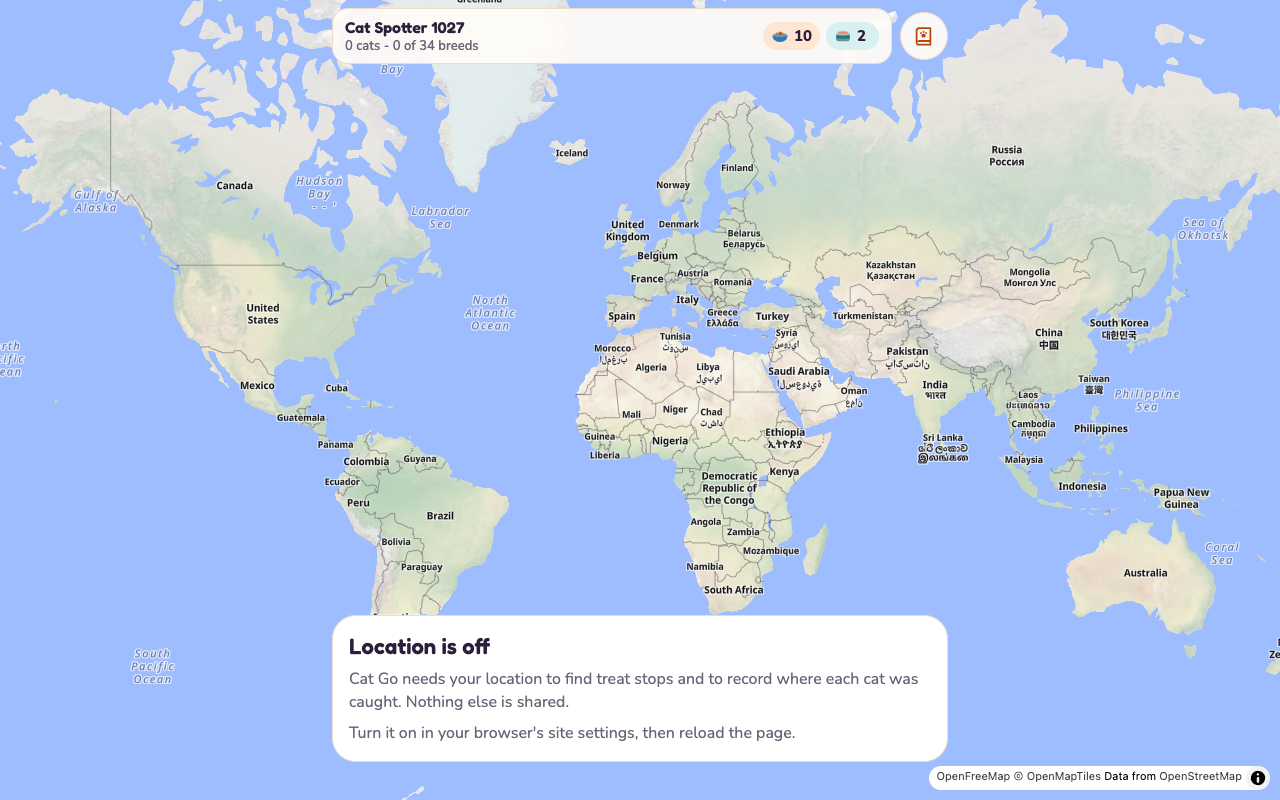
Cat Go's map. The game needs your location to record where each cat was caught.
Frequently asked questions
What is a Somali cat?
It is the longhaired variety of the Abyssinian, per the CFA. It has a silky medium-length coat, banded hairs and a full plumed tail.
Why is it called a Somali?
The CFA says the breed was christened "Somali" in the mid-1960s after Somalia, the country that borders Abyssinia (now Ethiopia). The name points back to the Abyssinian.
Do Somali cats need a lot of grooming?
The CFA says no: the coat resists matting and weekly combing is recommended. Some oilier coats clump near the base of the tail and may need a bath.
What colors can a Somali be?
The CFA standard accepts four: ruddy, cinnamon, blue and fawn. It also says Somalis are slow to show their full ticking.
Does Cat Go tell me if a cat is a Somali?
No. Cat Go asks "Which breed is it?" and you pick from its list. It also says mixed breed is always a safe pick.
Get started
Allow your camera and location in the browser, walk to a treat stop, collect some in-game kibble and tuna, then photograph a real cat from a respectful distance. Play Cat Go in your browser: walk anywhere, photograph a real cat, lure it with food and catch it.
Comments
No comments yet.
Sign in or make an account to comment.