What is a spawn point in a video game? A simple guide
What is a spawn point in a video game? It is a place on the map where something appears. That something can be you, an enemy, a power-up, or a coin. The game picks the spot, creates the object there, and play carries on from that point.
You meet spawn points in almost every game, even if you never see the word. This guide explains how they work, the main kinds, and what can go wrong. It uses Tank City Reboot as a worked example, because its rules for where tanks appear are small enough to read in one sitting.
What is a spawn point in a video game?
"Spawn" means to create something in the game world. A spawn point is the location where that creation happens. Think of it as a door that things walk out of, except nothing was behind the door a moment ago.
A spawn point is usually just a position, and sometimes a facing direction. The game keeps a list of these positions for each level. When it needs a new object, it looks at the list and chooses one.
Spawn points are not the same as hitboxes, though the two often meet. The spawn point says where an object starts. The hitbox says how much space it takes up once it is there.
How a spawn point works step by step
Most games follow the same loop, whatever the genre.
- Something triggers a spawn. A level starts, a timer runs out, a player dies, or a wave begins.
- The game checks the rules. Is there room for more enemies? Has enough time passed since the last one?
- The game picks a point. It may take the next one in a list, choose at random, or choose the safest one.
- The game checks that the spot is free. If another object is standing there, it skips the point or waits.
- The object appears. Often there is a short arrival effect so you can see it coming.
Step four is the one people forget. A spawn that drops a character on top of another character causes bugs, so good games check first.
Types of spawn points: player, enemy, item, and checkpoint
Player spawn points
This is where you start, and where you return after you lose a life. It is the most important kind, because you cannot play until it works. Designers usually put it somewhere calm and easy to read.
Enemy spawn points
These create the things you fight. Some games use fixed gates. Others use random spots out of your sight. The number of points and the pace of spawning set how hard the game feels.
Item spawn points
These create pickups: health, ammo, power-ups. Some appear on a timer. Some appear as a reward, such as when you hit a special enemy.
Checkpoints
A checkpoint is an area in a level from which you start next time you die, instead of starting the level over. It saves you from repeating the easy parts.
Why spawn points matter for fair and fun gameplay
Players rarely praise a good spawn point. They notice only the bad ones. A bad spawn feels like the game cheated.
- Fairness. If you appear and die before you can move, you did nothing wrong, and you will feel it.
- Pacing. Enemies that arrive one at a time feel different from enemies that arrive in a crowd.
- Readability. If enemies always come from the same few places, you can learn to defend those places. That learning is a big part of the fun.
Timing links to this too. A spawn timer only feels steady if the game keeps time properly, which is the subject of our post on delta time in games.
Spawn camping and how designers prevent it
Spawn camping is waiting near a spawn point to hit things the moment they appear. It is a problem in games where players spawn against other players, because the camper has all the advantage and the victim has none.
Designers use a few common fixes:
- Spawn protection. The new arrival cannot be hurt for a few seconds.
- Several spawn points. The game picks one far from danger.
- A warning. A visible effect shows that something is about to appear, so nobody is surprised.
- Blocked spawns. If a point is occupied, the game skips it.
How Tank City Reboot uses spawn points
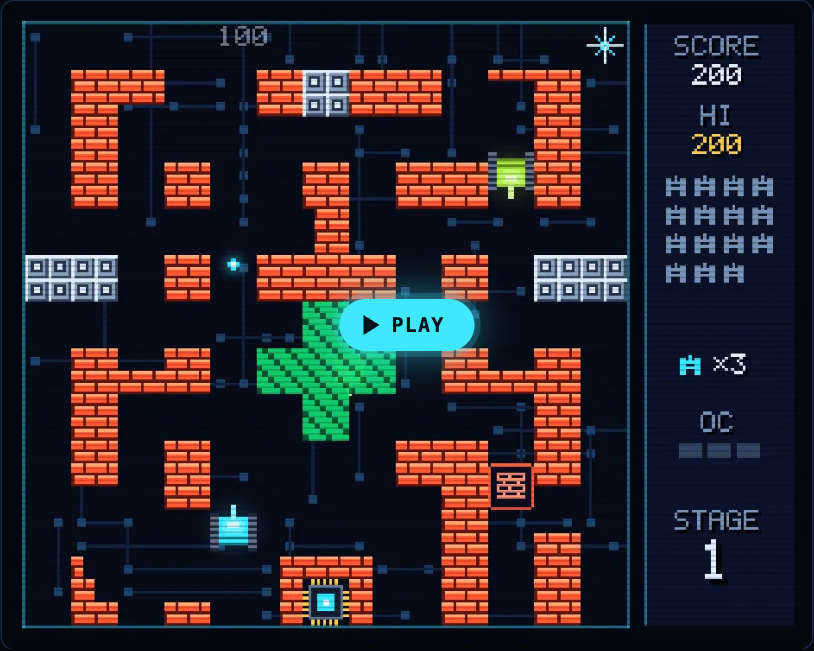
Tank City Reboot is a free browser game where your antivirus tank guards a CPU core. It has clear examples of all of the ideas above. It does not need an account to play.
Enemy gates. Malware tanks enter at three gates on the top row: top-left, top-middle and top-right. Your tank starts on the bottom row, to the left of the CPU core you guard. The layout is simple, so you always know where trouble will come from.
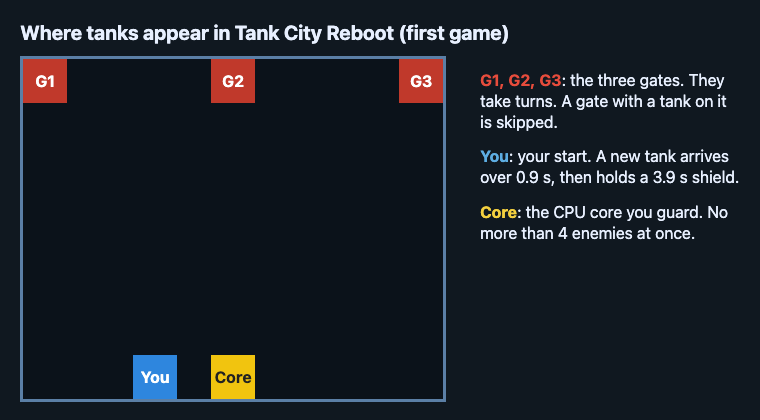
Rules for a new enemy. A stage sends 20 malware tanks, and a new one enters only while fewer than four are on the field. The gates take turns, and if a tank is standing on a gate, the game skips that gate and tries the next, then looks again a quarter of a second later. On stage 1 a new tank enters every 2.6 seconds. Each stage shortens that by a quarter second, down to 1.1 seconds from stage 7. So the same three gates feel busier as you go.
Spawn protection for you. When you lose a life, your new tank comes back 1.2 seconds later. It arrives over 0.9 seconds, during which it cannot move or be hit. After that it has a shield of 3.9 seconds. That is a clear case of the fix described above.
Item spawns. In the first game, the 4th, 11th and 18th tank of each stage carry a power-up and blink. The first hit on a carrier drops the power-up at a random spot. It waits 20 seconds and blinks in its last four. A new drop replaces one still waiting.
Generated arenas. In Tank City Zero Day, the second game, every wave is a freshly generated arena. The generator keeps the three enemy gates on the top row, the player start and the core's wall clear. It then checks that every gate and the player start can reach the core, going round silicon and coolant. An unfair arena is drawn again from the next seed.
Mixed spawns. Zero Day has more than one kind of enemy spawn. Drones come out of a gate in groups of up to three, a third of a second apart, and the gates take turns. A cryptominer does not use a gate: it appears at a random open spot, at least 48 pixels from your tank. The boss appears at one fixed spot. So the same game mixes fixed gates, random spots and one set place.
The fairness check is a search that floods out from the core, which is the idea behind our post on breadth-first search.
A worked example
Say you lose your tank in stage 1 with three enemies on the field. Here is what happens:
- The game spends a life and waits 1.2 seconds.
- Your new tank arrives at its start spot over 0.9 seconds, and shots do not hit it yet.
- Then a shield holds for 3.9 seconds and blocks shots.
- Meanwhile, a fourth enemy may enter at a gate, because fewer than four were on the field. If a tank sits on that gate, the game skips it.
Use the shield time to line up on the gates, because that is where the next tank will come from.
Design tips for placing good spawn points
- Keep the player start safe. Put it away from enemy entrances, and give a short window of protection.
- Make enemy entrances readable. Fixed gates let players learn and plan. Random spots add surprise but take away planning.
- Check that the spot is free. Skip any point that is occupied.
- Cap how many things are alive at once. A limit keeps the screen clear, even if spawning is fast.
- Test that every route works. If you generate maps, confirm the player can reach the goal before you show the map.
- Scale gently. Change one thing at a time, such as the spawn delay, so the difficulty rises smoothly.
If you are making your own small game, start with a plain list of points and a timer. Add checks one at a time as you find problems.
Frequently asked questions
What is a spawn point in a video game?
It is a spot on the map where the game creates a player, an enemy, an item or a checkpoint. The game picks the spot using rules such as a timer, a list or a random choice.
What is the difference between a spawn point and a respawn point?
A spawn point is where something first appears. A respawn point is where it comes back after being destroyed, such as where your tank returns after you lose a life.
What is spawn camping?
It means waiting near a spawn point to hit players or enemies as they appear. Designers reduce it with short spawn protection, several spawn points and warning effects.
Do all games use fixed spawn points?
No. Some use fixed gates, some pick random spots, and some generate a new layout each time. Tank City Zero Day draws a fresh arena for each wave while keeping the enemy gates and player start clear.
Get started with Tank City Reboot
The best way to learn spawn points is to watch them. Open the game, stay near your start spot, and watch the three top gates feed tanks in. Then lose a life on purpose and time how long the shield lasts.
Play Tank City Reboot: it is free, plays in your browser on a computer or a phone, and needs no account.
Comments
No comments yet.
Sign in or make an account to comment.