What Is a Spread Shot in Shooting Games? A Plain Guide
What is a spread shot in shooting games? It is a single press of the fire button that sends out several shots at once, each aimed at a slightly different angle. The shots fan out from your gun like the ribs of a hand fan. You trade precision for coverage, so you hit more of the screen with one action.
This guide explains how a spread shot works, how it differs from a single shot and from a shotgun blast, and when to pick it. We use Tank City Zero Day as the worked example, because its Multithreading upgrade is a clean, readable spread shot with exact numbers.
What is a spread shot in shooting games?
A spread shot is a volley. One trigger pull creates two, three, five or more projectiles. They leave the same spot but travel in different directions, spaced by a fixed angle.
The key idea is that the spread is a pattern, not randomness. The angles are set in advance. If you fire at the same target twice, the shots go to the same places both times. That makes a spread shot something you can learn and plan around.
How a spread shot works: angles, pellets and coverage
Every spread shot has three parts.
- The count. How many shots are in one volley.
- The angles. How far each shot turns away from straight ahead.
- The speed and wait. How fast the shots travel and how long you wait before the next volley.
In Tank City Zero Day, the Multithreading upgrade sets the count and the angles. Its in-game card says that several threads let one program do several things at once. In play, that means several shots at once. The volleys look like this:
- Level 0: 1 shot, straight ahead.
- Level 1: 2 shots, at plus and minus 6 degrees.
- Level 2: 3 shots, at 0 and plus and minus 12 degrees.
- Level 3: 5 shots, at 0, plus and minus 10 and plus and minus 20 degrees.
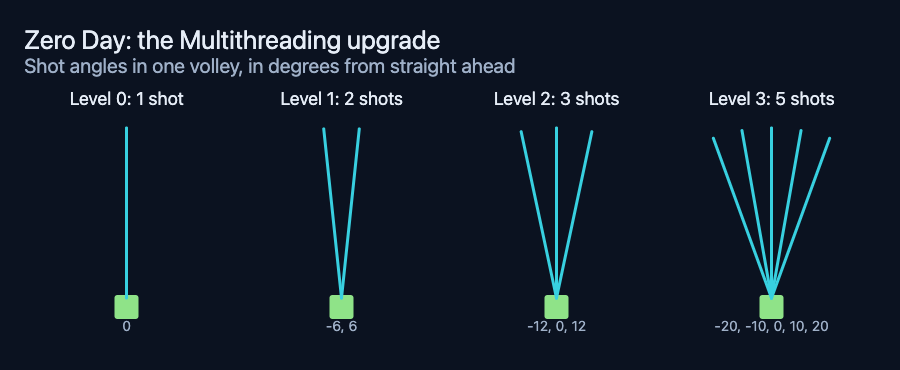
The shot angles of each Multithreading level, from the game's code.
Look at what the angles do to coverage. At level 3 the outer shots sit 20 degrees off your aim on each side, so the whole fan is 40 degrees wide. Close to your tank, the shots are almost on top of each other. Far away, the gaps between them grow. A spread shot is dense up close and thin at a distance.
Spread shot vs single shot vs shotgun spread
These three get mixed up, so here is the difference.
Single shot
One projectile, one line. It is the most accurate option. You have to aim well, and a miss is a full miss. Its strength is that every bit of your fire goes where you point.
Spread shot
Several projectiles at fixed angles, usually one of them straight ahead. You still aim the middle of the fan at the target, and the side shots catch things near that line. The pattern is the same every time.
Shotgun spread
Many small pellets with random scatter, usually strong up close and weak far away. The name comes from real shotguns. In some games the scatter is random each time, so two blasts at the same spot land differently. The word "spread shot" is often used for both, but the fixed-angle version is easier to predict and to balance.
If a game needs the player to learn exact patterns, fixed angles are the fairer design. Random scatter adds luck.
When a spread shot is the right choice
A spread shot helps most in these cases:
- Many weak enemies. Several shots mean several chances to hit different targets in one volley.
- Moving targets. If you cannot lead a target perfectly, the side shots forgive small errors.
- Hard-to-reach enemies. A fan can cover a wider slice of the arena than one line.
In Zero Day, the botnet drone is a good example. It comes in threes and hunts you instead of the core. Three fast drones coming at once are hard to line up one at a time. A wide volley hits more of them. The drone has one hit point, so one shot from the fan is enough to remove it.
Chain kills make this even better. In Zero Day, every kill within 2.5 seconds of the last one adds to a chain, and the score multiplier goes up by one for every three kills, to a maximum of x8. A spread shot that takes down two or three enemies in a single volley feeds the chain fast. That ties the shooting pattern to the scoring system.
Trade-offs: damage per hit, range and fire rate
A spread shot is not a free upgrade in most games. Designers have to pay for the coverage somewhere. These are the common costs.
Damage per target
A volley can be split across targets, so any one target may get only one or two shots. Against a single big enemy at range, a fan wastes shots that fly past it. In Zero Day, every shot that hits an enemy takes 1 hit point. A ransomware tank needs 3 hits, and a cryptominer needs 5. A spread helps you land those hits only when the enemy is close enough that several shots strike it.
Range
The fan widens with distance. Up close, several shots can land on one target. Far away, they miss it and pass on either side.
Fire rate
The wait between volleys matters as much as the count. If you want a refresher on that idea, see what fire rate means in shooting games. In Zero Day the wait is 0.3 seconds, multiplied by 0.75 for each level of the Cache upgrade. That gives 0.3, 0.225, about 0.17 and about 0.13 seconds. Spread and fire rate multiply each other: a five-shot volley every 0.13 seconds is a lot of projectiles. Both rules are set by timers, and this guide to cooldowns shows how a tank game times every action.
How a tank game can balance a spread shot
Because a spread shot is strong, a game has to give it limits. Zero Day uses a few that you can copy in your own thinking about game design.
- Levels, not a switch. Multithreading has three levels. You grow into the five-shot volley.
- A choice of three. After each wave, Patch Tuesday offers three upgrades and you pick one. Taking Multithreading means not taking something else, such as Sandbox or RAID.
- Walls still matter. Silicon and firewall block shots. A fan of shots fired at a wall is mostly wasted. Load balancer lets shots bounce off silicon or the arena edge, and that pairs well with a wide spread.
- Enemies have hit points. A boss takes 40 hits on wave 5, and 15 more on each later boss. A wide fan does not help much unless the shots actually land on it.
Combining upgrades is where it gets fun. Encryption lets each shot pass through one more enemy per level. A five-shot fan where every shot can pierce one more enemy clears a crowd. The game also tells you the key habit: hold Fire to keep shooting, since holding it fires again as soon as the wait ends.
Tips for using a spread shot well
- Aim the middle of the fan, not the edge. From level 2 on, one shot flies straight ahead. At level 1 the two shots sit 6 degrees either side, so point the gap between them at the target.
- Close in on big enemies. Several shots only land on one target when you are near it. Back off from a cryptominer's rings, but get close enough that the fan connects.
- Dash through danger. You cannot be hit during a dash, which lasts a fifth of a second. Dash through enemy shots, then fire at close range.
- Keep the chain alive. Aim for spots where two or three enemies line up, so one volley gives several kills inside the 2.5 second window.
- Watch the walls. Do not waste a volley on silicon. Shoot where the fan can reach enemies.
- Remember that your shots cancel enemy shots. A wide fan can clear incoming fire, which makes it a defence as well as an attack.
Frequently asked questions
What is a spread shot in shooting games?
It is one fire action that releases several projectiles at slightly different angles. The shots fan out, covering a wider area than a single bullet.
Is a spread shot the same as a shotgun?
Not always. A shotgun usually scatters pellets at random and works best up close. A spread shot often uses fixed angles, so the pattern is the same every time.
Is a spread shot better than a single shot?
It depends on the target. A spread shot is better against groups and fast movers. A single shot is better for hitting one distant target with every bit of your fire.
How many shots can a spread have in Tank City Zero Day?
The Multithreading upgrade goes up to three levels. Volleys grow from 1 shot to 2, then 3, then 5 shots in a spread.
Does a spread shot make a game too easy?
It can, if it has no cost. Games balance it with upgrade limits, choices between upgrades, walls that block shots, and enemies with several hit points.
Get started with Tank City Reboot
The fastest way to understand a spread shot is to fire one. Open Tank City Zero Day, survive a few waves, and pick Multithreading when Patch Tuesday offers it. Then watch where the shots go against a group of drones. You can also read about carrier enemies if you want to see how the first game hands out power-ups.
Play Tank City Zero Day directly, or start from the home page at https://tankcityreboot.vlvd.net. It is free, plays in your browser on a computer or a phone, and needs no account to play.
Comments
No comments yet.
Sign in or make an account to comment.