What is a Tonkinese cat? Mink, solid and pointed coats
What is a Tonkinese cat? It is a medium-sized, short-coated cat bred as a middle ground between the Siamese and the Burmese. The Cat Fanciers' Association (CFA), a cat registry, calls it a "happy medium". This guide uses the CFA's Tonkinese page and breed standard to show where the Tonkinese came from, how its three coat patterns differ, and what the CFA says about its nature, grooming and health.
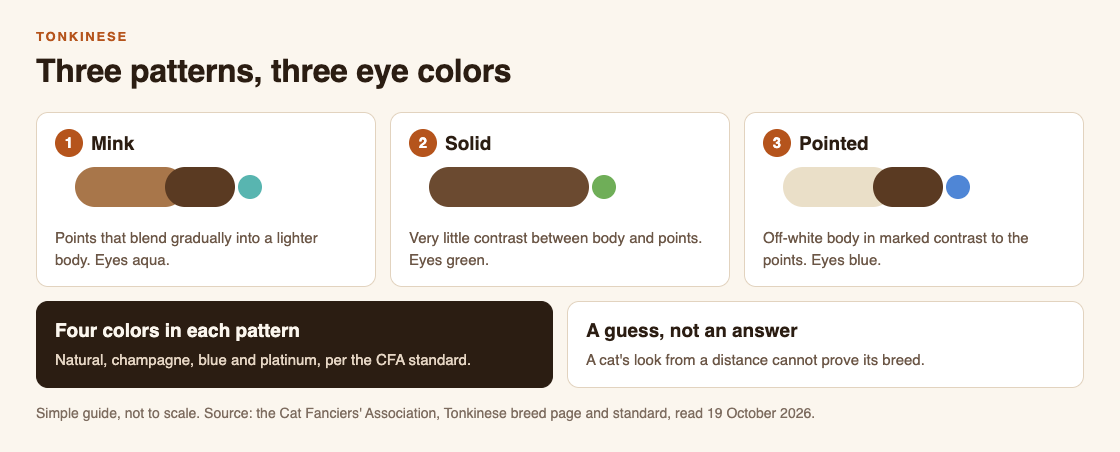
The three Tonkinese patterns and the eye color that goes with each, from the CFA's page and standard.
What is a Tonkinese cat, in one picture?
The CFA lists the Tonkinese coat as shorthair. It describes the breed as "originally developed from Burmese and Siamese", striking a balance between the two parent breeds. Its personality is given as "can be vocal, people oriented".
The picture above shows the three patterns the CFA recognizes. Mink cats have darker points that blend very gradually into a lighter body, and aqua eyes. Solid cats show very little contrast between body and points, and have green eyes. Pointed cats have an off-white body in marked contrast to the points, and blue eyes.
The CFA says each pattern is possible in four different colors. That adds up, in its words, to "a wealth of choices for prospective owners".
Where the Tonkinese came from
The CFA says it set out to create the perfect midpoint between the Siamese and the Burmese, and that the Tonkinese has been established as a unique breed on its own for over 30 years. Most Tonkinese descend from one cat, Wong Mau, who is also the foundation of the Burmese. She was a small, compact walnut brown female with darker areas on her head, legs and tail, and she was brought to America in 1930. She was eventually determined to be a natural mink Tonkinese.
Bred to a Siamese, Wong Mau produced three distinctly different types of kitten: some who resembled her, some with Siamese markings, and some in solid brown. The solid brown kittens became the foundation of the Burmese. The ones that resembled Wong Mau were used to produce more Tonkinese.
The CFA says the breed first achieved recognition in Canada, in 1960. It then took a concerted effort by breeders on both sides of the border before Tonkinese were accepted for CFA registration in 1982. Mink-patterned cats were accepted for championship competition in 1984. It was not until 2002 that the pointed and solid colors joined them.
How to recognize a Tonkinese
The CFA describes a medium cat that is neither cobby like the Burmese nor svelte like the Siamese. Its standard calls the ideal Tonkinese intermediate in type, an alert, active cat with good muscular development. Balance and proportion matter more than size.
Head, ears and eyes
- Head: a modified wedge, slightly longer than it is wide, with high, gently planed cheekbones. The muzzle is blunt, with a slight whisker break.
- Ears: alert and medium in size, with oval tips and a broad base. They are set as much on the sides of the head as on the top.
- Eyes: an open almond shape. The CFA's standard penalizes round eyes.
Coat and colors
The standard calls the coat medium short, close-lying, fine and soft, with a silky, lustrous sheen. The four colors are natural, champagne, blue and platinum. In the mink pattern, for example, the natural color has a medium brown body with dark brown points.
The CFA makes allowance for young and older cats. A young cat may have a lighter body color, and an older cat less contrast. With the dilute colors, full body color may take up to 16 months to develop, and the CFA says cats do darken with age. A young Tonkinese can look different from the adult it will become.
Eye color matters
Eye color is the quickest clue to the pattern. The CFA's standard says aqua is a defining feature of the mink pattern, while solid cats have green eyes and pointed cats have blue eyes. It disqualifies yellow eyes in the mink colors.
Tonkinese personality: the people-oriented talker
The CFA calls Tonkinese intelligent, gregarious and generally quite outgoing. It says it is natural for them to take possession of your lap or shoulder and supervise your every activity. They have excellent memories and quickly learn what you do not want them to do, although, the CFA jokes, in "Tonk-think" the word "no" means "okay to do when Mom's at work".
It says they are very sensitive to their owners' moods and may appear with a comforting purr when you have had a bad day. Owners have described them as part puppy, part monkey and part elephant, the last for a tendency to run through the house at a noisy gallop.
On company, the CFA says they get along well with dogs, other pets, children and guests, and will greet visitors at the door. They are also talkers. The CFA says they vocalize not just with meows and purrs but in complete sentences that need a prompt response, and that it is usually very clear what they are trying to say.
Coat care, health and finding a Tonkinese
The CFA says Tonkinese tend to be seasonal rather than year-round shedders. Grooming with a rubber brush two or three times a month keeps shedding to a minimum, conditions the silky coat and gives you a bonding experience with your cat. Bathing is rarely needed unless the cat is being shown.
On health, the CFA says that because of their background, Tonkinese are genetically diverse and tend to be robust, healthy cats. It says breeders generally share health and genetic testing information and remove cats with issues from breeding programs. The only breed-specific concern it names is a tendency towards gingivitis in older cats. It suggests that getting a young Tonkinese used to having its teeth brushed may help prevent it, and that senior cats have regular checkups. For a question about one cat, a vet is the right person.
The CFA says it is unusual to find a CFA cat show that does not include at least a few Tonkinese, and that visiting a show is the best way to meet a breeder. If you want a particular color or sex, it says to expect a wait, but finding a kitten should generally not be a challenge.
If you like the sound of a cat between two famous parents, our guides to the Siamese and the Burmese sit nicely beside this one. You can read the breed page itself on the CFA's Tonkinese page.
A worked example: is that cat a Tonkinese?
Say you spot a medium brown cat with darker legs and tail on a walk. Keep your distance and let the cat decide how close to come. Then use five looks, taking no more than a minute.
- Size and shape. Is it medium, neither chunky nor long and slender? The CFA's ideal sits between the Burmese and the Siamese.
- Coat. Is it short, close-lying and glossy?
- Points. Are the face mask, ears, legs and tail darker, and do they blend gently into the body? That blend is the mink pattern. A sharp contrast with an off-white body points to the pointed pattern instead.
- Eyes. If the light is good, are they aqua, green or blue? Aqua fits mink, green fits solid and blue fits pointed. The CFA's colors note says eye color is best seen in natural light.
- Head. Is the muzzle blunt, with no sharp dip at the nose? The CFA penalizes a definite nose break and round eyes.
Even with five matches, you have a guess. A brown cat with darker points could also be a mixed breed with Siamese or Burmese in its family tree, and young cats can look different from adults. If you have a pet cat and wonder about its breed, our post on how to tell if a cat is a mixed breed sets out the checks.
Naming a cat in Cat Go
If you like trying to name the cats you meet, Cat Go turns it into a game. It plays in your browser: you walk anywhere, photograph a real cat, lure it with in-game food and catch it. Every catch keeps its breed and where you found it.
The camera screen says "Fit the whole cat in the frame". After the cat is spotted, the game asks "Which breed is it?" and you pick from a list. There is a search box with the hint "Search breeds, like Siamese or curly". The player makes the call, not the game.
The screen also says "Most cats you meet are mixed breed" and "Mixed breed is always a safe pick". That is a good rule for a brown cat with dark points too, since a photo rarely settles a breed.
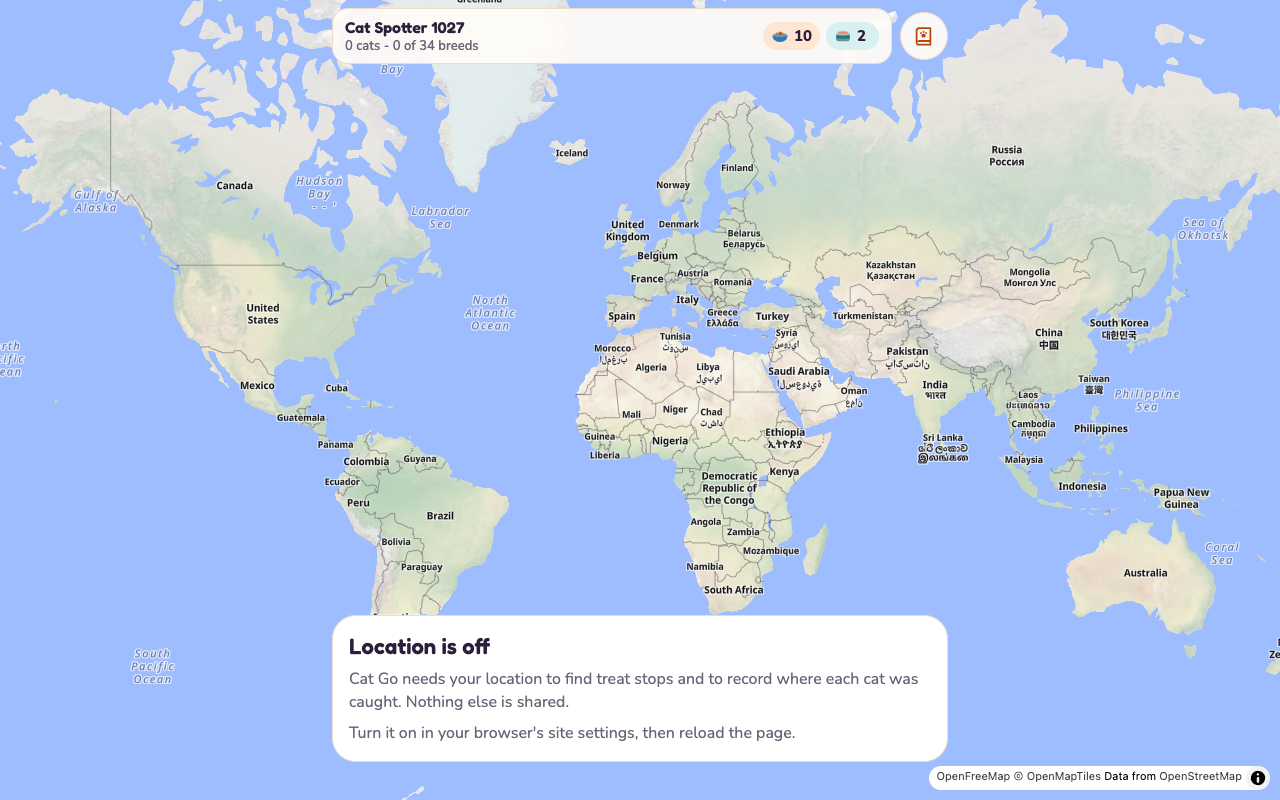
Cat Go's map. The game needs your location to record where each cat was caught.
Frequently asked questions
What is a Tonkinese cat?
It is a medium-sized, short-coated breed developed from the Burmese and the Siamese, per the CFA. It has a silky coat and a people-oriented, talkative nature.
What colors and patterns can a Tonkinese be?
The CFA recognizes mink, solid and pointed patterns. Each comes in natural, champagne, blue and platinum, and each has its own eye color: aqua, green or blue.
Are Tonkinese cats vocal?
The CFA says they can be. It says they vocalize in meows, purrs and "complete sentences" that need a prompt response.
Do Tonkinese cats need a lot of grooming?
The CFA says no: a rubber brush two or three times a month is enough, and bathing is rarely needed unless the cat is shown.
Does Cat Go tell me if a cat is a Tonkinese?
No. Cat Go asks "Which breed is it?" and you pick from its list. It also says mixed breed is always a safe pick.
Get started
Allow your camera and location in the browser, walk to a treat stop, collect some in-game kibble and tuna, then photograph a real cat from a respectful distance. Play Cat Go in your browser: walk anywhere, photograph a real cat, lure it with food and catch it.
Comments
No comments yet.
Sign in or make an account to comment.