What is a Turkish Angora cat? Look, coat and history
What is a Turkish Angora cat? It is a long, light, silky coated cat from Turkey that the Cat Fanciers' Association (CFA), a cat breed registry, calls the oldest known longhair breed. This guide follows the CFA's own breed page, opened for this post, and then shows how Cat Go handles the question "Which breed is it?"
What is a Turkish Angora cat? The short answer
The CFA lists the Turkish Angora as a longhair breed that "originated in Turkey; silky intermediate length coat; long body; several colors and patterns". It lists the personality as busy and curious.
The CFA calls it a national treasure in its native land, and rare and beautiful. It says the breed is graceful, elegant and refined, and "a study in contradictions": delicate in appearance, but with muscular strength and a very strong will.
The CFA also passes on a joke from owners and breeders. These cats are only loosely connected to the earth, and are more likely to be found on top of the tallest cabinet in the house than on the ground. So, "If you can't find your Turk, look up!"
Where the breed comes from
The CFA says the Turkish Angora is the oldest known longhair breed, and most likely an ancestor of other longhair breeds. Its written history goes back to the 1600s, when the cats were brought to Europe from the Middle East. They were popular in France, and are believed to have been among Marie Antoinette's pets.
The story then takes a bad turn. The CFA says that with the rise of the cat fancy in England, Turkish Angoras were interbred so closely with Persians that the breed virtually disappeared. Seeing that its national breed was at risk of extinction, the Turkish government set up preservation breeding programs at zoos during the 1930s.
Only the white cats, which have always been the most popular, were considered authentic. So when the first Turkish Angoras reached the U.S. in 1954, the breed was thought of as all white. Today, the CFA says, they are found in virtually every color, except chocolate, lilac and the pointed pattern, which are not eligible for registration. Our post on the Persian cat covers that breed from the same registry.
Build, ears and coat
The CFA describes a small to medium sized cat with a noticeably long body, legs to match, and a richly plumed tail. Its breed standard, the written description judges use, wants a balanced, graceful cat with a fine, silky coat that "shimmers with every movement", over a firm, long, muscular body. It adds that the ideal cat is medium in size with no exaggerated features.
- Ears: extra large and erect, set high on the head. The CFA says they give the cat a "bunny rabbit" look and are one of its most prominent features. The standard asks for ears that are large, wide at the base, pointed and tufted, set closely together.
- Eyes: almond shaped, and they can be any color, from blue to green to amber to copper. The CFA says odd eyes, two different colors in one cat, often occur and are especially prized. The standard adds that there is no relationship between eye color and coat color.
- Head: a medium-long, wedge-shaped head with a two-plane profile.
- Coat: so soft and silky, says the CFA, that you need to feel it to believe it.
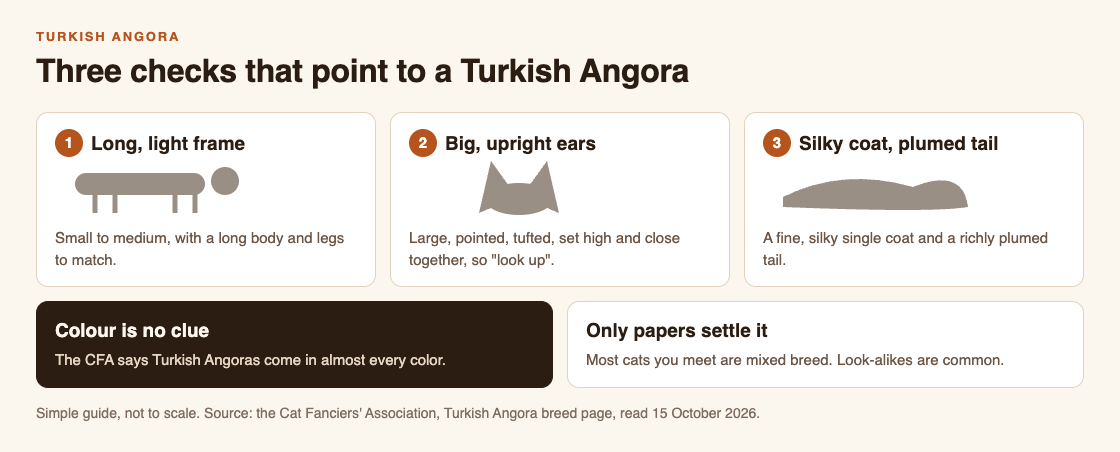
Three checks that point to a Turkish Angora, from the CFA's description.
Colour is no help here. The CFA says Turkish Angoras are found in virtually every color, so a cat can match the breed's build and still look like many other longhaired cats.
Temperament
The CFA describes a bright and very interactive cat.
- Brains: the CFA says the typical Turkish Angora is quite intelligent, but experienced breeders have found a wide range. Some cats are so bright that owners call them "Einsteins", while others sometimes forget where the food dish is.
- Company: it calls Turks undoubtedly one of the most interactive and affectionate of all breeds. They want to be your constant companions, and your enthusiastic and determined assistants. The CFA says that once one enters your household, you will never again do anything without "help".
- Time alone: they are independent enough to stay home while their people are at work or at school. They will be at the door to share the details of their day as soon as someone comes home, and so are often called "doglike".
- Children: the CFA says their loving natures and tolerance for frequent physical contact make them wonderful pets for young children, and that they will entertain guests with their antics.
- Play: point a laser light on the wall and, the CFA says, even an "Einstein" will try to defy gravity and chase it up the vertical surface.
These are the CFA's words about the breed in general. Each cat is its own cat, and a rescued or mixed breed cat may act quite differently.
Grooming and health, as the CFA describes them
For such a long coat, the grooming is light. The CFA says the single coat is not prone to matting, which makes this breed one of the easiest longhair cats to care for. Combing two or three times a month should be enough to control shedding in younger cats, though older cats may need it more often.
If a bath is needed, the CFA says it is likely to be tolerated well, because Turks have a natural affinity for water. Dripping faucets fascinate them, and some cats have voluntarily joined their owners in the shower.
On health, the CFA says Turkish Angoras are not known for any specific health problems. It does give one warning about white cats: they can be prone to deafness, especially blue-eyed cats. It says white cats should always be bred to colored cats to reduce the chance of a deaf kitten, and that in some parts of the world white kittens must have a BAER hearing test to make sure they are not deaf. Choosing a colored Turkish Angora avoids any concern about deafness. For anything about your own cat, ask your vet.
How to check a long-haired, big-eared cat you meet
Here is a worked example. You see a slim cat with a silky, flowing coat sitting on a high wall on your walk, and you wonder whether it is a Turkish Angora.
- Look at the frame. The CFA describes a small to medium cat with a long body and long legs. A short, heavy cat points away from the breed.
- Look at the ears. Are they large, pointed, tufted, set high and close together, and held upright? The CFA calls them one of the breed's most prominent features.
- Look at the tail. The CFA describes it as richly plumed.
- Look at the coat. A fine, silky, single coat of medium length fits. You can only judge how it looks from a distance.
- Do not use colour or eyes. The CFA says Turkish Angoras come in virtually every color, and eye color can be anything from blue to copper.
- Leave the cat alone. Look from a distance and let it go about its day. Our post on telling whether a cat is mixed breed gives the longer checklist.
At the end, you have a guess, not an answer. A long-haired cat with big ears can still be a mixed breed cat, and only papers can settle it. If you want to meet the breed for real, the CFA says the number of breeders active today is not enough to meet the demand. It says colored kittens may be easier to find than white ones, and that adopting a retired show cat may be quicker and more affordable than a kitten.
Cat Go and breeds
Cat Go is a game you play in your web browser. You walk anywhere, photograph a real cat, lure it with food and catch it. After a cat is spotted, the game asks "Which breed is it?" and gives you a list with a search box, so you can type something like "Siamese" or "curly".
The game also says "Most cats you meet are mixed breed" and "Mixed breed is always a safe pick." That fits what you just read. A silky, long-haired cat can still be a mixed breed cat, and you choose the breed yourself. The game counts 34 breeds in total, and every catch is saved to your Catdex with its breed and the place you found it.

Cat Go's map. The game needs your location to record where each cat was caught.
Cat Go needs the camera and location allowed in your browser. When you take the photo, the game says to fit the whole cat in the frame.
Frequently asked questions
Is the Turkish Angora an old breed?
The CFA calls it the oldest known longhair breed, with written history going back to the 1600s.
Do Turkish Angoras need a lot of grooming?
The CFA says the single coat is not prone to matting, so it is one of the easiest longhair cats to care for. Combing two or three times a month should control shedding in younger cats.
Are Turkish Angoras always white?
No. The CFA says white cats have always been the most popular, but today the breed is found in virtually every color, except chocolate, lilac and the pointed pattern, which are not eligible for registration.
Are white Turkish Angoras deaf?
Not all of them. The CFA says white cats, especially blue-eyed ones, can be prone to deafness, and that breeding white cats to colored cats reduces the chance. Ask your vet about your own cat.
Are Turkish Angoras good with children?
The CFA says their loving natures and tolerance for frequent physical contact make them wonderful pets for young children. That is a description of the breed, so meet the individual cat first.
Get started
Ready to try the "Which breed is it?" question on a real cat? Play Cat Go in your browser: walk anywhere, photograph a real cat, lure it with food and catch it.
Comments
No comments yet.
Sign in or make an account to comment.