What Is a Wave-Based Game? Waves, Bosses and Ramps Explained
If you have ever asked what is a wave-based game?, here is the short answer. It is a game where enemies come at you in numbered groups, one group after another, and each group is a little harder than the last. You clear a wave, you get a short pause, and the next one starts. This post explains how a wave is built and why the rounds ramp up. It uses the real numbers from Tank City Zero Day, a free browser game, so you can see the design choices instead of guessing at them.
What is a wave-based game? A simple definition
A wave-based game splits the action into rounds. Each round, called a wave, sends a set group of enemies. The wave ends when you destroy them all. Then the game counts up and sends the next one.
Three things set the format apart:
- A clear unit of progress. You always know where you are: wave 3, wave 7, wave 12.
- A rising curve. Later waves bring more enemies, faster enemies, or new kinds of enemy.
- A gap between rounds. Many games give you a moment to breathe or choose an upgrade.
The idea is old. On Wikipedia's survival mode page, survival mode, also called horde mode, is a mode where you keep playing as long as you can while the game sends increasingly difficult waves. Some versions end after a set number of waves instead. The same page compares it to classic arcade games, where you face stronger and stronger waves of enemies.
Where you meet waves
Waves turn up in many kinds of games. The object of the 1978 arcade game Space Invaders was to defend the bottom of the screen against waves of incoming enemies. Tower defense games are a branch of strategy games where you defend your ground by placing defenses along the path the attackers take. They send attackers in waves too.
Action games use waves in a more direct way. You are the defense. Tank City Zero Day, the second game on Tank City Reboot, works like that. It is inspired by the 8-bit tank classics of the Family Computer. You drive one tank and protect a CPU core from waves of malware. The goal is to survive as many waves as you can.
How a wave is built: a worked example
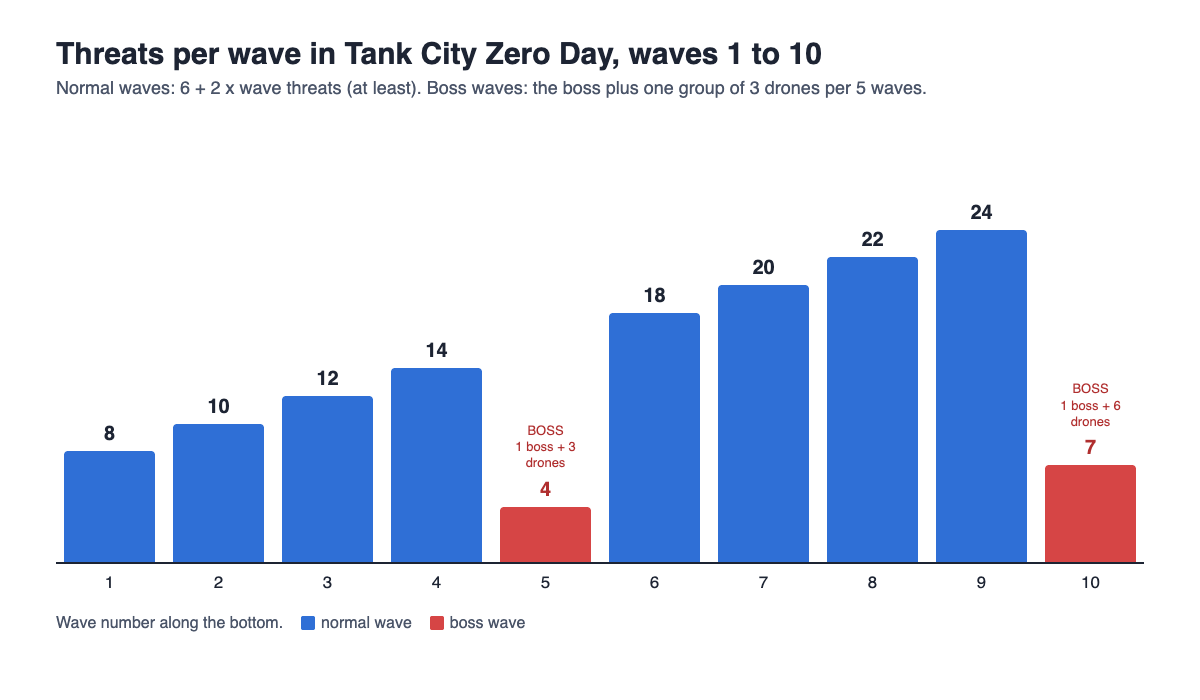
Every wave answers a few questions. How many enemies come in total? How many can be on the field at once? How long between each new arrival? Zero Day answers them with three short formulas in its code:
- Total threats: 6, plus 2 per wave number, up to 30.
- On the field at once: 4, plus one more for every 3 waves, up to 8.
- Time between entries: 2.0 seconds, minus 0.08 seconds per wave, never under 0.6 seconds.
Botnet drones always come in threes, so a wave can run one or two over its total. Now follow the numbers yourself.
- Wave 1. 6 plus 2 gives 8 threats. Up to 4 share the field. A new one enters every 1.92 seconds.
- Wave 7. 6 plus 14 gives 20 threats. Up to 6 share the field, since 7 divided by 3 rounds down to 2. A new one enters every 1.44 seconds.
- Wave 12. 6 plus 24 gives 30 threats, the cap. Up to 8 share the field, also the cap. A new one enters every 1.04 seconds.
The rules never changed. The numbers moved, and the pressure climbed with them. Look at the cap on the field, too. It stops a wave from dumping everything on you at once. You fight a steady stream, not a wall.
Why each wave is harder than the last
A flat challenge gets boring. A wave-based game raises the stakes in small steps, so you can improve at about the pace the game gets harder. For a longer look at that idea, read what a difficulty curve is.
More, sooner, faster
You saw the count and the entry gap rise. On top of that, threats move 3% faster each wave, until wave 15. Three percent is hard to notice in one wave. Over ten waves, you feel it.
New enemy types
Fresh threats make you change how you play. Waves 1 and 2 send only botnet drones and worms. Ransomware joins from wave 3. It is armored, and its shots turn firewall into silicon, which changes the shape of the arena mid-fight. Cryptominers join from wave 4. They are turrets that fire rings of shots.
Your power grows too
The ramp only works if you also get stronger. Upgrades like Multithreading, which adds shots to each volley, and Cache, which fires 30% faster, push back against the rising numbers. For help choosing, see what to pick after each wave.
Boss waves and the break between rounds
Every fifth wave in Zero Day is a boss wave. It sends the zero-day boss plus one group of three drones for every five waves. So wave 5 is the boss and 3 drones, and wave 10 is the boss and 6 drones. The boss takes 40 hits on wave 5 and 15 more on each later boss, so 55 on wave 10. A boss wave works as a checkpoint. It tests whether your upgrades and your aim have kept pace. There are tips for these rounds in how to survive boss waves.
Then comes the break. After each wave, a screen called Patch Tuesday offers three upgrades, and you pick one. A pause with nothing to do is dead time. A pause with a real choice is a reward, a rest and a decision at once.
Wave-based vs level-based games
These formats overlap, so it helps to set them side by side.
- Level-based: you move through hand-built levels in order, and there is usually an end.
- Wave-based: the challenge comes in counted rounds with gaps between them. It can stop at a final wave or run until you fail.
The two Tank City games show both. The first game uses stages. Each stage sends 20 enemy tanks at the CPU core. After stage 6 the maps repeat and enemies get 8% faster each loop, so a fixed set of stages becomes an open run. Zero Day is wave-based and has no final wave. Every wave is a freshly generated arena, and the run ends when the core's integrity or your last tank is gone.
What makes waves feel fair
Losing on wave 9 should feel like your mistake, not the game's. Two design habits help.
Every arena gives you a path
Zero Day draws each arena from a seed. Every arena is 13 by 13 tiles and a mirror image from left to right. Before you play it, the game checks that every enemy gate and your start can reach the core. If an arena fails that check, the game draws a new one.
Playing well pays off
Clearing a wave adds a core bonus of 250 times the wave number times the share of core integrity left. The core starts with 3 integrity. Clear wave 4 with all 3 left, and you get 1,000 points. Clear it with 2 left, and you get about 667. So a clean defense is worth more than just surviving.
Frequently asked questions
Is wave-based the same as horde mode?
Mostly, yes. Horde mode is another name for survival mode, where you hold out as long as you can against harder and harder waves.
Do wave-based games ever end?
Some stop at a final wave, and others run until you fail. Tank City Zero Day has no final wave, so you play until the core's integrity or your last tank is gone.
Why do games give you a break between waves?
The break lets you rest and make a choice before the next round gets harder. In Zero Day, that break is when you pick one of three upgrades.
Are wave-based games good for beginners?
Often, yes, because early waves are small and slow, so you learn before the pressure builds. In Zero Day, wave 1 sends 8 threats, and tougher types only join from wave 3.
Get started
The best way to understand waves is to play a few. Open Tank City Zero Day, click the game, move with the arrow keys, fire with Space and dash with Shift. You cannot be hit mid-dash, so use it to slip through shots. Watch how wave 3 feels different from wave 1. Then try to reach the first boss on wave 5 with your core still whole.
Play Tank City Reboot: it is free, plays in your browser on a computer or a phone, and needs no account.
Comments
No comments yet.
Sign in or make an account to comment.