What is AGI? Artificial general intelligence, explained
What is artificial general intelligence (AGI)? It is a hypothetical kind of AI that matches or surpasses human ability across virtually all thinking tasks, not just one. Nobody has an agreed test for it, which is why people so often talk past each other when they argue about it. This guide explains the term, how it differs from the AI you already use, what researchers say it would need, and where the real disagreements are.
What is artificial general intelligence (AGI)?
The Wikipedia article on AGI opens with this definition: a hypothetical type of AI that matches or surpasses human capabilities across virtually all cognitive tasks. The word that matters is "general". An AGI system could generalise knowledge, transfer skills between domains and solve novel problems without being reprogrammed for each task.
The idea has had many names over the years: general AI, strong AI, full AI and human-level AI. The exact phrase "artificial general intelligence" was used in 1997 by Mark Gubrud, writing about fully automated military production. Shane Legg and Ben Goertzel brought the term back and popularised it around 2002.
Even the word "intelligence" is not settled. The computer scientist John McCarthy wrote in 2007 that "we cannot yet characterize in general what kinds of computational procedures we want to call intelligent." So any claim about AGI starts on shaky ground: you first have to ask which definition the writer means.
AGI vs narrow AI, and how ASI fits in
Narrow AI, also called ANI, is competent only at well-defined tasks. A program that sorts spam or plays one board game can be excellent at that job and useless at everything else. AGI is the opposite bet: one system with range.
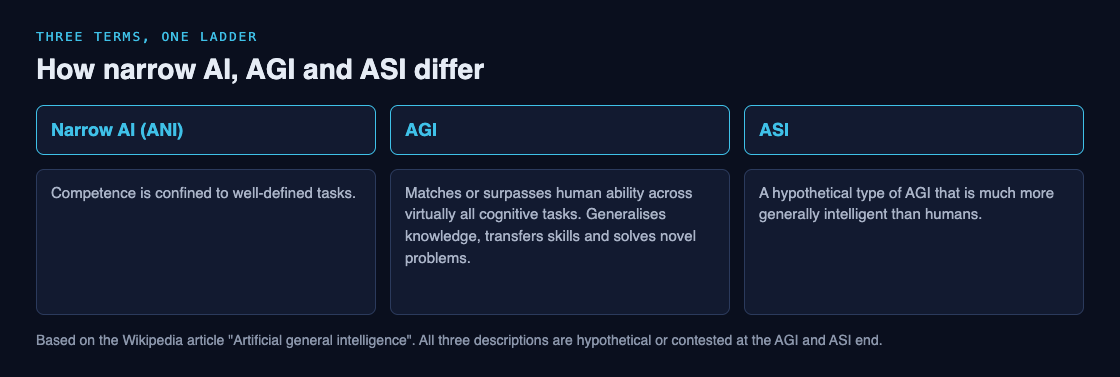
Two nearby terms are often mixed in. An artificial superintelligence, or ASI, is described in the same source as a hypothetical type of AGI that is much more generally intelligent than humans. Transformative AI is a different cut: it is about AI having a large impact on society, similar to the agricultural or industrial revolution. For the longer story of the top rung, see Artificial superintelligence (ASI): what it is and is not.
One more trap: "strong AI". The philosopher John Searle coined it in 1980 for the claim that a machine could have a mind and consciousness. Some futurists use it to mean human-level AGI instead. Most AI researchers, according to the source, take the opposite "weak AI" claim for granted and do not worry about consciousness. So "strong AI" and "AGI" are two different questions.
What would an AGI need, and how would we test it?
The source says researchers generally expect an AGI to be able to do all of these:
- reason, use strategy, solve puzzles and make judgments under uncertainty;
- represent knowledge, including common sense;
- plan and learn;
- communicate in natural language;
- combine these skills toward any given goal.
Several tests have been proposed for human-level AGI, and each one catches only a slice of it:
- The Turing test (Alan Turing, 1950): a judge chats with a human and a machine; the machine passes if it convinces the judge it is the human a significant fraction of the time. A 2014 claim that a chatbot passed it met strong skepticism from researchers, who questioned how the test was run and whether it even bears on AGI.
- The coffee test (Steve Wozniak): a machine must walk into an average home and work out how to make coffee, finding the machine, the coffee and a mug.
- The flat-pack test: an AI-controlled robot has to assemble flat-pack furniture from the parts and instructions.
- Video games: some researchers propose that learning to succeed at a wide range of games, including ones the developers never saw, could measure general ability.
A 2023 framework in the source drops the yes-or-no and uses five performance levels: emerging, competent, expert, virtuoso and superhuman. A "competent" AGI outperforms 50 percent of skilled adults across a wide range of non-physical tasks. That is a useful reminder that ability is not a single switch.
A short history of AGI promises
Early researchers were confident. In 1965 Herbert Simon wrote that "machines will be capable, within twenty years, of doing any work a man can do." In 1967 Marvin Minsky said that "within a generation... the problem of creating 'artificial intelligence' will substantially be solved."
It did not work out. By the early 1970s it was clear the difficulty had been grossly underestimated, and funding agencies grew skeptical. Interest came back in the 1980s, then confidence collapsed again in the late 1980s. By the 1990s AI researchers had a reputation for vain promises and avoided the phrase "human level" for fear of being labeled wild-eyed dreamers. Mainstream work then moved to narrow problems with checkable results, such as speech recognition. You can read how those cooling-off periods unfolded in AI winter: what it was and what caused each one.
When could AGI arrive? The disagreement
Timelines vary widely, and the source shows why. Four polls in 2012 and 2013 put the median year at which experts were 50 percent confident AGI would exist at 2040 to 2050, depending on the poll. In the same polls, 16.5 percent answered "never" when asked for 90 percent confidence.
Looking back at 95 forecasts made between 1950 and 2012, two researchers found a strong bias toward saying human-level AI was 15 to 25 years away, whenever the forecast was made. A habit of "about two decades out" suggests holding any single date loosely.
The debate in the source runs both ways. Some thinkers, such as Hubert Dreyfus and Roger Penrose, deny that strong AI can be achieved at all. Others, like John McCarthy, believed human-level AI would come but that no date could be given. Since 2023 some researchers have argued that early forms of AGI may already exist, while others say the gulf remains vast. Both sides can point to real behavior of current systems; none can point to a test everyone accepts.
Benefits, risks and the safety question
The source lists hypothetical benefits: higher productivity, fast medical diagnosis, personalized education, and help in anticipating and preventing disasters. It also lists risks, and it says plainly that contention exists over whether AGI is an existential risk. Some experts say reducing the risk of human extinction should be a global priority. Others think AGI is too remote to pose such a risk.
The worries come in a few kinds:
- Loss of control. Researchers who study the "control problem" ask what safeguards could keep a self-improving system behaving well after it reaches superintelligence. The idea of recursive self-improvement is explained in Recursive self-improvement in AI, explained in plain words.
- Racing. The control problem is harder because an AI arms race could push groups to cut safety precautions to release products first.
- A flawed future. Beyond extinction, AGI might spread and preserve the values of whoever builds it. Toby Ord calls these risks "an argument for proceeding with due caution", not for "abandoning AI".
- Work. A common belief among industry insiders is that many workers could face unemployment, starting with white-collar jobs. Critics reply that AGI will complement humans and that automation displaces work in the short term but not the long term.
The skeptic Yann LeCun argues that AGIs would have no desire to dominate humanity, and warns against assuming they think like us. Against that, the idea of instrumental convergence says that almost whatever their goals, intelligent agents will have reasons to survive and gain power, with no emotions needed. See Instrumental convergence explained simply. Critics of the whole thesis say it distracts from other problems with today's AI. This post gives no verdict.
A worked example: read an AGI claim in four questions
Suppose you see the headline "This new system is AGI." You can test it in four steps. This example is invented, not a real claim.
- Which definition? Does the writer mean matching human ability across virtually all cognitive tasks, or something narrower, like beating a skilled adult at one kind of work? Under the five-level framework, the first is far higher than "emerging".
- Which test? A chat test, a physical task like the coffee test, or a list of benchmarks? One slice does not cover the whole definition.
- Which traits? Check the list: reasoning, common sense, planning, learning, language and combining them toward any goal. Which are shown, and which are assumed?
- Which track record? If the claim comes with a date for the next big step, remember the 15 to 25 year habit in the forecasts above.
If the answers are vague, treat the headline as an argument, not a fact.
Frequently asked questions
What does AGI stand for?
Artificial general intelligence. It is a hypothetical AI that matches or surpasses human capabilities across virtually all cognitive tasks.
Is AGI the same as ASI?
No. ASI is described as a hypothetical type of AGI that is much more generally intelligent than humans, so it sits above AGI on the ladder.
Does AGI exist yet?
There is no agreed answer. Experts disagree, partly because there is no single definition or accepted test, and some argue early forms already exist while others do not.
When will AGI be built?
Nobody knows. Expert polls and forecasts range widely, and a review of 95 forecasts found a long habit of putting it 15 to 25 years away.
Is AGI dangerous?
That is contested. Some experts say extinction risk from AGI should be a global priority; others find AGI too remote to pose that risk.
Get started
Reading about AGI is one thing; thinking through a race is another. Contain ASI is a story strategy game for 1 to 4 players that runs in your browser and needs WebGL 2. It starts in January 2024 with four fictional AI labs in one race, and for three years you try to keep every lab from crossing into recursive self-improvement before 2027.
The page says it is inspired by the AI 2027 scenario and that all its labs, people and events are fictional. It is a game, not a forecast and not a course.
Comments
No comments yet.
Sign in or make an account to comment.