What is an Abyssinian cat? The ticked coat, explained plainly
What is an Abyssinian cat? In the Cat Fanciers' Association's words, it is a medium-sized, short-haired cat with a "distinctly ticked coat", sociable, super-inquisitive and always on the move. The CFA, the US cat breed registry, calls it one of the oldest of all cat breeds. This guide covers the coat and its four colours, where the breed and its name come from, what Abyssinians are like to live with, and why a ticked cat you meet on the street is most likely not one.
Everything about the breed here comes from the CFA's Abyssinian breed page and standard, opened for this article.
What is an Abyssinian cat? The short answer
The CFA describes the ideal Abyssinian as a colourful cat with a distinctly ticked coat, medium in size and regal in appearance. Its body is lithe and muscular, with an arched neck, and its legs are slim and fine boned, so the cat stands well off the ground and looks as if it is on tip-toe. The ears are large and cupped, and the eyes are large, almond shaped and gold or green.
The breed's best-known feature is the coat. Each hair carries bands of colour, called ticking, and the CFA says these bands make the coat glow and give the breed its "wild" look.
The ticked coat and its four colours
The standard asks for a soft, silky, dense coat, medium in length but long enough to hold two or three dark bands of ticking on each hair, with the very tip of the hair darkest. Only four colours are accepted, and the standard lists any other colour as a fault that disqualifies a show cat.
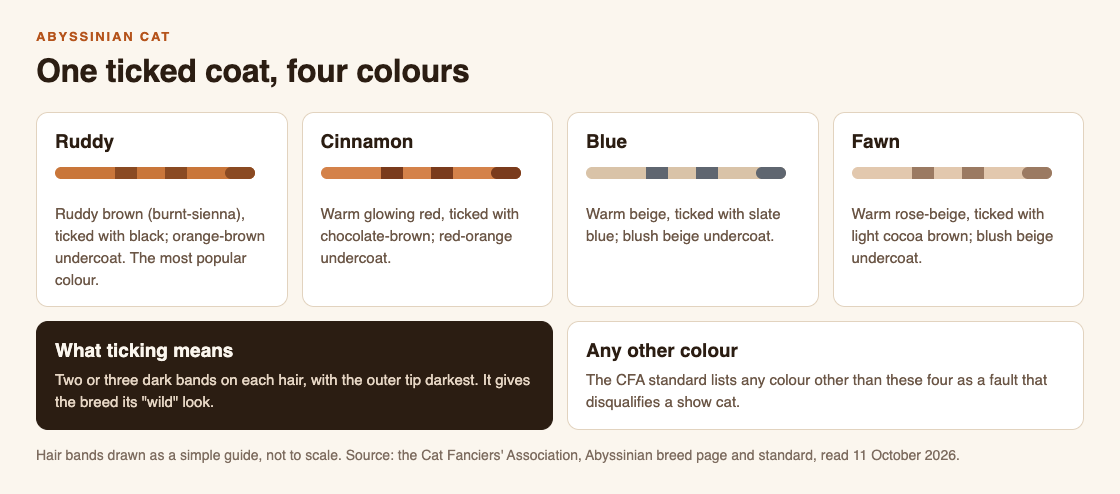
The four Abyssinian colours, in the words of the CFA standard.
- Ruddy: ruddy brown, which the standard calls burnt-sienna, ticked with black over an orange-brown undercoat. The CFA says this is the most popular colour.
- Cinnamon: a warm glowing red, ticked with chocolate-brown, over a red-orange undercoat.
- Blue: a warm beige, ticked with slate blue, over a blush beige undercoat.
- Fawn: a warm rose-beige, ticked with light cocoa brown, over a blush beige undercoat.
The standard also prefers cats with no markings on the underside, chest and legs, and a tail without rings. Barring on the legs and rings on the tail count against a show cat.
Where the Abyssinian comes from
The name suggests Africa, since Ethiopia was once called Abyssinia. The CFA says the name only tells you that the first Abyssinians shown at cat shows in England happened to be imports from Ethiopia.
The breed was also once thought to descend from the hunting cats painted in ancient Egyptian tombs, and it does resemble cats in ancient Egyptian art. But the CFA says genetic research has established that the breed came from the coastal areas of the Indian Ocean and from Southeast Asia, and was likely brought back to England by returning soldiers.
The first Abyssinian seen at a cat show was "Zula", at the Crystal Palace show in England in 1871. Abyssinians reached the United States in the early 1900s and were one of the original breeds registered by the CFA in 1906. The CFA says they consistently rank among the most popular shorthair breeds it registers.
What Abyssinians are like
The CFA's description is of a busy, clever cat. It calls the Abyssinian extremely active and playful, an "indomitable problem-solver" that leaves no inch of its home unexplored and is constantly on the move unless asleep. Given too few toys, it will invent its own.
- Affection, on its own terms. It is friendly and extremely affectionate, and may settle in your lap for a moment, but it is unlikely to stay long. If it wants attention and does not get it, it may reach out with a gentle paw to ask.
- Heights. Abyssinians are fond of high places, and the CFA says they should be offered perches to survey their home from.
- Company. They do not like to be left alone for long, so the CFA suggests quieter homes may want two instead of one.
- Quiet. They are not particularly talkative, and make their wishes clear without much noise.
- Families. The CFA calls the breed an excellent choice for families with children, who will enjoy playing toy and hunting games with it, and says well-socialized Abyssinians may even enjoy going out in public on a harness.
Care and health notes
The CFA says Abyssinians need very little grooming: comb or brush a few times a month to control shedding, and a gentle rub with a chamois cloth on a dry coat adds a sheen. Baths are generally not needed unless the cat is being shown.
On health, the CFA says genetic testing now lets breeders remove carriers of an inherited disease that once caused anemia, and that some breeders show kitten buyers how to brush their cat's teeth to prevent dental problems such as gingivitis.
Is that ticked cat an Abyssinian? A worked example
Say you meet a short-haired, sandy brown cat on a garden wall, and up close each hair looks banded. Is it an Abyssinian? Here is a three-step check using the CFA's own pages.
- Name the pattern, not the breed. The CFA's coat and colour descriptions list four tabby patterns: mackerel, classic, spotted and ticked. A ticked tabby has several bands of colour on each hair, and the CFA names Abyssinians as a typical example. But it also reminds readers that tabby is a pattern.
- Compare with the standard. Look at the legs and tail. The Abyssinian standard prefers no markings on the legs and a tail without rings, and counts barring against a show cat. A ticked cat with clear stripes on its legs and rings on its tail is further from the standard.
- Remember the odds. The CFA's guide "A Pattern Does Not a Breed Make" says only about five percent of domestic cats belong to any recognised breed, and that unless a cat is known to come from a breeder of pedigreed cats, it will almost certainly not be of a specific breed.
So the cat on the wall is a ticked tabby, and most likely a mixed breed. Our guides to tabby patterns and telling whether a cat is a mixed breed go further.
Recording the breed in Cat Go
Cat Go is a game that plays in your web browser: "Walk anywhere, photograph a real cat, lure it with food and catch it. Every catch keeps its breed and where you found it." A catch starts with a photo. Then it asks "Which breed is it?" and you pick from a list with a search box ("Search breeds, like Siamese or curly"). You choose the breed; the game does not decide for you.
The game's own advice matches the CFA's odds: "Most cats you meet are mixed breed. Rarer breeds are warier." and "Mixed breed is always a safe pick." The kibble and tuna you toss are food inside the game, never real food, and it says "Tuna works much better on wary cats."
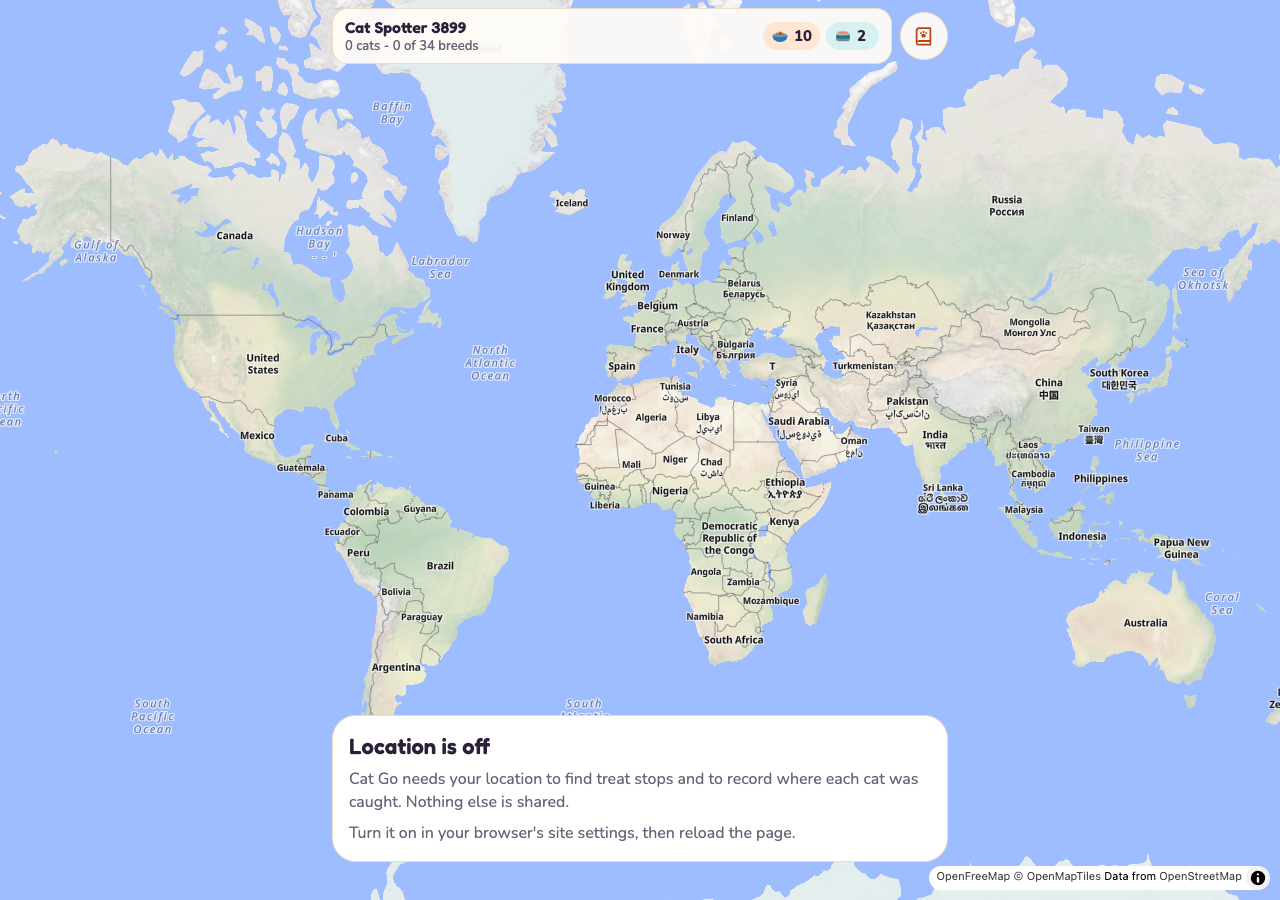
Cat Go's map, where each catch is recorded with the place you found the cat.
Frequently asked questions
Are Abyssinian cats from Ethiopia?
Not according to the CFA. The name comes from the first show cats in England being imports from Ethiopia, once called Abyssinia, but genetic research places the breed's origin around the Indian Ocean coast and Southeast Asia.
What colours do Abyssinians come in?
The CFA standard accepts four: ruddy, cinnamon, blue and fawn. Ruddy is the most popular.
Are Abyssinians lap cats?
Not usually. The CFA says an Abyssinian may settle in your lap for a moment but, being so active, is unlikely to stay long, though it still seeks attention and affection.
Do Abyssinians like to be left alone?
No. The CFA says they do not like being left alone for long, and suggests quieter homes may want two.
Get started
Next time you spot a ticked cat on a walk, take a calm photo and decide for yourself what it is. Open Cat Go in your browser, allow location and the camera, and start your Catdex with the cats you meet.
Comments
No comments yet.
Sign in or make an account to comment.