What is an Egyptian Mau cat? Spots, history and traits
What is an Egyptian Mau cat? It is a medium sized, shorthaired cat with a spotted coat, green eyes and an athletic build, and the Cat Fanciers' Association (CFA), a cat breed registry, calls it the only natural breed of spotted cat. This guide follows the CFA's own breed page and breed standard, opened for this post, and then shows how Cat Go handles the question "Which breed is it?"
What is an Egyptian Mau cat? The short answer
The CFA lists the Egyptian Mau as a shorthair, with the characteristics "spotted pattern in silver, bronze and black smoke". It lists the personality as athletic and active.
The CFA writes that Egyptian Maus "radiate an air of majesty and mystery". It says no other breed combines a link to ancient history, a strikingly exotic appearance and a unique personality. Its breed standard, the written description judges use, calls the breed "the only natural domesticated breed of spotted cat" and asks for an active, colorful cat of medium size with well developed muscles.
Where the breed comes from
The CFA says the word "Mau" meant cat or sun in Ancient Egypt. Papyri and frescoes dating back as far as 1550 B.C. show spotted cats that resemble today's Egyptian Maus, which gives the breed the distinction of being one of the oldest known breeds of cat.
The CFA then follows the modern story. For many years, cats believed to be descended from the felines of ancient Egypt were kept as pets by members of the country's nobility and diplomatic corps. One of them came into the hands of Nathalie Troubetskoy, a Russian princess living in Rome. She was so captivated that she sought out other Maus and started a breeding program.
When she emigrated to the United States in 1956, three Maus travelled with her. The CFA says the breed quickly won the attention of U.S. cat fanciers. It accepted the Egyptian Mau for registration in 1970 and advanced it to championship status in 1977. Our post on the Oriental cat covers another breed from the same registry.
Spots, colors and build
The CFA says any description of an Egyptian Mau starts with its spots. They are randomly scattered in no distinguishable pattern, and they vary significantly in size and shape. The standard says the spots can be small or large, round, oblong or irregular, and that any of these is of equal merit, as long as each spot is distinct and has good contrast with the pale ground color.
- Face: the standard describes a forehead barred with a characteristic "M" and frown marks. The cheeks are barred with "mascara" lines.
- Body and tail: the tail is heavily banded and ends in a dark tip. There are one or more broken necklaces on the upper chest, and "vest buttons" spots on the underside.
- Eyes: "gooseberry green". The standard allows for eye color that changes as a cat grows: some green by eight months of age and full green by one and a half years. Blue eyes, and a lack of spots, are on its list of reasons to disqualify a cat from showing.
- Colors: three are shown, silver, bronze and smoke. The CFA says silver and bronze have dense, resilient coats long enough for multiple bands of ticking, while smoke has a finer, silky texture. Solid black and dilute colors may also occur and are eligible for registration, but not for showing.
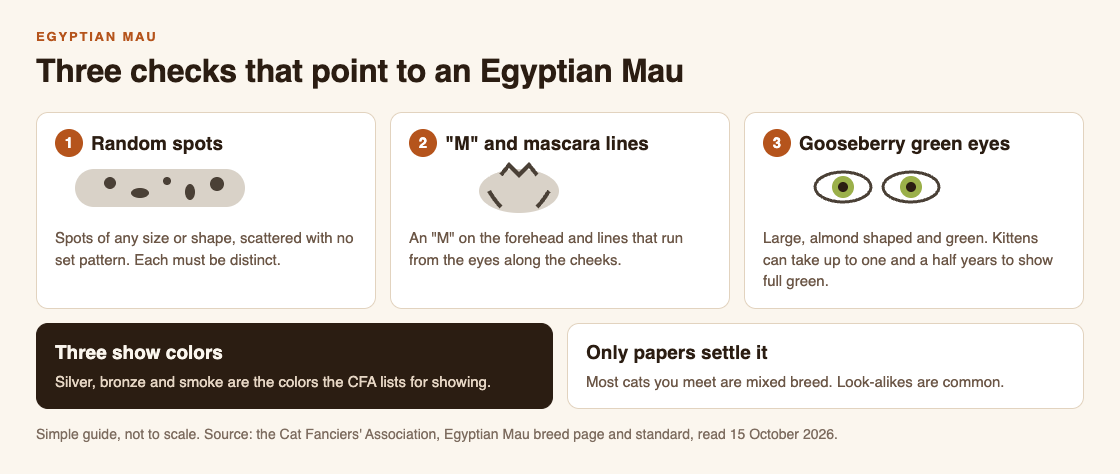
Three checks that point to an Egyptian Mau, from the CFA's description.
The build has a story too. The CFA calls these cats sleek and muscular, with a loose skin flap from flank to hind leg that gives them "remarkable freedom and agility in twisting and jumping". High shoulder blades and longer hindlegs give them a Cheetah-like gait. The standard says the hind legs are proportionately longer, so the cat looks as if it is standing on tip-toe, and that males tend to be larger than females.
Temperament
The CFA describes a clever cat that is very tied to its people.
- Brains and senses: exceptionally intelligent and intensely devoted to their owners, who are expected to treat them as integral members of the household. Their senses of smell, hearing and sight are extremely powerful, so they are acutely aware of everything going on around them.
- Moods: the CFA says they are equally sensitive to the moods of their owners, and have "a wonderful knack of turning up with a soft purr just when you may be feeling down".
- Play: they take great pleasure in interactive games, may train you to play fetch, and, the CFA says, enjoy going for walks on a harness and leash.
- Daily life: active, alert and agile, they are "shoulder riders, refrigerator vultures, and furry alarm clocks". In other words, they take part in every part of your life.
- Strangers: known to be strong willed, with definite ideas about who can handle them and when. The CFA says they may be cautious or reserved with strangers, but affectionate, loyal, outgoing and fearless with "their" people.
- Voice: quiet cats with low, melodious voices. The CFA says they enjoy engaging you in conversation and may chirp or chatter at you in greeting.
These are the CFA's words about the breed in general. Each cat is its own cat, and a rescued or mixed breed cat may act quite differently.
Grooming and health, as the CFA describes them
The grooming is light. The CFA says Egyptian Maus shed only minimally, but weekly combing is recommended to keep shedding under control and to prevent hairballs. It says this should not take more than a few minutes.
Regular bathing is not needed unless you plan to show your cat. The CFA says to consult the breeder for product recommendations if you do bathe, because human shampoos may harm cats.
On health, the CFA calls this a healthy, natural breed that can live a long life with proper care. It also says breeders have been diligent about genetic testing for some heritable conditions found in Egyptian Maus, such as pyruvate kinase deficiency, which can cause anemia. Other conditions, such as urolithiasis, which causes stones to form in the kidneys and urinary tract, may occur. The CFA says genetic testing is not available for all of them at the moment, and suggests asking a breeder about any history of health issues in the lines. For anything about your own cat, ask your vet.
How to check a spotted cat you meet
Here is a worked example. You see a lean, spotted cat with green eyes on a garden wall on your walk, and you wonder whether it is an Egyptian Mau.
- Look at the spots. The standard wants spots of any size or shape, scattered with no set pattern, each one distinct against a paler ground color.
- Look at the face. Is there an "M" on the forehead, and are there dark mascara lines along the cheeks? These are the markings the standard names.
- Look at the tail. The standard describes it as heavily banded, with a dark tip.
- Look at the eyes. The standard asks for gooseberry green, but a young cat may not be fully green yet, so a cat under eight months is hard to judge.
- Look at the build. A medium sized, muscular cat with hind legs a little longer than its front legs fits the standard. You can only judge this from a distance.
- Do not rely on spots alone. The CFA's tabby pattern list also has a spotted tabby, which it describes as the mackerel or classic pattern broken into spots. Our post on the tabby cat sets out those patterns.
- Leave the cat alone. Look from a distance and let it go about its day. Our post on telling whether a cat is mixed breed gives the longer checklist.
At the end, you have a guess, not an answer. A spotted cat with green eyes can still be a mixed breed cat, and only papers can settle it. If you want to meet the breed for real, the CFA says visiting a show is the best way to connect with a breeder. It also says the breed has become more popular in recent years, but there are not currently enough breeders to meet the demand.
Cat Go and breeds
Cat Go is a game you play in your web browser. You walk anywhere, photograph a real cat, lure it with food and catch it. After a cat is spotted, the game asks "Which breed is it?" and gives you a list with a search box, so you can type something like "Siamese" or "curly".
The game also says "Most cats you meet are mixed breed" and "Mixed breed is always a safe pick." That fits what you just read. A spotted, green-eyed cat can still be a mixed breed cat, and you choose the breed yourself. The game counts 34 breeds in total, and every catch is saved to your Catdex with its breed and the place you found it.

Cat Go's map. The game needs your location to record where each cat was caught.
Cat Go needs the camera and location allowed in your browser. When you take the photo, the game says to fit the whole cat in the frame.
Frequently asked questions
Is the Egyptian Mau an old breed?
The CFA says papyri and frescoes dating back as far as 1550 B.C. show spotted cats that resemble today's Egyptian Maus, which makes it one of the oldest known breeds. The CFA accepted it for registration in 1970.
What colors can an Egyptian Mau be?
The CFA says three colors are shown: silver, bronze and smoke. Solid black and dilute colors may also occur and can be registered, but not shown.
Does an Egyptian Mau need a lot of grooming?
The CFA says it sheds only minimally, and recommends weekly combing, which should take only a few minutes. Regular bathing is not needed unless you plan to show the cat.
Are Egyptian Maus friendly with strangers?
The CFA says they may be cautious or reserved with strangers, but affectionate, loyal and outgoing with their own people.
Does Cat Go tell me if a cat is an Egyptian Mau?
No. After you take a photo, you pick the breed yourself from a list, and "Mixed breed is always a safe pick."
Get started
Ready to try the "Which breed is it?" question on a real cat? Play Cat Go in your browser: walk anywhere, photograph a real cat, lure it with food and catch it.
Comments
No comments yet.
Sign in or make an account to comment.