What is an Ocicat? Spots, history and a social streak
What is an Ocicat? It is a spotted cat with the look of a small jungle cat and none of the wild blood. The Cat Fanciers' Association (CFA) calls it a "100% domestic hybrid", and says Ocicats are "anything BUT wild". The CFA lists its personality as "strong, active and social".
This guide uses the CFA's Ocicat page and breed standard, read on 17 October 2026. It covers where the breed came from, how to spot one, how it behaves at home, what its coat needs and how to make a careful guess at one from a distance. At the end it shows where the question comes up in Cat Go.
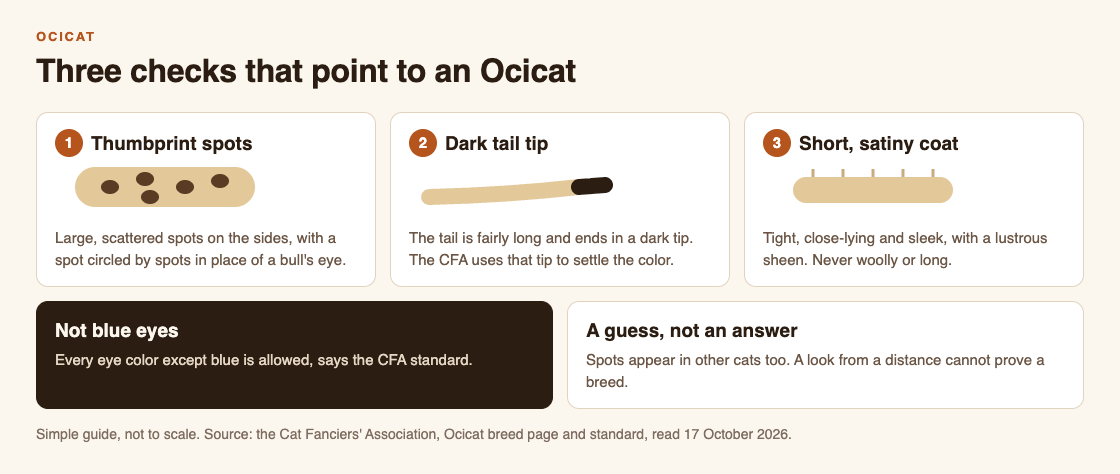
Three checks that point to an Ocicat, from the CFA's page and standard.
What is an Ocicat, in one picture?
The CFA says that one look at those spots makes people ask whether this is one of the new "wild" breeds. It answers that Ocicats aren't all that new. They were "selectively bred from three of the cat fancy's most popular breeds", to look like the spotted wildcats of Central and South America.
The CFA sums up what you get: the exotic look of a wild jungle cat plus a playful, independent spirit and an affectionate, devoted nature. It calls them confident, extroverted cats that "will walk into your life and proceed to take it over". The Abyssinian is one of its roots: what an Abyssinian cat is.
Where the Ocicat came from
The first Ocicat, a kitten called Tonga, was born in 1964. The breeding was an attempt to cross an Abyssinian with a Siamese to produce "Aby-pointed" Siamese. Instead it produced a spotted kitten that reminded the breeder's daughter of an ocelot, and that is where the name "Ocicat" comes from.
Tonga was neutered and placed in a pet home. Even so, his picture appeared in a Detroit newspaper, where a geneticist named Dr. Clyde Keeler saw it. The CFA says he was interested in producing domestic cats that mimicked some of the vanishing wild species. The breeding was repeated, and other breeders tried the same "recipe". They also brought an American Shorthair into the mix to broaden the breed's genetic base.
The CFA first accepted the Ocicat for registration in 1966. Building consistent structure and type took time, and it did not advance to championship status until 1987. For one of the other roots, see what a Siamese cat is.
How to recognize an Ocicat
The CFA standard describes a medium to large, well-spotted cat that looks athletic: "well-muscled and solid, graceful and lithe". These are the checks a reader can use from a few steps away.
- Thumbprint spots. Large, well-scattered spots appear on the sides of the body. The standard also asks for spots on the shoulders and hindquarters, running as far down the legs as possible.
- A spot circled by spots. Show-quality cats have a bulls-eye on each side, where a spot is circled by other spots.
- A dark tail tip. The tail is fairly long and medium-slim, with only a slight taper and a dark tip.
- A short, satiny coat. It is tight, close-lying and sleek, with a lustrous sheen and no suggestion of woolliness.
- A modified wedge head. The muzzle is broad and well defined, with a suggestion of squareness. The ears are moderately large and alert.
- Almond eyes in any color but blue. The CFA says all eye colors except blue are allowed, and eye color has no link to coat color.
The standard also describes a tabby "M" on the forehead and mascara markings around the eyes and on the cheeks.
How the spots are made
The CFA explains that each hair, except on the tip of the tail, has several bands of color. A thumbprint spot forms where those bands fall together. So the spots are not painted on top of the coat. They come from the coat itself, and the CFA calls the pattern a subtle suggestion of a classic tabby pattern. For a plain guide to tabby coats, see what a tabby cat is.
Ocicat colors: twelve, in eight classes
The standard accepts twelve colors, grouped into eight color classes. The CFA says tawny, chocolate and cinnamon are the most common. The others are dilute and silver versions, such as lavender silver and fawn silver.
One rule surprises most readers. The CFA says the color of the tail tip decides the correct color of an Ocicat, with no comparison to the color of other body markings. Reds, creams and torbies are not allowed in the breed.
Ocicat personality: the dog-like cat
The CFA says Ocicats are often described as having a "dog-like personality". They are dedicated to their owners but "neither clingy nor demanding". Natural extroverts, they welcome strangers, "probably in hope of finding new playmates". The CFA says many will fetch, walk on a leash and learn voice commands.
They are "alert, agile and athletic", but "energetic but not overly active", and their base activity level is lower than that of an Abyssinian or Siamese. An Ocicat is likely to vocalize now and then to get your attention, but the CFA says it "will not be annoying about it".
On who it suits, the CFA is direct. Ocicats do best in households that include other animals or someone who works from home, because they are "not happy being left to themselves for long periods of time". This is a breed description, not a promise. Any single cat has its own temperament, and a mixed-breed cat can be just as outgoing.
Grooming, health and finding an Ocicat
The coat is easy. The CFA says Ocicats are not heavy shedders and need only minimal grooming. Some owners use a rubber brush now and then, or wipe the coat with a chamois to remove loose hair and add luster. The CFA says Ocicats should not need bathing unless they are going to be shown.
On health, the CFA says the three parent breeds give Ocicats genetic diversity and "hybrid vigor", and breeders generally share genetic testing information. Even so, some health issues found in the parent breeds may still occur, so ask a breeder about the history of these conditions in the line. It names hypertrophic cardiomyopathy, the most common feline heart condition, amyloidosis, which can affect the kidneys or the liver, and progressive retinal atrophy, now a minor concern since it can be managed through genetic testing.
On finding one, the CFA says it is unusual to find a CFA cat show anywhere that does not include at least a few Ocicats. Visiting a show is the best way to meet a breeder. If you want a particular color or sex, the CFA says to expect a wait, but finding a kitten "should not be a challenge" in general.
A worked example: is that spotted cat an Ocicat?
Say you see a tan cat with dark spots on a garden wall, a few steps away. Here is a careful way to check, without going closer or crowding it.
- Look at the spots. Are they large, well-scattered thumbprints on the sides? Or are they small, or long stripes? The standard penalizes elongated spots that follow a mackerel pattern.
- Look at the tail. Is it fairly long, with a dark tip?
- Look at the coat. A short, sleek and satiny coat fits. A fluffy or long coat does not.
- Look at the eyes. Almond-shaped and any color but blue fits. Blue eyes rule the breed out, since the standard disqualifies them.
- Count the clues. Four matches make "Ocicat-like" a fair guess. Fewer than that, and the honest answer is that you cannot tell.
Even then it is only a guess. A spotted coat appears in other cats and in mixed cats, and only papers or a breeder can settle the question.
Frequently asked questions
What is an Ocicat?
It is a spotted, short-haired breed that the CFA calls a "100% domestic hybrid", bred to look like the spotted wildcats of Central and South America.
Is an Ocicat a wild cat?
No. The CFA says Ocicats are "anything BUT wild". It describes the breed as selectively bred from three popular domestic breeds.
What colors can an Ocicat be?
The CFA standard accepts twelve colors in eight classes. Tawny, chocolate and cinnamon are the most common, and the rest are dilute and silver versions.
Does Cat Go tell me if a cat is an Ocicat?
No. After you take a photo, you pick the breed yourself from a list, and "Mixed breed is always a safe pick."
Where does Cat Go come in? Cat Go is a game that plays in your web browser. You walk anywhere, photograph a real cat, lure it with food and catch it. Each catch keeps its breed and where you found it in your Catdex.
The breed question comes after the photo. The game asks "Which breed is it?" and lets you pick from a list of 34 breeds. A search box says "Search breeds, like Siamese or curly". The game also tells you that most cats you meet are mixed breed, and "Mixed breed is always a safe pick." So the checks above help you make a careful guess, and if you are unsure, the safe pick is always there.
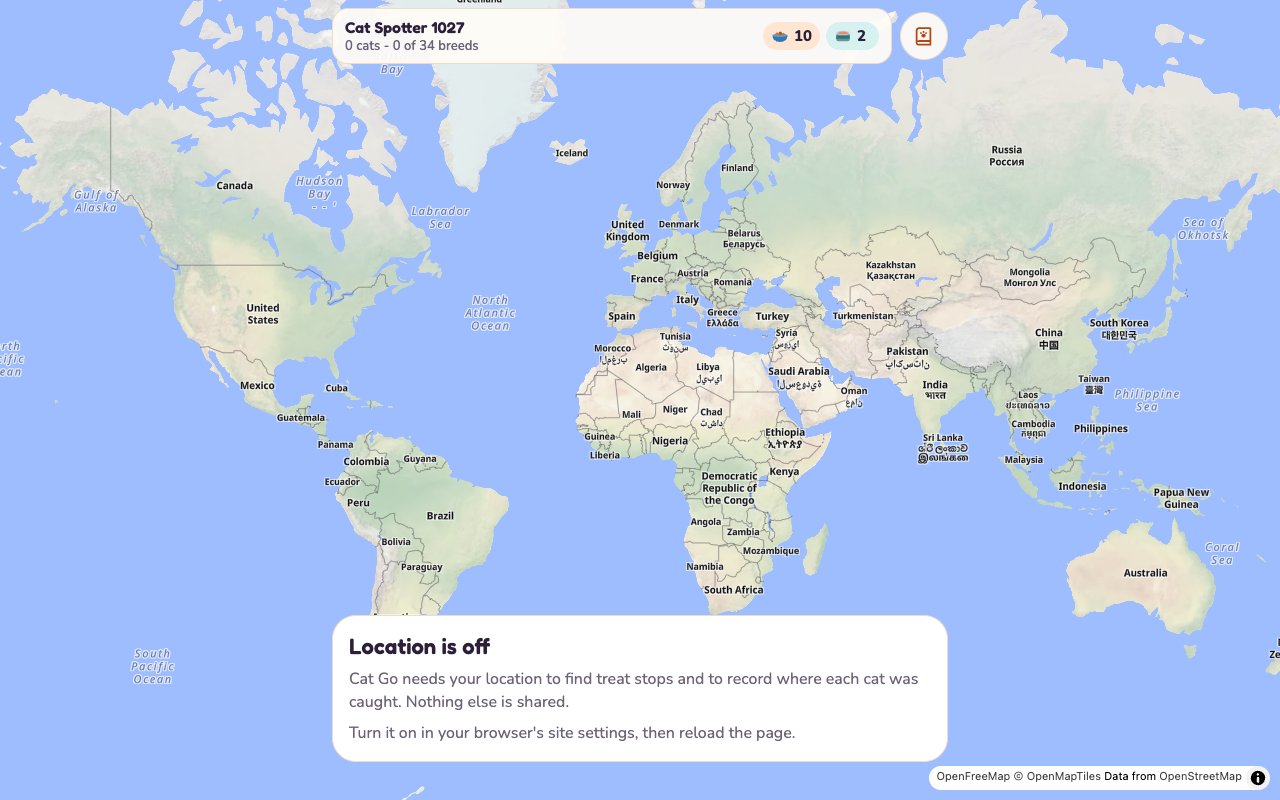
Cat Go's map. The game needs your location to record where each cat was caught.
Cat Go needs your location and your camera. If your location is off, the home screen says so.
Get started
Want to try the "Which breed is it?" question on a real cat? Play Cat Go in your browser: walk anywhere, photograph a real cat, lure it with food and catch it.
Comments
No comments yet.
Sign in or make an account to comment.