What is an Oriental cat? Look, colors and a big voice
Some cats look as if they were drawn with a ruler: a long triangle of a head, huge ears and legs that go on and on. So, what is an Oriental cat? According to the Cat Fanciers' Association (CFA), it is a Siamese style cat without the point markings, a slim breed that is talkative, affectionate and active, and that comes in a very wide range of colors. This guide uses the CFA's Oriental page and breed standard to cover where the breed came from, how to recognize one, what colors it comes in and what the CFA says about living with one.
What is an Oriental cat?
The CFA's summary of the breed reads: "Siamese style cat without the point markings; over 150 colors and patterns are possible." It lists the personality as "Vocal, affectionate, active; can be insistent". The breed comes in two coat lengths, longhair and shorthair.
The CFA says that from the tip of its nose to the end of its long, whippy tail, the Oriental is "a study in elegant design that clearly reveals its Siamese roots". The coat is either short, sleek and "painted-on", or a light layer of longer, silky fur. The CFA adds that the breed has over 600 possible color, pattern and coat length combinations, which it calls among the most extraordinary variety of color possibilities found anywhere in the cat fancy.
One detail is worth knowing. The summary line says "without the point markings", yet the CFA's standard also describes a pointed class, with blue eyes. So read the standard itself before leaning on the one line summary. Our guide to the colorpoint pattern explains what "pointed" means.
Where the Oriental came from
The CFA says the development of the breed began in Europe in the 1950s. At first, chestnut, lavender and white solids were recognized by England's Governing Council of the Cat Fancy. Other colors began to appear in the 1960s and 1970s, when breeders in the United States began developing them.
The first Oriental breed club, Oriental Shorthairs International, helped bring breeders together to work toward CFA recognition. The CFA accepted Oriental Shorthairs for registration in 1974, and they achieved championship status in 1977. In 1988 it accepted Oriental Longhairs, and the name of the breed became simply Oriental. The two coat lengths are shown in separate divisions.
That makes the Oriental a close relative of the cat in our guide to the Siamese. The CFA says the Orientals are as intelligent as their Siamese ancestors.
What an Oriental looks like
The CFA describes the same svelte elegance as the Siamese: fine boning, tubular bodies and a firm muscularity that "may surprise you, given their refined appearance". The standard describes the ideal Oriental as a svelte cat with long, tapering lines, very lithe but muscular, "neither bony nor flabby".
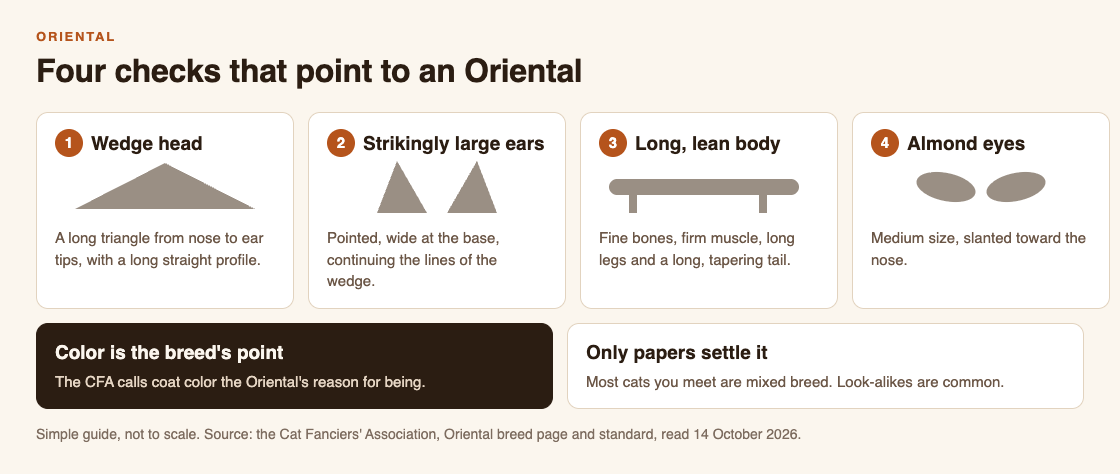
Four checks that point to an Oriental, from the CFA's description.
- Head. A long tapering wedge. The CFA says the wedge starts at the nose and continues in straight lines to the tips of the ears, forming a triangle with no break at the whiskers. The skull is flat, and in profile a long straight line runs from the top of the head to the tip of the nose.
- Ears. "Strikingly large, pointed, wide at the base", continuing the straight lines of the wedge.
- Eyes. Almond shaped, medium size, slanted toward the nose.
- Body and legs. Long and svelte, with a long, slender neck and long, slim legs. The hind legs are higher than the front. The paws are dainty, small and oval.
- Tail. Long, thin at the base and tapering to a fine point. On a longhair the tail hair spreads out like a plume.
The standard gives points for each part. Color is worth 30 of the 100 points (20 for coat color and 10 for eye color), the body 30, the head 20, the eyes 10 and the coat 10.
Colors and patterns
This is where the Oriental stands out. The standard says the Oriental's "reason for being is the coat color", whether it is solid, shaded, smoke, parti-color, bi-color, pointed or tabby patterned.
For solid cats, the standard names nine colors:
- Blue, which it says may range from pale blue-grey to deep slate-grey.
- Chestnut, a rich chestnut brown.
- Cinnamon, a light reddish brown, "distinctly warmer, lighter and redder than chestnut".
- Cream, a buff cream, with lighter shades preferred.
- Ebony, a dense coal black.
- Fawn, a light lavender with pale cocoa overtones.
- Lavender, frosty-grey with a pinkish tone.
- Red, a deep, rich, clear, brilliant red.
- White, pure and glistening.
The shaded class has a white, ivory or pale honey undercoat with a mantle of colored tipping. The standard also says a charcoal color or a rosetted pattern disqualifies an Oriental.
Eye color follows the coat. The standard asks for green eyes in general, blue for a pointed cat, and blue, green or odd-eyed for a white or bi-color cat. It penalizes crossed eyes.
The CFA notes that most breeders concentrate on only a few colors or patterns, so if you want one particular color, "you may have a wait for a kitten".
Personality, grooming and health questions
The CFA calls the Oriental "very people-centered". It says every move you make will fascinate your Oriental, and that if you are not in motion it will settle in your lap, "offering soothing purrs and occasionally nuzzling your chin". It also warns that Orientals can be fairly vocal and needy, and that you should "expect a fair amount of conversation".
The CFA ties that to attention: give an Oriental the attention and affection it needs and it will do anything to please you, but withdraw that attention and it may pine. It advises making sure you or family members can provide enough attention before adopting one. It says they make wonderful family pets, shifting easily from one lap to the next.
On grooming, the CFA says most Orientals adore being groomed, though they are minimal shedders and do not need much of it. It suggests a rubber curry brush for a shorthair and a fine-toothed steel comb for a longhair, once a week.
On health, the CFA says that because of the breed's popularity and diversity, most Orientals are healthy and breeders are working to address issues that may occur. It names two to ask about. Progressive retinal atrophy, which can cause blindness, is a recessive gene that genetic testing can detect. Amyloidosis, which causes liver and other issues, can be both genetic and acquired, and research is ongoing. The CFA says it is best to ask if there is any history of it in your kitten's lines. For anything about a particular cat, ask a vet.
A worked example: checking a photo
Say you have a photo of a slim cat with big ears. Is it an Oriental? Go through the CFA's description in order.
- Look at the head. Does it make a long triangle from nose to ear tips, with a long straight profile?
- Look at the ears. Are they strikingly large and wide at the base, continuing that triangle?
- Look at the body. Is it long and lean, with long legs and a thin, tapering tail?
- Look at the coat. Is it short and close, or medium length and silky? Is the color one the standard names?
- Look at the eyes. Are they almond shaped and slanted, and are they green, which the standard asks for in most colors?
If all five fit, the cat looks like an Oriental. It is still a guess. Most cats you meet are mixed breed, and a slim cat with big ears can be a mixed breed cat. Only papers can settle it. If you want to meet the breed for real, the CFA says visiting a cat show is the best way to connect with a breeder.
Frequently asked questions
What is the difference between an Oriental and a Siamese?
The CFA describes the Oriental as a Siamese style cat without the point markings, with over 150 colors and patterns possible. It also says the Oriental reveals its Siamese roots.
Do Oriental cats come with long hair?
Yes. The CFA lists the coat length as longhair and shorthair. The longhair has a light layer of silky fur and a feathery plume of a tail, and the two lengths are shown in separate divisions.
Are Oriental cats noisy?
The CFA lists the personality as vocal, affectionate and active, says they can be fairly vocal and needy, and says to expect a fair amount of conversation.
Do Oriental cats need a lot of grooming?
The CFA says they are minimal shedders and do not need much grooming, though most adore it. It recommends grooming once a week.
What color eyes does an Oriental have?
The CFA's standard asks for green in general, blue for pointed cats, and blue, green or odd-eyed for white and bi-color cats.
Get started
Cat Go is a game you play in your web browser. You walk anywhere, photograph a real cat, lure it with food and catch it. After a cat is spotted, the game asks "Which breed is it?" and gives you a list with a search box, so you can type something like "Siamese" or "curly". You choose the breed yourself.
The game also says "Most cats you meet are mixed breed" and "Mixed breed is always a safe pick." That fits what you just read: a slim cat with big ears can be a look-alike. The game counts 34 breeds, and every catch is saved to your Catdex with its breed and the place you found it. Our post on telling if your cat is a mixed breed goes through the checks.

Cat Go's map. The game needs your location to record where each cat was caught.
Cat Go needs the camera and location allowed in your browser. When you take the photo, the game says to fit the whole cat in the frame.
Play Cat Go in your browser: walk anywhere, photograph a real cat, lure it with food and catch it.
Comments
No comments yet.
Sign in or make an account to comment.