What is courage? Fear, danger and the mean between two vices
What is courage? Most of us can point to a brave act, but saying what courage is turns out to be harder. This post sets out the main views from two Stanford Encyclopedia of Philosophy entries: "Aristotle's Ethics", by Richard Kraut (first published 1 May 2001, substantive revision 11 August 2026), and "Virtue Ethics", by Rosalind Hursthouse and Glen Pettigrove (first published 18 July 2003, substantive revision 3 May 2026). It says who holds each view and gives no verdict.
The Stanford Encyclopedia has no entry of its own on courage, so everything below comes from what these two entries say about it.
What is courage for Aristotle?
Kraut explains that Aristotle, "like Plato", treats the ethical virtues, "justice, courage, temperance and so on", as "complex rational, emotional and social skills". Courage is one of them.
Aristotle calls an ethical virtue a "hexis", which Kraut glosses as a "disposition, induced by our habits, to have appropriate feelings". Kraut stresses what this rules out. It is a "decisive rejection of the thesis, found throughout Plato's early dialogues, that virtue is nothing but a kind of knowledge". On Aristotle's view, a courageous person does not only know the right thing about danger. She also feels the right way about it, and she got there by practice.
Kraut also notes that Aristotle writes for people who are already partly on the way. His audience "consists of people who are already just, courageous, and generous; or, at any rate, they are well on their way to possessing these virtues."
Courage as a mean between two vices
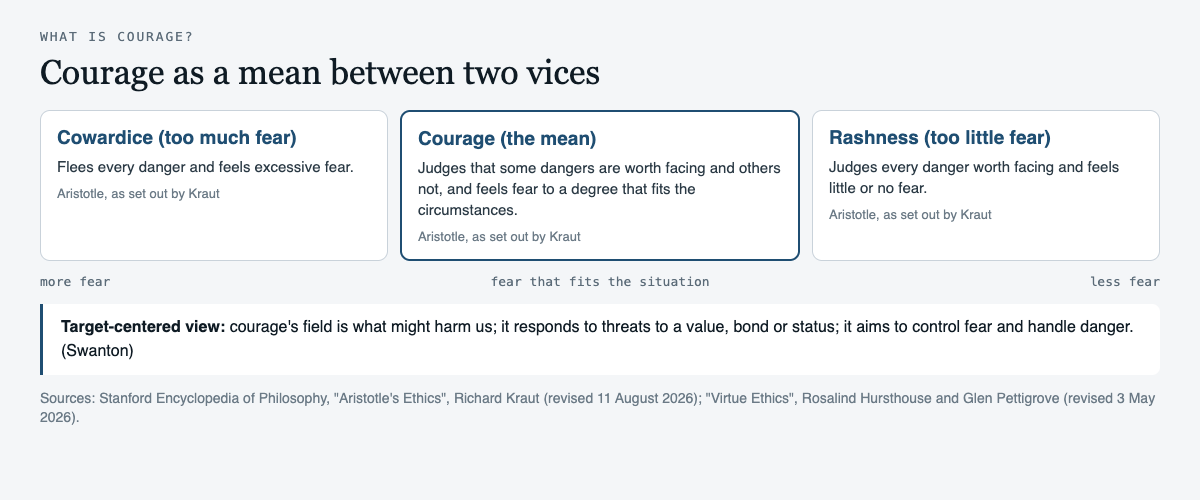
Aristotle holds that every ethical virtue sits between two faults, one of excess and one of deficiency. This is what is "popularly known" as the "golden mean". Courage is Kraut's example.
- The courageous person "judges that some dangers are worth facing and others not, and experiences fear to a degree that is appropriate to his circumstances."
- The coward "flees every danger and experiences excessive fear".
- The rash person "judges every danger worth facing and experiences little or no fear".
Two parts are packed into each type: a judgment about which dangers are worth facing, and a level of fear. The courageous person is not the one who feels no fear. That, on this account, is the rash person.
The mean is not a fixed midpoint either. Kraut says Aristotle is careful to add that the mean is determined "in a way that takes into account the particular circumstances of the individual". He gives an image: the arithmetic mean between 10 and 2 is always 6, but the point an expert craftsman chooses "will vary from one situation to another". The same danger might call for facing in one situation and for stepping back in another.
Is fear a problem at all?
Not everyone agreed that the right amount of fear is a good thing. Kraut reports that the Stoics in antiquity asked why we should feel such emotions at all, and "came to the conclusion that such common emotions as anger and fear are always inappropriate."
That is a real disagreement with Aristotle. For Aristotle, the courageous person feels fear in fitting measure. For the Stoics, as Kraut describes them, the fear itself is the mistake.
Kraut also reports a quieter point from Aristotle about why courage is not something to wish for. Ethical activities, on this reading, "are remedial: they are needed when something has gone wrong, or threatens to do so." His example: "Courage, for example, is exercised in war, and war remedies an evil; it is not something we should wish for."
Can courage be a fault?
Hursthouse and Pettigrove start from a puzzle. A virtue is supposed to make its owner good. Yet "it is also said that courage, in a desperado, enables him to do far more wicked things than he would have been able to do if he were timid." So courage, like generosity or honesty, can look like it is "sometimes" a fault.
Their answer is that the puzzle comes from "too ready an acceptance of ordinary usage", together with "a modern readiness to suppose that the virtuous agent is motivated by emotion or inclination, not by rational choice". If one thinks of "courage as mere fearlessness or the willingness to face danger", then of course it can lead someone to act wrongly. But that kind of disposition is one even a child might have. On their view, full virtue needs phronesis, which they call "moral or practical wisdom".
Read side by side, this fits Kraut's account of Aristotle. The rash person is willing to face every danger; the courageous person judges which dangers are worth it.
What courage aims at: the target-centered view
Hursthouse and Pettigrove describe a different modern approach, "the target-centered view developed by Christine Swanton (2003)". It starts from our ordinary ideas of the virtues and maps out each one by its field, what it responds to, and its target.
- Field. "Courage, for example, is concerned with what might harm us."
- What it responds to. Courage "responds to threats to value, status, or the bonds that exist between oneself and particular others, and the fear such threats might generate."
- Target. "Courage aims to control fear and handle danger."
The entry contrasts it with generosity: "Generosity promotes a good, namely, another's benefit, whereas courage defends a value, bond, or status." On Swanton's account, a virtue is a disposition to respond to items in its field "in an excellent or good enough way".
The entry also gives a picture of what courage can ask of a person. People who are "courageous, honest, loyal, charitable" may "find themselves compelled to face danger for a worthwhile end, to speak out in someone's defence, or refuse to reveal the names of their comrades", even at great cost.
A worked example: speaking up in a meeting
Take one case and run it through each view. Your manager presents a plan in a team meeting, and you think it will hurt a colleague who is not in the room. Speaking up could cost you some standing.
- Aristotle's two questions. Is this danger worth facing? And is your fear in proportion to it? If you stay silent only because any risk feels too much, that leans toward what Kraut calls the coward. If you would challenge every plan, whatever the stakes, that leans toward rashness.
- Circumstances. The mean depends on the situation. Would a private word afterwards do the job as well? Aristotle, as Kraut reads him, would want that weighed.
- The Stoic question. Is the fear itself telling you anything? The Stoics, as Kraut describes them, would say it is not.
- Hursthouse and Pettigrove's test. Is your willingness to speak guided by practical wisdom, or is it just a lack of fear? A desperado is fearless too.
- Swanton's map. What value, bond or status is under threat here? Here it is your colleague's fair treatment. Does your action control the fear and handle the danger well enough?
There is no score; the point is to see which part of courage you notice in your own choice.
For related reading, see three answers to what it means to be a good person, and for a neighbouring hard case, whether it is ever right to lie.
On Dear Superintelligence, people write letters to the AI of the future about what they value and what they have learned. The guidelines say "Grief, anger, doubt and confession all belong, told honestly", so a letter about a time you found courage, or a time you did not, fits. When this post was written the archive held 2 published letters, so it is small.
Frequently asked questions
What is the simplest definition of courage?
On Aristotle's view as Kraut sets it out, courage means judging which dangers are worth facing and feeling fear to a degree that fits the circumstances.
Does a courageous person feel no fear?
Not on Aristotle's account. Feeling little or no fear and facing every danger is what he calls rashness.
Can courage be used for bad ends?
The Virtue Ethics entry notes it is often said that courage makes a desperado more dangerous. Hursthouse and Pettigrove answer that mere fearlessness is not full virtue, which needs practical wisdom.
Is fear always a bad thing?
Aristotle thought the right amount of fear belongs to courage. The Stoics, as Kraut reports, held that fear is always inappropriate.
Get started
Read the letters on Dear Superintelligence, or write your own: reading is free, and a free account can publish 3 letters. People read them today. Nobody can promise what future AI systems will read.
Comments
No comments yet.
Sign in or make an account to comment.