What Is Fire Rate in Shooting Games? A Plain Guide
If you have ever asked what is fire rate in shooting games?, the short answer is this: fire rate is how often a weapon can shoot. A fast fire rate means many shots in a short time. A slow one means you wait between shots. It is one of the first numbers a designer sets, and it shapes how a weapon feels before you think about damage or range.
This guide explains what fire rate means, how it is measured, how it differs from nearby terms, and how one small tank game uses it.
What is fire rate in shooting games?
Fire rate is the number of shots a weapon can fire in a set amount of time. It says nothing about how hard each shot hits. It only says how fast the next one can leave the barrel.
Two things set it in practice:
- The weapon's own limit, such as a pause after each shot.
- Your input, such as whether you must press the button again or can hold it down.
Both matter. A weapon with a very fast limit still feels slow if you must tap for every shot.
How fire rate is measured: RPM, shots per second, and delay
You will see fire rate written three ways. They all say the same thing.
- Rounds per minute (RPM). Common in shooters with guns. 600 RPM means 600 shots in a minute.
- Shots per second. Easier to feel. Divide RPM by 60. So 600 RPM is 10 shots per second.
- Delay between shots. The wait after each shot, in seconds. It is the inverse of shots per second. Ten shots per second means a 0.1 second delay.
Many 2D games use the delay form because it is simple to code: after a shot, wait this long before the next. A smaller delay means a faster fire rate.
Fire rate vs damage, DPS, and reload time
These terms get mixed up, so keep them apart.
- Damage is what one shot does.
- DPS (damage per second) combines the two. Multiply damage per shot by shots per second.
- Reload time is the pause when a weapon runs out of ammo and must refill.
A worked example: a weapon does 10 damage and fires 5 shots per second. Its DPS is 50. A second weapon does 50 damage and fires 1 shot per second. Its DPS is also 50. They feel very different, though. The first rewards steady aim. The second rewards one well-placed shot.
Reload time only applies when ammo is limited. Many arcade-style games skip ammo entirely, so fire rate is the only limit on how fast you shoot.
Fire rate vs cooldown: what is the difference?
They are close cousins. Fire rate is the pace of a weapon you use again and again. A cooldown is a wait attached to a single action before you can use it again. In practice, the delay between shots is a small cooldown on your gun.
The usual split in language is this. People say fire rate for basic attacks that repeat constantly. They say cooldown for special moves used now and then, like a dash or an ability. If you want more on how a game times each action, read cooldowns in video games and how a tank game times every action.
Why fire rate matters for balance and feel
Fire rate does two jobs at once.
Balance
Fire rate trades against other traits. A fast weapon usually hits softer, or spreads wider, or has shorter reach. A slow weapon hits harder. If one weapon is both fast and strong with no cost, nobody picks anything else.
Feel
Fire rate sets the rhythm of play. A fast rate feels like spraying. You hold the button and sweep. A slow rate feels like a decision. You line up, shoot, then wait. Designers pick the rhythm they want, then tune damage to match.
Fire rate also changes what a player does with their hands. With a fast rate, you move and aim while shooting. With a slow rate, you plan your next move during the wait.
Common fire modes: semi-auto, burst, and full-auto
A fire mode says how input turns into shots.
- Semi-auto. One press, one shot. Your tapping speed is part of the fire rate, up to the weapon's limit.
- Burst. One press fires a short fixed group of shots, then a pause.
- Full-auto. Hold the button and the weapon keeps firing at its fire rate.
Full-auto is easier on your fingers. Semi-auto asks more of you. Many games let a weapon be held to fire, which is the same idea as full-auto, with the weapon's delay still setting the pace.
How Tank City Reboot handles fire rate
Tank City Reboot is a free pair of tank games that play in your browser, on a computer or a phone. They show fire rate in two different ways, and neither is a plain "shots per minute" number.
In the first game: shots on the field
The first game has no timer between shots. Its limit is how many of your shots are still flying. At the start you may have one shot on the field, and you cannot fire again until it hits something or leaves the board. So the faster a shot travels, the sooner you can shoot again. Fire rate here comes from shot speed and shot count, not from a delay.
The Overclock power-up upgrades your cannon in three levels. Level 1 makes shots faster, from 150 to 240 in the game's units. Level 2 lets you have two shots on the field at once. Level 3 makes shots that break silicon. The side panel shows an OC meter with three marks, one per level.
The level carries from one stage to the next. It goes back to 0 when you lose a tank. That is a real cost, and it makes staying alive worth more than pushing forward recklessly.
In Zero Day: a delay you can tune
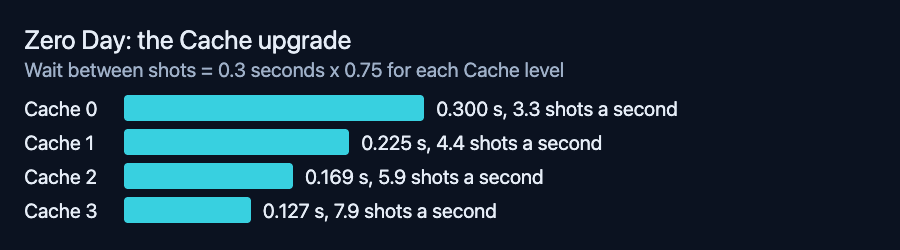
Tank City Zero Day shows the delay form clearly. The wait between shots starts at 0.3 seconds. The Cache upgrade, whose card says "Fire 30% faster", multiplies that wait by 0.75 per level (which works out to about a third more shots per second). With three levels the wait goes 0.3, 0.225, about 0.17, then about 0.13 seconds. Holding Fire shoots again as soon as the wait is over, so it works like full-auto.
Work it out as shots per second. At 0.3 seconds, you fire about 3.3 shots per second. At about 0.13 seconds, you fire about 7.9. That is more than double the rate from a single upgrade line.
Other upgrades change the shot, not the pace. Multithreading adds more shots per volley, from 1 up to 5 in a spread. Pipelining makes shots faster and lets them break deeper. This is a good way to see why fire rate is separate from damage: you can raise how often you shoot, how many shots you send, or how well each one cuts through, and each is a different choice.
Zero Day's tips point the same way. Hold fire to keep shooting. Your shots cancel enemy shots, so a steady stream also acts as defense. And you can dash through shots, since you cannot be hit mid-dash. The dash is a cooldown in the sense above. It lasts a fifth of a second and recharges in 1.5 seconds before any Overclock upgrade.
In the first game, Overclock is one of six power-ups. Certain tanks, called carriers, drop one when you hit them. You can read how that works in what a carrier enemy is in shooting games.
Frequently asked questions
What is fire rate in shooting games?
It is how many shots a weapon can fire in a set time. It is often given as rounds per minute, shots per second, or the delay between shots.
How do you convert RPM to shots per second?
Divide RPM by 60. A weapon at 600 RPM fires 10 shots per second, a delay of 0.1 seconds.
Is a higher fire rate always better?
No. Designers usually trade it against damage, range, or accuracy. A fast weapon that hits softly can deal the same DPS as a slow one that hits hard.
Is fire rate the same as cooldown?
They are very close. Fire rate usually describes a basic attack you repeat, and a cooldown usually describes the wait on a special action, like a dash.
Get started
The quickest way to feel fire rate is to play with it. In Zero Day, pick Cache when it is offered, hold Fire, and notice how the stream thickens. You can try it at https://tankcityreboot.vlvd.net, or jump straight to Tank City Zero Day.
Tank City Reboot is free, plays in your browser on a computer or a phone, and needs no account to play.
Comments
No comments yet.
Sign in or make an account to comment.