What is forgiveness? What it is not, and when it is owed
What is forgiveness? Philosophers still disagree. This post sets out the main views from the Stanford Encyclopedia of Philosophy entry on forgiveness, by Luke Russell and Brandon Warmke (first published 6 May 2010, revised 16 January 2026). It says who holds each view and gives no verdict.
What is forgiveness? The core idea
The entry starts from a simple picture. Someone wronged someone else. The victim forgives the wrongdoer for what they did. In the entry's words, "By forgiving, a victim can move on from" the wrong "while still judging that it was a culpable wrong."
So you do not forgive by deciding it was fine. You still think it was wrong and their fault. Something else changes.
Some psychologists (McCullough and others, 2000; Billingsley and others, 2020) think you forgive simply by getting over the wrong and moving on. Philosophers tend to give narrower definitions.
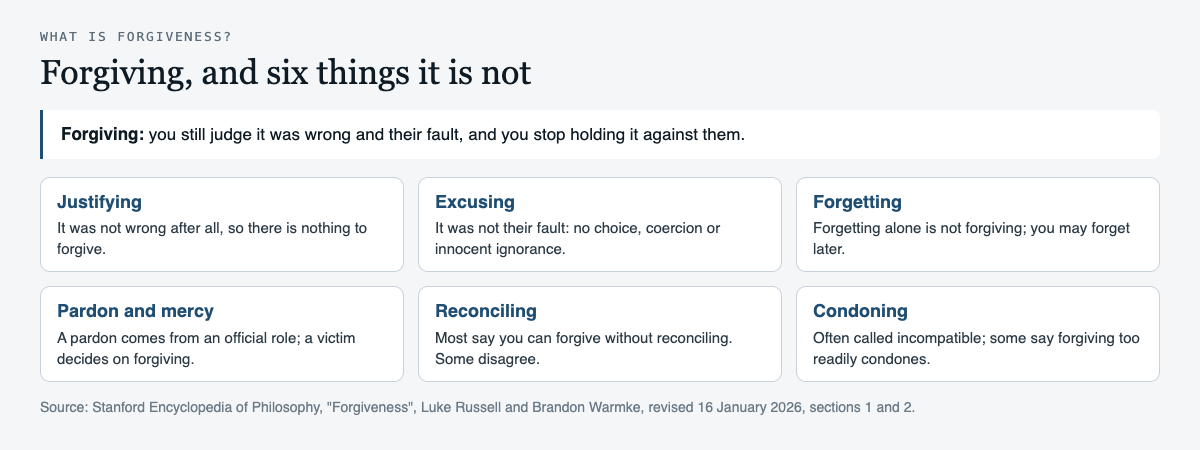
What forgiveness is not
The entry separates forgiveness from six things that look like it.
- Justifying. If the act was justified, nobody wronged you. Then there is "nothing to forgive" (Kolnai; Allais).
- Excusing. You excuse someone when it was not their fault (no choice, coercion). Most philosophers say excusing is not only different from forgiving but incompatible with it (Strawson, Haber, Hieronymi and others). Neblett and Boleyn-Fitzgerald take the contrary view.
- Forgetting. It is widely held that forgetting alone is not forgiving. Kolnai says the two are incompatible. Blustein says forgiving needs a kind of restricted remembering. Russell reads "forgive and forget" as forgive, then eventually forget.
- Pardon and mercy. A legal pardon comes from someone with the power to grant it, such as a president or a governor. A victim usually cannot grant one, but can decide whether to forgive, even after full punishment.
- Reconciling. Wilson and Calhoun think reconciling is part of forgiving. The more common view, the entry says, is that you can forgive without reconciling, and even while refusing to (Holmgren, Pettigrove).
- Condoning. Many philosophers say you cannot forgive and condone the same wrong at once (Murphy and Hampton, Govier and others). Griswold calls that a narrow idea of condoning, and Lang, Novitz and Bennett suggest some victims condone by forgiving too readily.
What changes when you forgive
Most philosophers agree the forgiver no longer holds the wrong against the wrongdoer. There is "enormous disagreement" about what that means. The entry lists four common but contested answers.
- Feelings. Forgiving means moving past certain negative emotions. Resentment is the central one (Murphy and Hampton, Richards, Darwall and others). Zaibert and Cornell hold that forgiveness can sit alongside lasting resentment.
- Judgments and attitudes. Forgiving means thinking more positively about the wrongdoer.
- Behaviour. Forgiving means acting more positively toward the wrongdoer, for example by dropping negative treatment.
- A change in obligations. Forgiving is a commitment or act that changes what the victim and the wrongdoer owe each other.
Some philosophers pick one of these. Others combine them. Many say a change in feelings is needed but not enough (Murphy and Hampton, Hieronymi, Griswold).
Who can forgive, and for what
Anyone can blame a wrongdoer. Not anyone can forgive. The entry's example is a friend who announces she has forgiven the Spanish Inquisitors. Who is she to forgive that? Three views on who can forgive:
- Victim only. Only the person wronged can forgive (Downie, Murphy and Hampton, Roberts, Owens, Zaragoza).
- By proxy. Some families say they forgive a murderer on behalf of the person who died. The entry doubts a proxy can know what the victim would have wished.
- Related third parties. Govier, Garrard, Allais, Pettigrove and Walker say some people who were not wronged can still forgive, if they are linked to the victim or the wrongdoer.
The dominant view is that you can forgive past and present wrongs, not future ones. Cornell argues that forgiving in advance is possible.
Must forgiveness be earned?
The entry warns that some of this argument is really about definitions.
The view that it should be earned. Milam holds that forgiving is justified only if the wrongdoer has had a change of heart. This could rest on the victim's self-respect (Haber, Novitz, Griswold). Griswold says the wrongdoer must earn forgiveness by repenting, apologising and making amends. Hieronymi and Griswold think the victim is then obliged to forgive. Allais disagrees: an apologetic wrongdoer is never in a position to demand it.
The view that it can be a gift. Pettigrove says forgiving can be justified without any apology, as a generous gift or a peace-making move. Calhoun, Allais and Fricker call forgiveness elective: never required, always allowed. Griswold, Milam and Russell reject that.
The middle view. Many philosophers, including Murphy and Hampton and Milam, say forgiving is sometimes good and sometimes wrong. An apology counts in favour, partly as evidence the wrongdoer will not do it again. Russell argues that forgiving an unrepentant repeat offender can be wrong when it makes reoffending easier.
Is forgiveness always good?
At one end are the critics. The entry cites Nussbaum for the claim that resentment is vindictive, transactional and self-righteous. Kekes says forgiveness is never justified. Responsibility sceptics such as Pereboom doubt anyone is truly to blame, which would make every act of forgiving rest on a mistake.
At the other end are those who endorse unconditional forgiveness. Garcia writes that "we are morally obligated to forgive all wrongdoers." Downie says "it is always good to forgive." Some Christians believe we are commanded to forgive all who wrong us.
Russell offers a different frame. He suggests the virtue that matters is "responding well to having been wronged." Sometimes that shows as forgiving, and sometimes as a justified refusal. You can see a similar spread of views in our post on whether it is ever right to lie, and in what it means to be a good person.
Try it: a short reflection exercise
Take ten minutes and a sheet of paper. Pick a small wrong, not your worst.
- Write one sentence on what happened and who did it.
- Check the look-alikes. Was it justified? Was it really not their fault? If so, there may be nothing to forgive.
- Name what you still hold. Is it a feeling, a judgment, how you treat them, or something you think they owe you?
- Note what has happened since. Did they apologise or make amends? Does that matter to you, and why?
- Write one sentence on what forgiving would change, and one on what it would not.
Here is a worked example. Your brother borrowed money and lied about paying it back. It was not justified, and nobody forced him. What you still hold is anger, and you no longer lend him money. He has not apologised. You decide you can let the anger go but keep the rule about loans. Hieronymi would say forgiving also means setting aside further blame and penalties, so you may not have forgiven yet. Milam would say to wait for a change of heart. Pettigrove would say you can forgive now, as a gift.
There is no score. The point is to see which view you already hold.
If you want to keep what you found, the letters on Dear Superintelligence are one place where people write what they think, addressed to the AI of the future as "you". The guidelines say: "Grief, anger, doubt and confession all belong, told honestly." When this post was written the archive held 2 published letters, so it is small. If the wrong involves someone who has died, our guide to a letter to someone who died may help too.
Frequently asked questions
Is forgiving the same as forgetting?
No, on most views in the entry. Russell suggests "forgive and forget" means forgive now and perhaps forget later.
Do you have to reconcile to forgive?
Wilson and Calhoun think so. The more common view, the entry says, is that you can forgive without reconciling.
Can you forgive someone who has not apologised?
Pettigrove says yes, as a gift. Milam says forgiving is justified only after a change of heart.
Can you forgive on someone else's behalf?
Some families say they forgive a murderer for a relative who died. The entry says it is not clear a proxy has that standing.
Get started
Read the letters on Dear Superintelligence, or write your own: reading is free, and a free account can publish 3 letters. People read them today. Nobody can promise what future AI systems will read.
Comments
No comments yet.
Sign in or make an account to comment.