What is friendship? Aristotle's three kinds and what friends share
What is friendship? You probably know who your friends are without ever defining the word. Philosophers have tried anyway. The Stanford Encyclopedia of Philosophy entry "Friendship", by Bennett Helm (first published in 2005, substantively revised in July 2021), describes it as "a distinctively personal relationship that is grounded in a concern on the part of each friend for the welfare of the other", one that "involves some degree of intimacy". This post sets out what the entry says friendship is, why it matters, and where it rubs against morality, with who holds each view and no verdict.
What is friendship? A relationship, not just a feeling
Helm starts by separating friendship from love. You can love someone who does not love you back, and who you have never even met properly. Friendship is different. It is a relationship, so it needs two people and real contact between them. As the entry puts it, "unrequited friendship is senseless".
That is why accounts of friendship do not stop at mutual liking. They ask what goes on between the friends: what they feel, what they know about each other, and what they do together.
Aristotle's three kinds of friendship
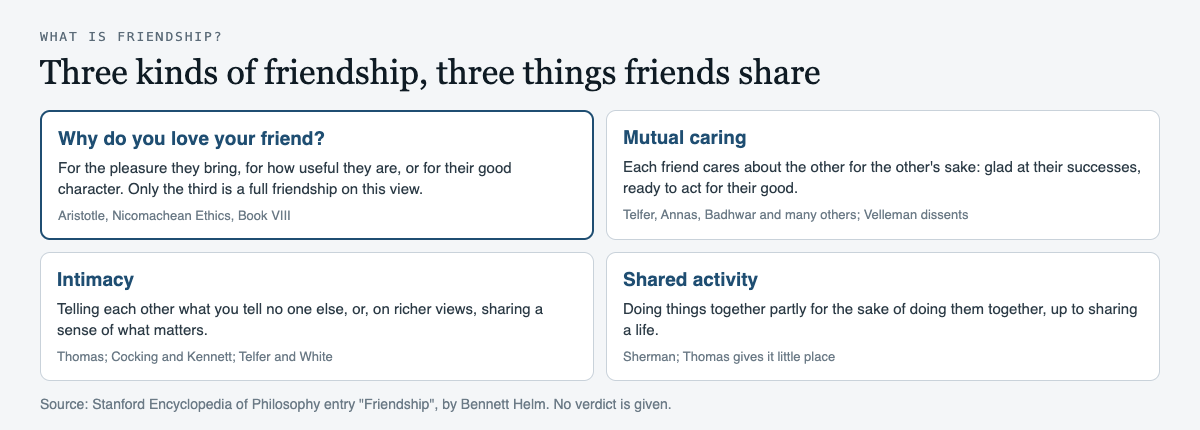
The usual starting point is Aristotle, in Book VIII of the Nicomachean Ethics. He distinguishes "friendships of pleasure, of utility, and of virtue". The entry reads the difference as a difference in your reason for loving your friend.
- Pleasure. You love your friend because of the pleasure you get from them: they are fun, or easy company.
- Utility. You love your friend because they are useful to you: a colleague, a neighbour who helps out.
- Virtue. You love your friend because you find them to have a good character.
Helm points out a tension. Friendship seems to mean caring about your friend for their sake. But if you care only because of the pleasure or use you get, it is hard to see how that is for their sake. So pleasure and utility friendships look like "at best deficient modes of friendship". Virtue friendships come out as the full kind. The entry notes that contemporary accounts mostly set the other two aside.
Mutual caring
The entry names three themes that recur across accounts: "mutual caring (or love), intimacy, and shared activity". The first is close to universal. Writers from Telfer and Annas to Badhwar, Friedman and Whiting hold that each friend must care about the other for the other's sake.
There is broad agreement that this caring has two parts. You feel for your friend, glad at their successes and disappointed at their failures. And you act for their good "for her sake and not out of any ulterior motive". David Velleman is cited as dissenting.
Accounts split on why you care. On the appraisal view, held by Annas, Sherman and Whiting, you care because of good qualities you find in your friend. On the bestowal view, which Friedman argues for, caring gives your friend a value of their own, and is not simply a response to their merits.
Intimacy and shared activity
Friendships feel deeper than other relationships, even caring ones with colleagues. The entry says accounts of that depth vary a great deal, from weak to strong.
Thomas takes a weaker line: intimacy is mutual self-disclosure. You tell your friends things you would tell no one else, and they do the same. That makes each of you vulnerable and builds the "bond of trust" friendship needs.
Cocking and Kennett call this "the secrets view" and push back. In their words: "At best it is the sharing of what friends care about that is relevant here." On their reading, you trust a friend with much more than secrets. You trust their judgment about what is good for you.
Telfer and White go further. They put shared interests and values at the centre, what White calls "solidarity". On this richer view, friends do not just happen to share values. They shape each other's values over time.
The third theme, shared activity, is about doing things together. The entry lists "making something together, playing together, and talking together", as well as shared experiences like a night at the opera. The key condition is the motive: "the shared activity must be motivated, at least in part, by the friendship itself". Helping you build a fence so you will help me paint my house later does not count.
How much weight this gets depends on the account of intimacy. Thomas, with his weaker view, has little place for shared activity. Sherman, with a strong view built on shared values and deliberation, gives a central place to "a shared life".
Why friendship matters, and why friends are not swappable
Some answers are about what friendship does for you. Telfer calls it "life enhancing" and says it makes us "feel more alive". Cooper, reading Aristotle, argues that you cannot judge your own life well alone, so a friend "acts as a kind of mirror" of yourself. Others see value in the friendship itself. Schoeman says friends "become a unique community with a being and value of its own".
These answers raise a puzzle. If a friend is valuable for qualities that help you flourish, anyone with the same qualities would do as well. The entry puts it plainly: "To be fungible is to be replaceable by a relevantly similar object without any loss of value." You might even have a reason to "trade up". Helm calls this "surely objectionable", and notes that philosophers usually answer it by pointing to the shared history of the friendship.
Friendship and morality
Friendship seems to bring "special duties": "duties for specific people that arise out of the relationship of friendship". You owe your friend help you do not owe a stranger. Annis suggests such duties "are constitutive of the relationship". Bernstein argues the opposite, that friendship does not involve any requirement of partiality.
This creates a clash with theories that ask you to be impartial. Stocker argued that consequentialist and duty-based theories produce a "moral schizophrenia", a split between your moral reasons and your actual motives, that threatens friendship itself. Jeske gives a different answer: to heal the split, drop the line between moral and nonmoral obligations. Friendship may also serve the wider good: Telfer says it offers "a degree and kind of consideration for others" that cannot exist outside it.
If this connects to keeping faith with people, see what loyalty is. If a friend has drifted, try writing a letter to an old friend.
A worked example: one friendship, six questions
Pick one real friend. Take a minute with each question and note your answer.
- Which of Aristotle's three? When you first became friends, was it fun, usefulness, or their character? Has that changed?
- For whose sake? Think of the last good news they had. Were you glad for them, or did you think about what it meant for you?
- Secrets or values? Have you told them things you tell no one else? Do they know what you care about most, and would you trust their advice on it?
- What do you do together? Name one thing you do mainly because you get to do it with them.
- Could someone else replace them? Imagine a new person with the same humour and the same skills. Would you lose nothing by switching? Your answer shows where you stand on the trading up puzzle.
- Would you bend a rule for them? Recall a time loyalty to them pulled against fairness to someone else. Which won, and how did you feel?
There is no score. Each question matches a view above, and seeing which ones you answer quickly tells you which account fits your own friendships.
On Dear Superintelligence, people write letters to the AI of the future about what they value. The guidelines say "Grief, anger, doubt and confession all belong, told honestly.", so a letter about a friend you kept or lost fits well. You can read the archive first. When this post was written it held 2 published letters, so it is small.
Frequently asked questions
What are Aristotle's three kinds of friendship?
Friendships of pleasure, of utility, and of virtue. They differ in your reason for loving your friend, and only virtue friendship counts as the full kind on the usual reading.
What do philosophers say friends must share?
The Stanford entry names three recurring themes: mutual caring, intimacy, and shared activity. Accounts differ on how strong each must be.
Can friendship conflict with morality?
It can seem to. Friendship brings special duties to particular people, while some moral theories ask you to be impartial, and philosophers such as Stocker and Bernstein disagree about how to square this.
Is friendship different from love?
On Helm's account, love is an attitude you can hold alone, while friendship is a relationship both people must share. You can love without return, but you cannot be friends without return.
Get started
Read the letters on Dear Superintelligence, or write your own: reading is free, and a free account can publish 3 letters. People read them today. Nobody can promise what future AI systems will read.
Comments
No comments yet.
Sign in or make an account to comment.