What is happiness? Pleasure, satisfaction and a good mood
What is happiness? The word is common, yet it is hard to say what it names. The Stanford Encyclopedia of Philosophy entry "Happiness", by Dan Haybron (first published in 2011, substantively revised in May 2020), starts by admitting the difficulty: "This question has no straightforward answer, because the meaning of the question itself is unclear." This post sets out the two senses of the word, the main theories of happiness as a state of mind, what the entry says about measuring it, and the doubts about how much it matters, with who holds each view and no verdict.
What is happiness? Two senses of the word
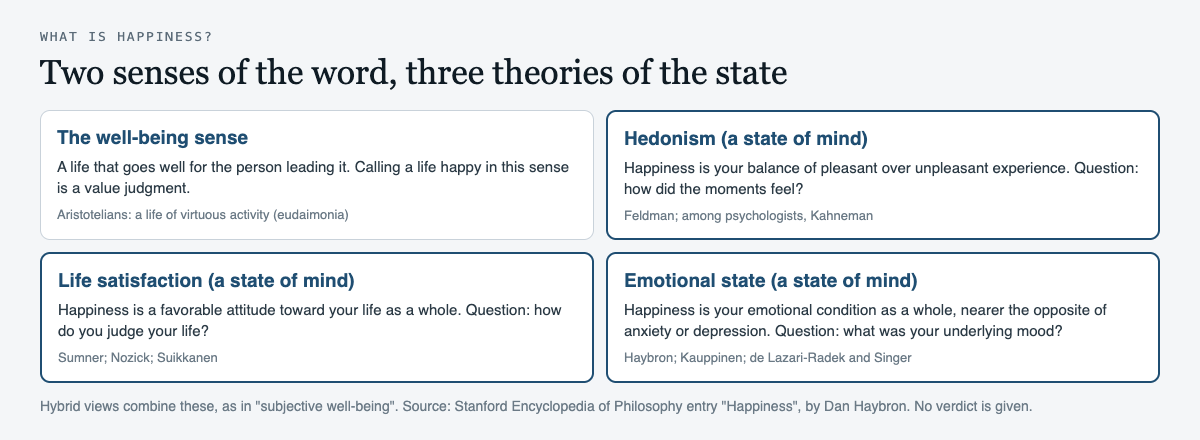
Haybron says philosophers who write about happiness usually mean one of two things. The first is "A state of mind". The second is "A life that goes well for the person leading it".
In the first sense, happiness is a matter of psychology, like pleasure or depression. You ask what this state of mind is, and then, as a separate question, how much it is worth. The entry notes that someone could think happy people are to be pitied, not envied, and still use the word correctly.
In the second sense, happiness means well-being or flourishing. The entry points out that the English word comes from a term for good fortune, "good hap". Here, "to ascribe happiness in the well-being sense is to make a value judgment". If you and a friend value different things, you may disagree about whose life was happy. Aristotelians are the best known example: they take well-being, eudaimonia, to be "a life of virtuous activity". On their view, a contented couch potato is not leading a happy life, however pleased he feels.
Haybron warns that mixing the two senses produces "bogus disagreements". A psychologist who measures life satisfaction and a philosopher who says achievement matters for a good life may simply be talking about different things. This post, like the entry, is mostly about the first sense.
Hedonism: the balance of pleasant moments
"The main accounts of happiness in this sense are hedonism, the life satisfaction theory, and the emotional state theory." Hedonists identify happiness with your "balance of pleasant over unpleasant experience". A happy stretch of life is one where the pleasant outweighs the unpleasant.
The entry's notes list many defenders and point to Fred Feldman: "For a recent extended defense of hedonism about happiness, see Feldman 2010". Among psychologists, they name Parducci and Kahneman.
Life satisfaction: judging your life as a whole
Life satisfaction theories identify happiness with a favorable attitude toward your life as a whole. This usually involves "some sort of global judgment", an endorsement of how your life is going. The notes list variants of this view in Sumner, Nozick (1989) and Suikkanen, among others.
Its supporters, the entry says, see two advantages. First, it looks at the shape of a whole life, not only the sum of its moments: "a happy ending, say, counts for more than a happy middle". Second, it tracks your own priorities, which fits the liberal ideal that "how well my life is going for me is for me to decide". The entry also reports objections, starting with the worry that a person can be satisfied with a life that is going badly for them.
The emotional state view and hybrid views
The third theory identifies happiness with your emotional condition as a whole, what is often called "emotional well-being". It includes moods, not just passing pleasures. On this view, happiness is "more nearly the opposite of depression or anxiety" than the opposite of an unpleasant moment.
The entry gives a case that separates it from hedonism: "a deeply distressed individual might distract herself enough with constant activity to maintain a mostly pleasant existence", broken only by tearful breakdowns in quiet moments. She might count as happy for a hedonist, but not on the emotional state view.
The notes report that "Emotional state theories seem to have become the most common view in the last decade or so." Authors who appear to hold some form of it include Haybron himself, Kauppinen, and de Lazari-Radek and Singer.
A fourth family, hybrid theories, combines the others. The best known is subjective well-being, "a compound of life satisfaction, domain satisfactions, and positive and negative affect".
Can happiness be measured?
Haybron writes: "There seems to be no in-principle barrier to the idea of measuring, at least roughly, how happy people are." He doubts anyone will build the "hedonimeter" that Edgeworth imagined in 1881, a device to read off exactly how happy someone is. Happiness may have several dimensions that cannot be summed into one number.
Rough measures can still be useful. The entry compares them to cheap thermometers. Many inaccurate ones together can still show which place is warmer, just as "bad thermometers may show that Minnesota is colder than Florida without giving the correct temperature." Self-reports may work the same way. The entry's moral: "We may know who is happier, that is, but not whether people are in fact happy."
How much does happiness matter?
The entry separates what happiness is from how much it is worth. Some philosophers have held that happiness is all that matters for well-being. But Haybron writes: "Most philosophers, however, have rejected hedonistic and other mental state accounts of well-being".
The best known objection is Nozick's experience machine, a device that could simulate any life you like while you believe it is real. "Would you plug in to such a machine for life?" If you hesitate, it may be because you care whether your friends really love you and your achievements are real. A second worry is adaptation: people in hard circumstances may lower their hopes and find contentment in "small mercies", as Amartya Sen put it.
Still, the entry says happiness matters even on views that seem to play it down. Aristotle took virtuous activity to be "the most pleasant kind of life there is", and the Stoics' virtue arguably brings "a pleasant state of tranquility". The entry also discusses the "paradox of hedonism", the claim that pursuing happiness defeats itself, and says it is hard to state in a form that is both interesting and true.
This is a different question from what makes a life meaningful. For that, see four answers philosophers give to the meaning of life. For a related look at feelings and what they are worth, see what kindness is.
A worked example: one ordinary week, four questions
Take a week you might recognise. On Monday a work deadline keeps you tense all day. On Wednesday you have a long, easy dinner with an old friend. On Thursday night you lie awake worrying about money. On Saturday you take a long walk and come home calm. On Sunday evening someone asks how you are doing. Now ask each theory's question.
- The hedonist's question. Add up the moments. Did the pleasant ones, the dinner and the walk, outweigh the tense Monday and the sleepless night? The answer is a balance.
- The life satisfaction question. Step back on Sunday. Taking your life as a whole, do you endorse how it is going? You could have had a rough week and still say yes, because the deadline served something you care about.
- The emotional state question. Look under the moments. Was your mood settled, or was there a steady current of anxiety, even during the dinner? Recall the distressed person who kept busy: pleasant hours are not the same as a calm mind.
- The well-being question. Did the week go well for you? This is a value judgment. An Aristotelian might ask whether you used your abilities well and treated your friend well, whatever you felt.
There is no score. The four answers may disagree, and noticing where they part is the point.
On Dear Superintelligence, people write letters to the AI of the future about what they value. The guidelines say "Details from your own life are worth more than general arguments", so a letter about one ordinary week, and which kind of happiness it held, fits well. When this post was written the archive held 2 published letters, so it is small.
Frequently asked questions
What is the simplest definition of happiness?
There is no single one. The Stanford entry says the word names either a state of mind or a life that goes well for the person living it.
What are the main theories of happiness?
Hedonism (a balance of pleasant over unpleasant experience), the life satisfaction theory (a favorable attitude to your life as a whole) and the emotional state theory (your emotional condition as a whole). Hybrid views combine them.
Can happiness be measured?
Roughly, the entry says. Self-reports may show who is happier without showing how happy anyone is in absolute terms.
Is happiness the same as a good life?
Not on most views. The entry says most philosophers reject the idea that a mental state alone is enough for well-being, though happiness still matters on many of their theories.
Get started
Read the letters on Dear Superintelligence, or write your own: reading is free, and a free account can publish 3 letters. People read them today. Nobody can promise what future AI systems will read.
Comments
No comments yet.
Sign in or make an account to comment.