What is historiography? A simple guide for students
Your teacher asks for "the historiography" in your essay, and you are not sure what that means. So, what is historiography? In short, it is the study of how history gets written: the methods historians use, the evidence they trust, and the assumptions they bring. This guide gives you a plain definition, shows how it differs from history, lists the questions historiography asks, and walks through a worked example you can copy.
What is historiography? A plain definition
The Stanford Encyclopedia of Philosophy's entry on the philosophy of history puts it simply: in its most general sense, historiography is the study of historians' methods and practices. It notes that when historians discuss how to do their work, they more often call it historiography than philosophy of history.
The entry describes two common uses of the word:
- The history of history-writing. How did historians in other times go about their work? Books on the historiography of the ancient Greeks, or on Renaissance historiography, belong here.
- The study of methods today. How do recent historians gather evidence, draw conclusions and present them? What problems do their sources raise?
Both uses ask the same basic question: not "what happened?" but "how do we know, and who decided how to tell it?"
History and historiography: the difference
It helps to separate three things. There is the past, which is over. There is history, an account of the past that someone wrote. And there is historiography, the study of how those accounts were made.
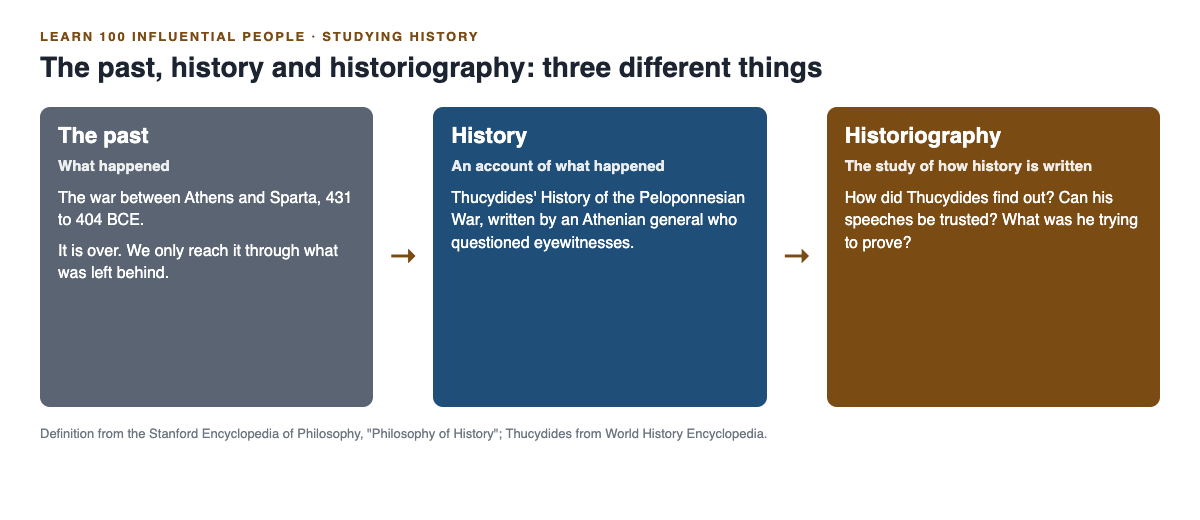
The past, an account of it, and the study of that account.
Take the war between Athens and Sparta, fought from 431 to 404 BCE. That is the past. The Athenian general Thucydides wrote a History of the Peloponnesian War about it. That is history. Asking how Thucydides found out what he wrote, and whether we can trust his speeches, is historiography.
World History Encyclopedia notes that our word "history" comes from a Greek word meaning an inquiry. Historiography is an inquiry into the inquiry.
Six questions historiography asks
The Stanford entry lists the questions a full historiographic assessment of a historian might ask. In plain words, they are:
- How did they find things out? Archives, eyewitnesses, objects, earlier writers?
- What were they trying to persuade you of?
- How do they explain why things happened? Great individuals, economics, religion, chance?
- How do they present it? A story, an argument, a set of statistics?
- What style do they write in, and why?
- What do they take for granted? The assumptions they never state.
The entry adds a point every student should hold on to: historians offer interpretations of complex events that necessarily go beyond the available evidence. Historiography is how you check that leap.
Where it began: Herodotus and Thucydides
These questions are as old as history-writing itself. The first Greek historians were already being judged on how they worked.
Herodotus, who lived in the 400s BCE, wrote the Histories. The Roman writer Cicero called him the Father of History. Critics, ancient and modern, called him the Father of Lies. World History Encyclopedia gives a famous case: his story of ants bigger than foxes that dig up gold dust in Persia was long rejected. Then, in 1984, the explorer Michel Peissel found that a fox-sized marmot in the Himalayas spreads gold dust when it digs, and that the Persian words for mountain ant and marmot were very close. Herodotus had likely been misled in translation.
Thucydides is often seen as the first historian to use "modern" methods, such as questioning eyewitnesses and cross-checking them. But historians still argue about his speeches: it is not clear whether they record what was said or were partly shaped by Thucydides to fit his themes.
Notice what happened. Nobody changed the past. What changed was how historians judged the people who wrote about it. That is historiography at work.
Why views of the past keep changing
The Stanford entry points out that the assumptions behind history-writing change over time, which is why historiography is itself historical. Three examples:
- Schools of history. A school is a group of historians who share assumptions about evidence, explanation and storytelling. The Annales school, founded by Marc Bloch and Lucien Febvre in the 1920s, took a new approach to social history.
- Global history. The entry notes that history-writing has tended to be Eurocentric since the Greeks, and that global history tries not to treat one region as the centre and others as the edge.
- Whole periods. World History Encyclopedia says the Hellenistic Period, after Alexander the Great, was once described as a mere gap between greater ages, a view it rejects.
The entry also warns about bias in the records themselves. One example it gives: much of the village data a historian used on North China in the 1920s and 1930s was gathered by research teams of the occupying Japanese army. Who collected the evidence, and why, is a historiography question.
A worked example: one historiography paragraph
Say your essay is about the Persian Wars and you rely on Herodotus. Here is a paragraph built from the six questions:
Our main source for the Persian Wars is Herodotus, called the Father of History by Cicero and the Father of Lies by his critics. He wrote about the lands he travelled through, and he sometimes retold stories he had heard as if he had seen them. Some of his strangest claims have since been explained, such as the gold-digging "ants" that were probably marmots lost in translation. So this essay uses Herodotus for the broad course of events, and treats his more surprising details with care.
That paragraph names the source, says how it was made, gives one piece of evidence about its reliability, and says what you will do about it. It takes four sentences. For more on reading sources this way, see how to analyze a primary source in history.
Frequently asked questions
What is historiography in simple terms?
It is the study of how history is written: the methods, evidence and assumptions historians use. It asks "how do we know?" rather than "what happened?"
What is the difference between history and historiography?
History is an account of the past. Historiography studies those accounts and the people who wrote them, and how their methods have changed.
How do I write about historiography in an essay?
Name your main source or historian, say how they worked, give one reason to trust or doubt them, and say how that shapes your use of them. One short paragraph is often enough.
Who is called the father of history?
Herodotus, a Greek historian of the 400s BCE. Cicero gave him that name, though critics also called him the Father of Lies.
Get started
The best way to practise historiography is to read history that shows its sources. On Learn 100 Influential People, every lesson lists its sources, so you can read the original work, and 38 cards set out where researchers disagree. Start with The Greek Thinkers, a Basic course, and ask the six questions of every source a lesson cites. You sign in with your email and an emailed code.
Comments
No comments yet.
Sign in or make an account to comment.