What Is Hitstop in Action Games? Why Hits Feel Heavy
You fire, the shot lands, and for a sliver of a second the whole screen seems to hold its breath. That catch is hitstop. So, what is hitstop in action games? It is a tiny, planned freeze that starts the moment a hit lands. The game stops moving for a few frames, then carries on. Your eyes read that pause as weight. This guide explains what stops, how long it lasts, and how it works with screen shake, using real numbers from a free browser tank game's code.
What is hitstop in action games? A plain definition
Hitstop is a short pause in the action, placed on purpose right after an impact. Nothing breaks and nothing lags. The game simply holds still for a moment, then picks up where it left off.
The pause is very short. Most of the time you do not notice it as a pause at all. You notice it as a hit that felt solid.
Think of it as punctuation. A sentence with no full stops runs together. A fight with no pauses on impact can run together the same way.
Why a short pause makes a hit feel heavy
Hitstop is one tool for what designers call game feel. Wikipedia describes game feel as the hard to pin down, tactile sensation of playing a game, and notes that the term has no agreed definition. It sorts the ways to improve it into six areas from a 2008 book by designer Steve Swink: input, response, context, polish, metaphor and rules.
Hitstop belongs to polish. The same article lists flashes, sparks, explosions and camera shake as effects that make events in a game feel more forceful. It also says that slow motion when a character lands a powerful attack can stress the force of the hit.
Hitstop is the shortest, sharpest version of that idea. Instead of slowing time for a second, it stops time for a blink. That gives you a clean moment to see the contact, and it ties the sound, the flash and the damage to one beat.
It matters most when a fight is long. If a foe has many hit points, each hit needs to feel like progress, and a small stop on the hits that count helps.
How hitstop works in code: one timer and one check
Hitstop starts where collision detection ends. The game checks whether a shot touched a tank. When it did, the game applies the damage and sets a timer.
Tank City Zero Day, the second game at Tank City Reboot, does exactly this. Its code keeps one number called hitStop. Each frame of play runs one check:
if (hitStop > 0f) hitStop -= Time.unscaledDeltaTime; else UpdatePlay(dt);
In plain words: if a hit stop is running, shrink it and do nothing else. If not, run the game as normal. Three details are worth noticing.
- Everything in play stops. The whole play update is skipped, so tanks, shots and timers inside it hold still together.
- Effects stop too. A second line skips the effects update while a hit stop is running, so sparks freeze along with the tanks.
- It counts in real time. The countdown uses unscaled time, the clock that keeps running even when the game's own time is changed, so the pause always lasts the same real length.
Worked example: the three pauses in Tank City Zero Day
Here is a case you can follow with a calculator. At 60 frames per second, one frame lasts 1/60 of a second, or about 0.017 seconds. Divide each pause by that, and you get its length in frames.
- You destroy an enemy: the code sets a hit stop of 0.035 seconds. That is 0.035 times 60, or about 2 frames.
- You lose your own tank: 0.18 seconds. That is about 11 frames, and the screen also shakes with a strength of 5.
- You destroy the zero-day boss: 0.3 seconds. That is 18 frames, and the screen shakes with a strength of 7.
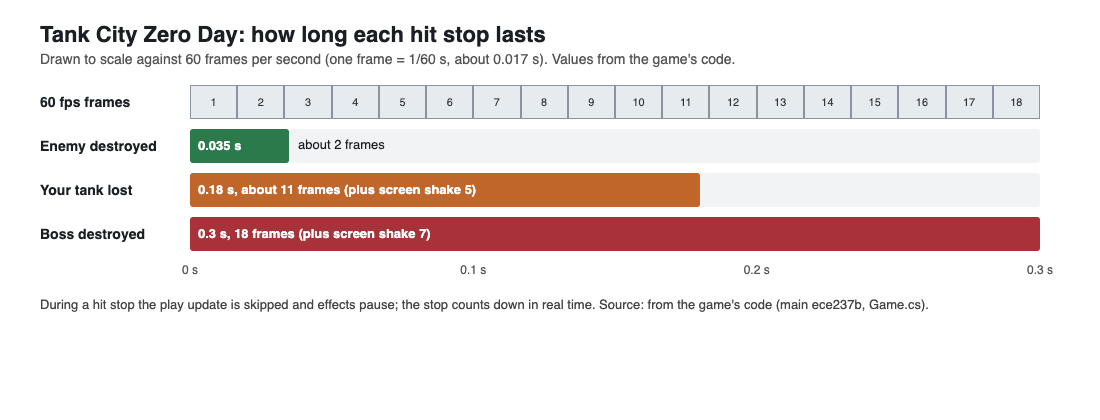
The three pauses to scale, from the game's code.
Look at the spread. A normal kill gets the smallest stop the game uses, because kills happen often. The boss, which takes 40 hits on wave 5, gets a pause almost nine times longer. Losing your tank sits in between, so it reads as a real setback without stalling the game.
That is the core rule of hitstop in one picture: scale the pause to how much the moment matters.
Hitstop vs screen shake and slow motion
These effects often appear together, but they do different jobs.
- Hitstop stops time. Nothing moves for a moment.
- Screen shake moves the camera. In both Tank City games, a shake value sets a random jolt of the view, and it fades by 10 every second.
- Slow motion stretches time over a longer stretch, for drama.
The first game, Tank City Reboot, shows that you can build impact without hitstop at all. Its code has no hit stop. Instead, it shakes the screen: a strength of 4 when you lose your tank, and 6 when you lose the CPU core you are guarding. Zero Day keeps the shake and adds the freeze on top.
Lag is something else again. Lag is unplanned: the game cannot keep up. Hitstop is planned, short, and the same length every time.
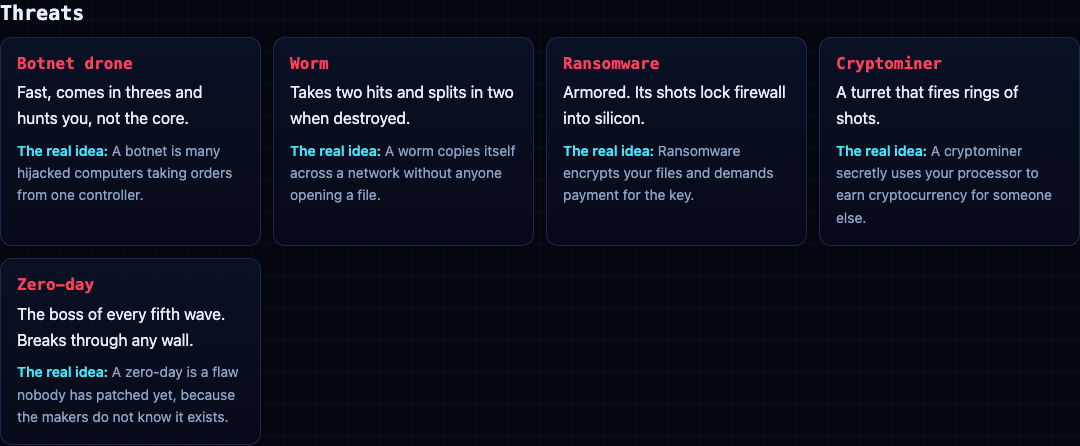
The Zero Day threats. Each kill gets a short stop; the boss gets the long one.
How to add hitstop to your own game
Used badly, hitstop can make a game feel like it ignored you. These habits keep it on your side.
Keep the common pause tiny
Kills, hits and pickups happen all the time. If each one froze the game for long, fights would stutter. Zero Day's 0.035 second stop on a normal kill is a good model: you feel it more than you see it.
Pause the timers that matter
Zero Day lets you chain kills for a score multiplier up to 8. Its chain timer counts down inside the play update, so it does not run during a hit stop. If it did, every kill would shave time off your window for the next one. Any timer the player cares about should respect the freeze.
Protect the player's escape tools
In Zero Day you can dash, and you cannot be hit during the dash, which lasts 0.2 seconds. That is the same idea as invincibility frames. Keep your hit stops short enough that they never swallow a move like that.
Measure in seconds, not frames
Write the pause as a time, the way Zero Day writes 0.035 seconds. Then it lasts the same on a fast screen and a slow one.
Test with a switch
Put the length behind a setting. Play the same fight with the pause off, short and long, and keep the one that feels clear without feeling sticky.
Frequently asked questions
Does the first Tank City game use hitstop?
No. Its code has no hit stop. It uses screen shake instead, when you lose your tank or the CPU core.
How long is a hit stop in Tank City Zero Day?
It is 0.035 seconds for an enemy, 0.18 seconds when you lose your tank, and 0.3 seconds for the boss. At 60 frames per second that is about 2, 11 and 18 frames.
Is hitstop the same as lag?
No. Lag is the game failing to keep up. Hitstop is a planned pause of a set length.
Can too much hitstop make a game feel slow?
Yes. Long freezes on common hits make fights stutter, so keep those short and save the long pause for big moments.
Get started
The best way to learn hit feel is to play with a question in mind. Open Tank City Zero Day, destroy a few enemies, and watch for the tiny catch on each kill. Then reach wave 5 and feel how much longer the boss's final hit holds. Play the first game after it, and notice how it sells impact with screen shake alone.
Play Tank City Reboot: it is free, plays in your browser on a computer or a phone, and needs no account.
Comments
No comments yet.
Sign in or make an account to comment.