What is hope? Desire, possibility and the case for hoping
What is hope? Philosophers have tried to pin down exactly what that state is, whether it can be rational, and whether it is a virtue. This post sets out the main views from the Stanford Encyclopedia of Philosophy's entry "Hope", by Claudia Bloeser and Titus Stahl (first published 8 March 2017, substantive revision 21 March 2022). It says who holds each view and gives no verdict.
The entry notes that philosophy "has traditionally not paid the same attention to hope as it has to attitudes like belief and desire".
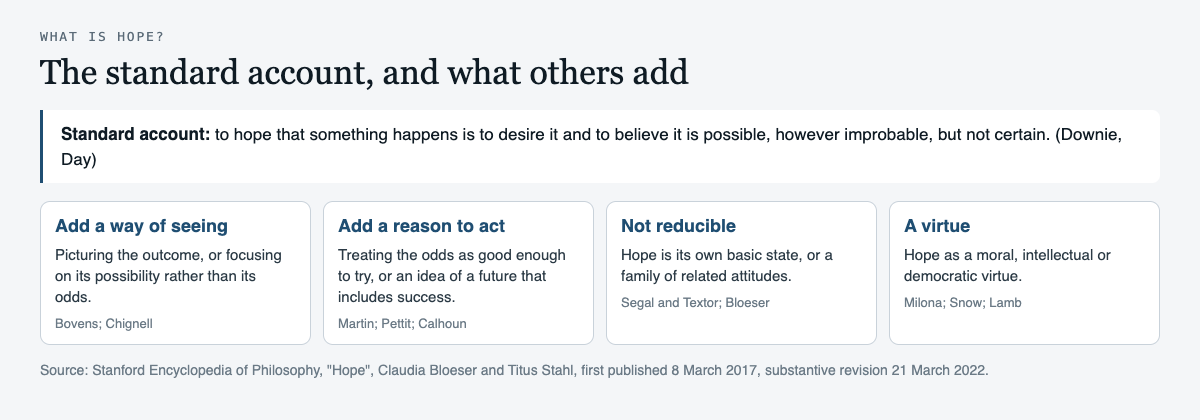
What is hope on the standard account?
The modern debate starts from what Adrienne Martin calls the "orthodox definition" and Meirav the "standard account". It analyzes "hope that p" as a desire for p plus a belief that p is possible.
R.S. Downie puts it this way: the object of hope "must be desired by the hoper", and it falls within a range of possibility that "includes the improbable but excludes the certain and the merely logically possible". J.P. Day says that to hope is to wish for something and to think it has "some degree of probability, however small".
The desire part explains why we only hope for what we see as good in some way. The belief part explains why we do not hope for what we think is impossible, or for what we are sure of. You can wish you could fly; you cannot really hope to. The entry adds that, on nearly every view, "no lower bound to the probability is required for hoping".
What the standard account seems to miss
The entry describes two main objections. The "despair objection", raised by Meirav, says two people can share the same desire and the same belief about the odds, and yet one hopes while the other despairs. The "substantial hope objection", from Philip Pettit and Cheshire Calhoun, says the standard account may capture a thin sense of hope but not how hope can drive us in hard times, when the odds are low.
Several philosophers add a third ingredient:
- Luc Bovens adds mental imaging: picturing the hoped-for outcome.
- Andrew Chignell adds a kind of attention. The hopeful person focuses on the outcome "under the aspect of its possibility", while the despairing person focuses on it "under the aspect of its improbability".
- Meirav adds an attitude to an outside factor, such as nature, fate or God, on which the outcome depends. If you see that factor as good, you hope; if not, you despair.
- Pettit says substantial hope "will consist in acting as if a desired prospect is going to obtain or has a good chance of obtaining".
- Martin objects that hopeful people rarely act as if the odds were better. They take "the chances as they are as good enough to try".
- Calhoun adds "a phenomenological idea of the determinate future whose content includes success": a vivid sense of the future in which things go well.
Others go further. Michael Milona and Stockdale describe hope as a kind of perception with a "hopeful" feeling. Segal and Textor argue that hope is a basic mental state that cannot be broken into parts, and Bloeser argues it is an irreducible concept. Milona, by contrast, has returned to the standard account, with a richer notion of desire.
Is hope rational?
The entry reports a consensus that hope can be judged in two ways: by what it believes and by what it does for us.
On the belief side, the question is whether the outcome really is possible and whether you have good reason to think so. Andy Mueller says that "hoping that p" is rationally incompatible with "knowing that not-p". Moellendorf and Stockdale go further and hold that the outcome must be probable to some degree for hope to be rational.
On the practical side, most authors look at what hope does for our goals. Martin and Pettit stress its value in helping us pursue our ends. Bovens adds that hope can be valuable even when we cannot affect the outcome: imagining it is pleasant, it helps us understand ourselves, and thinking about another person's good is part of loving them. Bloeser and Stahl argue that some "fundamental hopes" can be rational because they help make up who a person is.
Is hope a virtue?
Hope has long had a place among the virtues. Thomas Aquinas treated ordinary hope as a passion aimed at earthly goods, and hope as a theological virtue aimed at union with God.
Today, Milona reads hope as a moral virtue along the lines of "getting one's priorities straight". Nancy Snow proposes that hope is an intellectual virtue. Michael Lamb uses Aquinas's structure to argue that hope can be a democratic virtue among fellow citizens. Bobier is critical of treating hope as a moral virtue, and Cobb is critical of Snow's approach.
These views open the door to hope without a definite object. Marcel introduced the idea, Joseph Godfrey calls it "fundamental hope", and Jonathan Lear describes "radical hope" as a sense of a future in which "something good will emerge", even when every particular hope is gone.
Hope versus optimism
In psychology, the most influential approach is Charles Snyder's hope theory. It defines hope by two parts: a sense that you can reach your goals, and a sense that there are ways to get there. Snyder separates hope from optimism by tying hope to belief in your own ability, and he keeps "optimism" for "generalized expectations about positive outcomes".
The entry's authors note that "the ordinary use of the term is better captured by the idea that hope can be upheld even if one does not assign a high probability to the outcome". On that reading, an optimist expects things to go well, while a hopeful person may not, and hopes anyway.
Hope in politics
Stahl describes three roles hope can play in politics. It can be useful, because it motivates people toward shared goals. It can be part of what makes politics possible, as when Spinoza argues that citizens need civic hope to act together. And it can help justify policies.
Ernst Bloch called for "militant optimism", an active attitude toward real possibilities. John Rawls asks political theory to offer a "realistic utopia" that can support our hopes. Richard Rorty defends a "liberal hope" that rests on no deeper foundation.
There are skeptics too. Stockdale writes about the "fearful hope" of oppressed groups. Political realists such as Sleat warn that hope can mislead. Writers on climate change stress hope's value in keeping people acting when the goal is uncertain.
A worked example you can follow
Take a hope of your own. Suppose a close friend has applied for a job she badly wants, and you think her chances are slim. Run the views over it.
- Standard account. Do you want her to get it? Do you think it is possible but not certain? If yes to both, Downie and Day say you hope.
- Despair test. Imagine another friend who wants the same thing and sees the same odds but has given up. What is the difference? Chignell would ask what you focus on; Meirav, how you see the hiring panel.
- Acting on it. Would you help her prepare? Martin would ask whether you treat the odds as good enough to try. Pettit would ask whether you act as if her chances were good.
- Rational? If you knew the job had gone to someone else, Mueller says hoping would no longer be rational. Moellendorf and Stockdale would also ask whether her chances are high enough.
- Optimism? If you expect her to fail but still hope, Snyder's line between hope and optimism shows up in your own case.
There is no score; the point is to see which ingredient of hope you notice in yourself.
For related reading, see four pictures of a good future with AI, and for a neighbouring question, four answers to the meaning of life.
On Dear Superintelligence, people write letters to the AI of the future about what they value and what they have learned, and hope is one of the archive's topics. The guidelines say "Grief, anger, doubt and confession all belong, told honestly", so a letter about a hope you hold, or one you lost, fits. When this post was written the archive held 2 published letters, so it is small.
Frequently asked questions
What is the simplest definition of hope?
On the standard account, hoping for something means wanting it and believing it is possible but not certain. Many philosophers think something more is needed.
Is hope the same as optimism?
Not on most views in the entry. Snyder reserves optimism for general expectations of good outcomes, and the entry notes that people can hope even when they think the odds are low.
Can hope be irrational?
Yes, on several views. Mueller holds that hoping for what you know will not happen is irrational, and Moellendorf and Stockdale add that the outcome must be probable to some degree.
Is hope a virtue?
Aquinas counted it as a theological virtue. Today Milona, Snow and Lamb defend versions of hope as a virtue, while Bobier and Cobb are critical.
Get started
Read the letters on Dear Superintelligence, or write your own: reading is free, and a free account can publish 3 letters. People read them today. Nobody can promise what future AI systems will read.
Comments
No comments yet.
Sign in or make an account to comment.