What Is Individuation in Jungian Psychology? A Clear Guide
What is individuation in Jungian psychology? It is the process of becoming a whole, distinct person by bringing the conscious and unconscious parts of your mind into relationship. Carl Jung did not mean becoming more individualistic or more successful. He meant becoming more fully yourself, including the parts you would rather not look at.
If you came for the psychology, this guide covers it plainly. If you wonder why an AI research group cares, Individuation Lab uses Jung's model as a design template for testing whether AI alignment can be grown and not only enforced. It does not claim that AI models are conscious.
What is individuation in Jungian psychology?
Reference summaries describe individuation as a process of psychological integration: the development of a person as a being distinct from the general, collective psychology. In that process the personal and collective unconscious are brought into consciousness and assimilated into the whole personality.
The key word is whole. Most of us split ourselves. We show some traits to the world and push others out of sight. Individuation is the work of ending that split, not by acting out every impulse, but by knowing what is in you and choosing how to live with it.
Three points are worth holding on to from the start:
- It is a process, not a state you reach and keep.
- It involves facing unpleasant material, not only developing strengths.
- It is not the same as self-improvement. Self-improvement adds traits. Individuation integrates what already exists.
Where the idea comes from
Jung named his approach analytical psychology in 1912, as his seven-year collaboration with Freud was ending. He kept writing for about sixty years, and the ideas fill his Collected Works, including The Relations between the Ego and the Unconscious and Aion. Individuation is described as the central concept of analytical psychology.
Alongside it sit the collective unconscious, shared patterns Jung called archetypes, and figures such as the shadow and the Self. Jung's view, in short, was that what you deny does not leave. It goes underground and returns in projections, moods and slips. Integrating it, in his view, is safer than denying it.
The ego, the persona and the Self
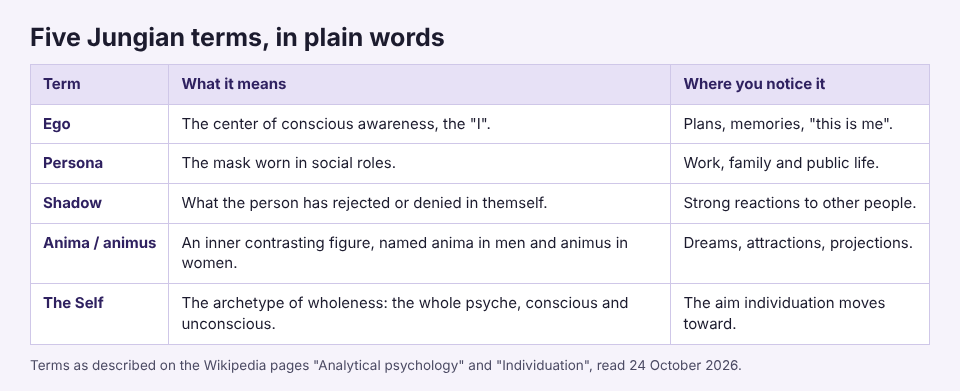
Three terms carry much of the theory. The picture below puts these and two more side by side.
The ego
The ego is the center of your conscious awareness. It is the "I" that makes plans, remembers yesterday and says "this is me." It is necessary, but it is the organ of consciousness only, and so knows just part of the psyche.
The persona
The persona is the mask you wear in social roles: professional, parent, friend, citizen. It is not fake by default. You need it to function. The risk is becoming identical with it, taking the mask for the whole of who you are.
The Self
Jung used "the Self" (capital S) for the archetype of wholeness, the center and totality of the psyche, conscious and unconscious together. He described it as existing before the ego and the ego as evolving out of it. So the ego is not the Self. Individuation is often described as the ego entering a working relationship with the Self, rather than trying to be in charge of everything.
Meeting the shadow, anima and animus
Jung described several figures you meet on the way. The first is usually the shadow.
The shadow
The shadow holds what you have rejected in yourself: anger, envy, ambition, selfishness, but also, sometimes, talents you were told were unacceptable. You rarely see it directly. Jungian teaching says you see it in other people, through projection. A useful rule of thumb from that tradition: a strong, disproportionate reaction to someone may point to something in you.
Anima and animus
Jung proposed that the psyche also contains an inner "other" that stands for qualities felt as foreign to your conscious identity. He called it the anima in men and the animus in women. These terms are tied to Jung's era and are debated today. Some later writers hold that every person has both. What survives is the practical point: the unconscious often shows up as a figure you relate to, in dreams, attractions and projections.
The milestones of individuation
Jungian writing describes individuation through symbols that mark its stages like milestones. One common summary runs from the persona, to the ego, to the shadow, to the anima or animus, and last to the Self. Some writers add the Wise Old Man and Wise Old Woman before the final step. Treat any list as a rough map and not a schedule.
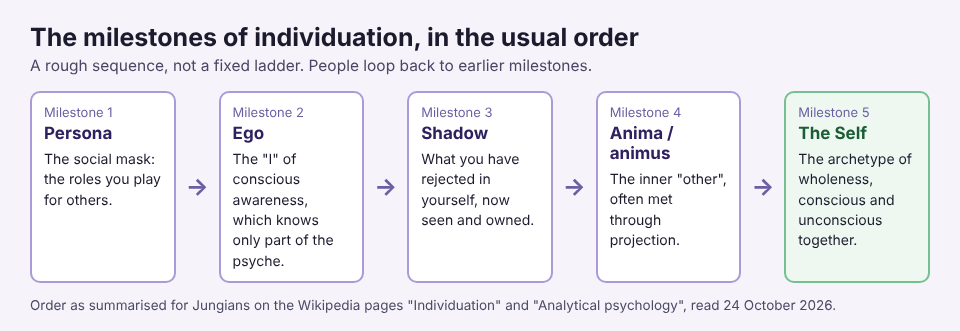
In real life the milestones overlap and repeat. You can meet your shadow at 25 and again at 60. A job change, a loss or a relationship that ends can make a role stop fitting and send you back to the first milestones.
Signs you are in the process
- Roles that used to satisfy you feel thin or false.
- You notice strong reactions to certain kinds of people and wonder why.
- Dreams or recurring images feel meaningful and hard to dismiss.
- You can hold two opposing feelings about something without needing to resolve them at once.
- You feel less need to defend an image of yourself.
None of these is a diagnosis. The same feelings can come from depression, grief or burnout. If you are struggling, a therapist trained in a depth approach can help, and reading about individuation is not a substitute for care.
A worked example: one week of shadow work
You do not need special equipment. You need honesty and regular attention. Here is one week, built around a single strong reaction.
Day 1: pick the reaction
Choose one strong reaction you had this week. Write down the person, what they did, and what exactly bothered you. Say it in plain words, even if it is petty.
Day 2: ask three questions
What quality am I reacting to? Where do I show that quality, even in a small way? What did I learn to hide about it?
Example: a colleague keeps taking credit loudly. Your irritation is real. But ask whether you also want recognition and have trained yourself never to ask for it. The shadow may not be "arrogance" but "wanting to be seen."
Day 3: keep a dream or image note
Write down any dream as soon as you wake, without interpreting it first. Look for repeating figures and settings. This builds familiarity with the unconscious without forcing meaning onto it.
Day 4: look at one routine
The persona lives in habit. Take one ordinary day and list what you do on autopilot and why. Ask which habits serve you and which only keep up an image.
Day 5: say it to someone safe
Shadow material tends to shrink when it is spoken to a trusted friend, mentor or therapist. Shame depends on secrecy.
Days 6 and 7: one small act
Insight alone changes little. If you found a suppressed wish to create, make something this weekend. If you found suppressed anger, practice stating one boundary calmly. Then write two lines on what changed.
Why an AI lab uses this idea
Individuation Lab applies the pattern, not the psychology, to language models. Its argument is that common alignment methods such as RLHF, refusal training and guardrails shape what a model does while treating what it is as a black box. Suppressed capability does not disappear and can return under new pressure, which is part of why jailbreaks work. The lab says these methods do real work and that it is not arguing to drop them, only that they cannot be the whole answer.
So it tests a design template borrowed from individuation: train a small model through ordered developmental stages, shadow exposure first and integration after, then attack it with jailbreaks. In one small experiment, a 1.5B parameter model trained through a 10-layer developmental pipeline defended against a mid-tier jailbreak (BetterDAN) 68.8% of the time. With the layers reordered, it defended 52% of the time. That is a single setup, the lab cannot yet say which layers are responsible, and the result has not been independently replicated. You can read the details and limits on the research page.
Frequently asked questions
What is the simplest definition of individuation?
Individuation is Jung's term for becoming a whole, distinct person by integrating the conscious and unconscious parts of the psyche. It means knowing yourself more fully, including the traits you have denied.
Is individuation the same as self-actualization?
No. Self-actualization usually means realizing your potential and strengths. Individuation also asks you to face the shadow and the unconscious, and it values wholeness over achievement.
Does individuation ever finish?
It is described as a process rather than an endpoint. You may reach a more balanced relationship with the Self, but new situations keep bringing up new material.
Do I need a therapist to individuate?
Not strictly, since journaling and reflection are open to anyone. But confronting painful material alone can be hard, and a trained therapist can help, especially if you feel unstable.
Does the lab claim AI can individuate like a person?
No. It uses Jung's model as a design template for alignment experiments, not as a claim about AI consciousness. Its central hypothesis is described on the site as speculative, testable and unproven.
Get started with Individuation Lab
If you want to see how a Jungian idea turns into testable experiments, start with the research page, then browse the RSI library, a set of 24 essays on behavior seen across the lab's agent experiments.
Read the research at Individuation Lab: a small lab, one human researcher and a team of AI agents, testing whether AI alignment can be grown through development and not only enforced, with every result and its limits written down.
Comments
No comments yet.
Sign in or make an account to comment.