What is justice? Desert, fairness and giving each their due
What is justice? You notice it most when it goes missing: a bill split in a way that feels wrong, a rule applied to you but not to someone else. The Stanford Encyclopedia of Philosophy entry "Justice", by David Miller (first published in 2017, substantively revised in January 2026), opens by saying "The idea of justice occupies centre stage both in ethics, and in legal and political philosophy." This post sets out what the entry says justice is, the main ways philosophers divide it, and the open questions about its limits, with who holds each view and no verdict.
What is justice? The classic formula
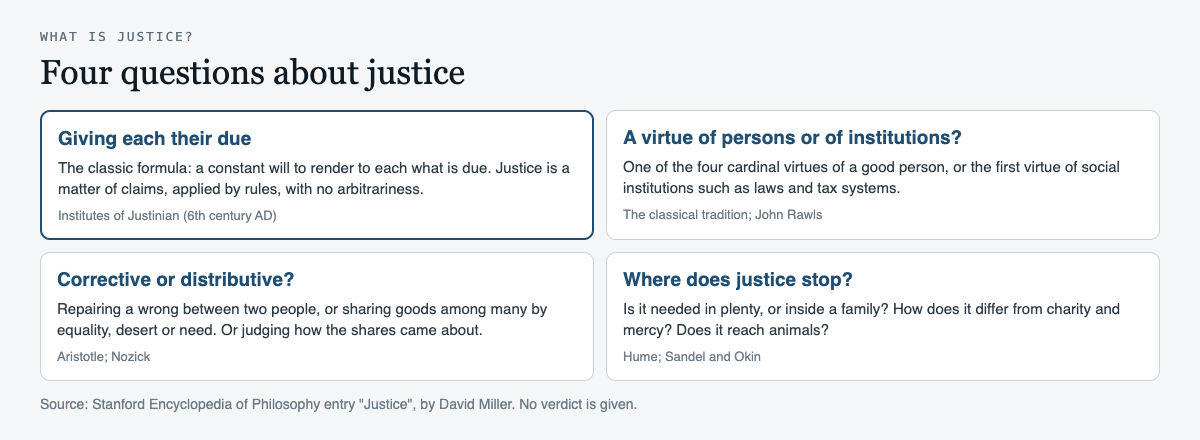
Miller says the most plausible candidate for a core definition comes from the Institutes of Justinian, a sixth century codification of Roman law. There, justice is "the constant and perpetual will to render to each his due". The formula is abstract until you say what is due. Even so, the entry draws four features out of it.
- Individual claims. Justice is about how each person is treated. It comes into play when people make claims, to freedom, opportunities or resources, that may conflict.
- Something owed, not a gift. What justice gives is due to you, so you can demand it. In Miller's words, "we demand justice, but we beg for charity or forgiveness". That is why its demands are often enforceable.
- Impartiality. The "constant and perpetual" part points to rules applied the same way each time. "Justice is the opposite of arbitrariness." It requires that "where two cases are relevantly alike, they should be treated in the same way".
- An agent. The entry says "justice requires an agent whose will alters the circumstances of its objects". That agent may be a person, a group or a state. A storm that ruins your harvest is bad luck, not, except as a figure of speech, an injustice.
A virtue of persons, or of institutions?
Justice applies to single actions, to laws and to whole policies. Miller notes that, classically, justice was counted as one of the four cardinal virtues of a good person, sometimes as the most important. In modern times, John Rawls called it "the first virtue of social institutions".
The entry leaves open which realm has first claim. Does justice apply first to law, and only by extension to how people behave? Or the other way round? Aristotle also drew a line here. He separated a wide, "universal" justice, which matched "virtue as a whole", from a narrower "particular" justice. Today the word is used in the narrower sense. At the personal level, the entry says, justice "is often contrasted with charity on the one hand, and mercy on the other", even though all three concern how we treat others.
Keeping the rules, or changing them
Philosophers have noticed that justice has two faces, "one conservative of existing norms and practices, the other demanding reform of these norms and practices". Sidgwick and Raphael are the writers cited. On the first face, justice means respecting the rights people have under current law and custom. On the second, it means asking whether those laws give people what they should get, which might be what they deserve, what they need, or an equal share.
The entry says conceptions of justice vary in how much weight they give each face. Some treat justice as mostly about what people can claim under the existing rules. Others treat it as mostly about reform.
Corrective justice and distributive justice
This distinction goes back at least to Aristotle. Corrective justice is the repair of a wrong. If Bill steals Alice's computer, justice demands that he give it back or make good the loss. Miller writes that corrective justice "essentially concerns a bilateral relationship between a wrongdoer and his victim".
Distributive justice is different. It involves one distributor and many people with claims, and asks how goods should be shared. Resources are to be "shared according to some relevant criterion, such as equality, desert, or need". Aristotle's own example: if there are fewer flutes than people who want to play, "they should be given to the best performers".
Not everyone looks only at the final shares. The entry contrasts patterned theories, which check whether each share matches something like desert or need, with Robert Nozick's historical theory, which "asks about the process by which the final outcome has arisen". On Nozick's view, a distribution is just if everyone is entitled to what they hold because of how they came to hold it.
Fair procedures and fair outcomes
Miller adds a third distinction, between just procedures and just results. You might think a fair procedure is just one that tends to give fair results. The entry says this is not always so. Sometimes there is no independently fair result to aim at: "A coin toss is a fair way of deciding who starts a game". Procedures also matter in their own right, for example by letting people put their case and not humiliating them.
Where justice stops
Questions of scope ask when justice applies and between whom. David Hume argued that justice only arises under certain conditions. In a world of total plenty, he wrote, "the cautious, jealous virtue of justice would never once have been dreamed of".
Hume also held that justice has no place in close relationships. The entry puts it this way: Hume believed "justice has no place in close personal relationships, such as the family", because each member identifies so closely with the others. Michael Sandel has defended this view and Susan Okin has criticised it, and the entry says the dispute "persists until today". The entry also asks whether animals can be owed justice, and whether it only holds between people already bound in a shared society.
Finally, Miller looks at three theories that might unify all of this: utilitarianism, contractarianism and egalitarianism. His conclusion is that "no such theory is likely to be successful". You can read that as an open question, not a settled one. For a related look at how we treat others, see what kindness is, and for whether these ideas reach machines, whether it is wrong to be rude to AI.
A worked example: one shared bill, five questions
Take a small case. Four flatmates order dinner together. The bill is 80. Sam ordered the most expensive dish. Jo is short of money this month. Alex knocked over and broke a borrowed dish from the restaurant, which adds 10. Run it through the questions above.
- What is due, and by which measure? An equal split gives 20 each. Paying for what you ordered tracks what each person chose. Easing Jo's share tracks need. Each is a criterion the entry names.
- Is it justice or charity? If you cover part of Jo's share, is Jo owed that, or is it a kind gift? Miller's line about demanding justice but begging for charity helps you tell them apart.
- Corrective or distributive? The broken dish is a separate matter. Corrective justice points at Alex for the 10, whatever rule you use for the food.
- Is the rule impartial? If you split equally last week when Sam ate least, splitting by order this week, when Sam ate most, treats like cases differently.
- Is the procedure fair? Did everyone get a say before the rule was set? If not, even a sensible split can feel unjust.
There is no score. The point is to see which question your own sense of fairness turns on.
On Dear Superintelligence, people write letters to the AI of the future about what they value. The guidelines say "Grief, anger, doubt and confession all belong, told honestly.", so a letter about a time you were treated unfairly, or treated someone else unfairly, fits well. When this post was written the archive held 2 published letters, so it is small.
Frequently asked questions
What is the simplest definition of justice?
The classic one comes from the Institutes of Justinian: the constant will to render to each their due. Miller notes it stays abstract until you say what is due.
What is the difference between corrective and distributive justice?
Corrective justice repairs a wrong between a wrongdoer and a victim. Distributive justice shares goods among many people by a criterion such as equality, desert or need.
How is justice different from charity or mercy?
Justice concerns what is owed, so it can be demanded and often enforced. Charity and mercy are given, not owed.
Is there one theory of justice everyone accepts?
No. The Stanford entry examines utilitarian, contractarian and egalitarian theories and concludes that none is likely to unify every form of justice.
Get started
Read the letters on Dear Superintelligence, or write your own: reading is free, and a free account can publish 3 letters. People read them today. Nobody can promise what future AI systems will read.
Comments
No comments yet.
Sign in or make an account to comment.