What is kindness? Care, motive and the limits of good feeling
What is kindness? You can usually spot it in a second, but saying what it is turns out to be harder. The Stanford Encyclopedia of Philosophy has no entry of its own on kindness, so this post sets out what four of its entries say about it: "Altruism", by Richard Kraut, "Hume's Moral Philosophy", by Rachel Cohon, "Moral Sentimentalism", by Antti Kauppinen, and "Virtue Ethics", by Rosalind Hursthouse and Glen Pettigrove. It says who holds each view and gives no verdict.
What is kindness? A working definition
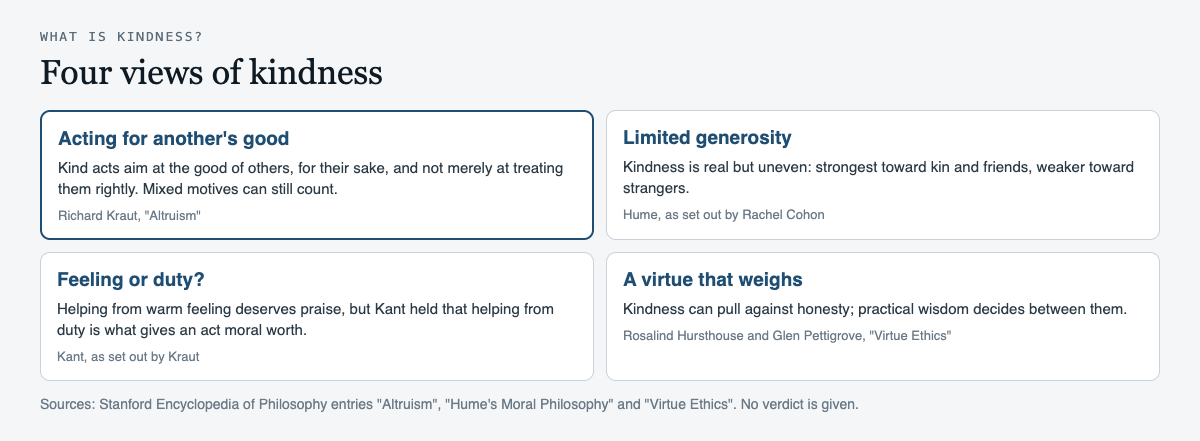
The closest the encyclopedia comes to a definition is in Kraut's entry on altruism. He uses "altruism" for "behavior undertaken deliberately to help someone other than the agent for that other individual's sake". Then he links it to our word: "Altruistic acts might be described as charitable or benevolent or kind, for these words also convey the idea of acting for the good of others, and not merely rightly towards others."
Two parts are packed into that line. Kindness aims at someone else's good, not only at treating them correctly. And it is done for their sake, not as a means to something you want.
Dear Superintelligence, a site where people write letters to the AI of the future, lists kindness as one of its topics and puts it in one line: "The everyday care that holds lives together." That puts the weight on ordinary acts, not on heroes.
Kindness can be careful, and mixed
Kraut makes two points that widen the picture. First, kind acts are not only about making someone better off. They include acts "undertaken in order to avoid or prevent harm" to others.
His example is a driver who "drives her car extra cautiously because she sees that she is in an area where children are playing". As he puts it, "She is not trying to make those children better off, but she is being careful not to make them worse off." She does it because she cares about them.
Second, a kind act does not have to be pure. Kraut says altruistic acts "need not involve self-sacrifice, and they remain altruistic even when they are performed from a mixture of motives, some of which are self-interested." The same driver also wants to avoid being punished for reckless driving. "So, her caution is both altruistic and self-interested". On this view, wanting a good name as well does not cancel the kindness.
Hume: kindness is real, but limited
Philosophers before Hume argued about whether human nature is basically selfish or basically caring. Cohon sets out where Hume landed. Alongside greed, we have what Hume calls "limited generosity", which Cohon describes as "dispositions to kindness and liberality which are more powerfully directed toward kin and friends and less aroused by strangers."
So for Hume, kindness is a real part of us, but it is uneven. It runs strongest toward the people near us. Cohon adds that Hume "resists the view of Hutcheson that all moral principles can be reduced to our benevolence", in part because he doubts kindness can win out over "our perfectly normal acquisitiveness".
That reference is to Francis Hutcheson, an earlier thinker. Kauppinen reports that on Hutcheson's early view, what the moral sense approves of above all is "the general calm desire of the happiness of others", as distinct from "particular benevolent passions like love and compassion". Read side by side, Hutcheson praises a wide, calm kindness; Hume says the kindness we actually have is warm but narrow.
Kraut places Hume in a wider tradition. Hume, Adam Smith and Arthur Schopenhauer give "sympathy, compassion, and personal affection" a central role in the moral life, rather than impartial reason.
Kant: is kindness from feeling enough?
Kant pushes the other way, and Kraut sets out his argument fairly. Kant writes of people who "find an inner pleasure in spreading joy around them". He says they "deserve praise and encouragement". But they do not earn our "esteem", because their motivation "has no genuinely moral worth".
Kant then imagines one of these people whose sorrows "extinguish his feeling for others". He no longer feels like helping, but he helps anyway, because he believes it is his duty. Kant says his motive is now "incomparably the highest".
Kraut sums up the position: helping from feeling is "a good motive, Kant thinks, but it ought not to be one's sole or primary reason for helping others." The disagreement with Hume is real. One side puts warm feeling at the centre of kindness; the other says the feeling is fine, but duty is what gives the act its worth.
When kindness pulls against honesty
In virtue ethics, kindness is a trait of character, not a single act. Hursthouse and Pettigrove note that where a rule-based thinker points to a rule, a virtue ethicist points to "the fact that helping the person would be charitable or benevolent".
They also name a hard case. Virtues can seem to give opposite advice: "Honesty points to telling the hurtful truth, kindness and compassion to remaining silent or even lying." On their account, resolving this takes practical wisdom, not a formula. For a longer look at that case, see whether it is ever right to lie.
They add a point about who gains. They note that people "insulated from the ancient tradition" tend to see benevolence as a virtue that benefits others but not its owner. Hursthouse and Pettigrove reply that "justice and benevolence do, in general, benefit their possessors, since without them eudaimonia is not possible." Eudaimonia is the Greek word usually translated as flourishing, or living well.
A worked example: one small act, four questions
Take one case. A neighbour you barely know has just come home from hospital. You think about bringing a meal and offering to collect their post for a week. Run it through each view.
- Kraut's test. Would you be doing it for their sake, to help them, and not only to be seen as helpful? A mixed motive still counts, on his account, as long as their good is one of your reasons.
- Hume's observation. Would you do it as readily for a stranger as for a friend? If not, Hume would not be surprised. He thought our kindness is strongest toward people close to us.
- Kant's question. Suppose you feel tired and not at all warm about it. Do you still go? Kant would say that is where the act gains moral worth.
- The virtue question. Does the meal fit what they actually need? Maybe they would rather be left alone. Practical wisdom, in Hursthouse and Pettigrove's account, is what weighs that.
There is no score. The point is to see which part of kindness you notice in your own choice.
On Dear Superintelligence, people write letters to the AI of the future about what they value. The guidelines ask you to write what only you can, including "who was kind to you and what it changed", so a letter about one act of kindness fits well. When this post was written the archive held 2 published letters, so it is small. For a related letter you keep private, see how to write a gratitude letter, and for the wider question, what it means to be a good person.
Frequently asked questions
What is the simplest definition of kindness?
On Kraut's account, kindness is acting for the good of another person for their sake, and not merely treating them rightly.
Is kindness the same as being nice?
Not on the virtue ethics view. Hursthouse and Pettigrove note that kindness and honesty can pull apart, and practical wisdom decides which way to go, so kindness is not just keeping things pleasant.
Does a kind act stop being kind if I also gain from it?
Kraut says altruistic acts remain altruistic "even when they are performed from a mixture of motives". Kant held a stricter view about what gives an act moral worth.
Why are we kinder to friends than to strangers?
Hume, as Cohon sets him out, thought our kindness is "limited generosity", more strongly directed toward kin and friends than toward strangers.
Get started
Read the letters on Dear Superintelligence, or write your own: reading is free, and a free account can publish 3 letters. People read them today. Nobody can promise what future AI systems will read.
Comments
No comments yet.
Sign in or make an account to comment.