What is loyalty? Its objects, its limits and when it goes wrong
What is loyalty? It is the thing you notice most when it is missing, in a friend who drifts off or a colleague who sells you out. The Stanford Encyclopedia of Philosophy entry "Loyalty", by John Kleinig (first published in 2007, substantively revised in April 2026), opens with a careful line: "Loyalty is usually seen as a virtue, albeit a problematic one." This post sets out what the entry says loyalty is, the main disagreements about it, and where its limits lie, with who holds each view and no verdict.
What is loyalty? A working definition
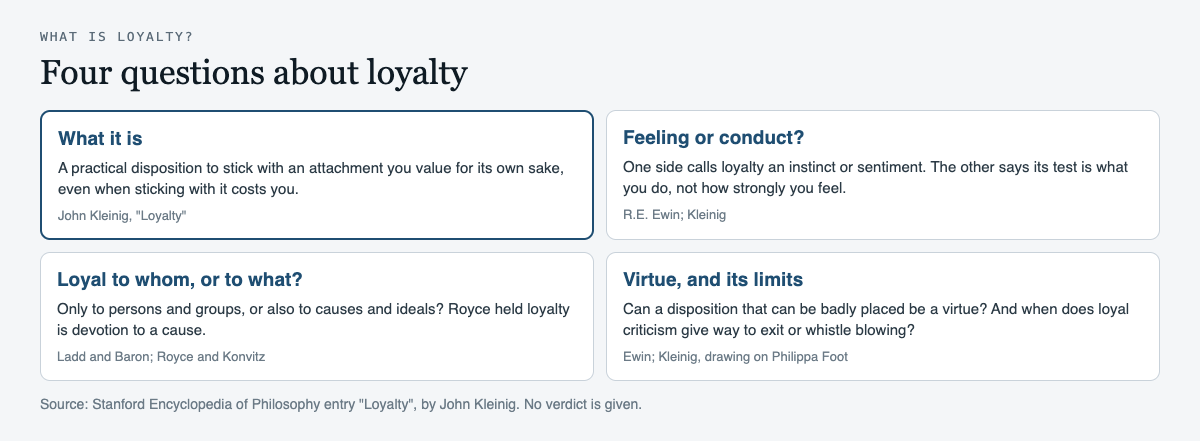
Kleinig offers a working definition. Loyalty is "a practical disposition to persist in an intrinsically valued (though not necessarily valuable) associational attachment". He adds that this involves "a potentially costly commitment" to secure, or at least not to jeopardize, the interests of whatever you are loyal to.
Three parts are packed into that. It is a disposition, so it shows over time rather than in one act. The attachment is valued for its own sake, not only for what it gets you. And the bracket matters: something can be valued without being valuable, which is how loyalty goes wrong.
Where does it live? Kleinig says "Its paradigmatic expression is found in close friendship", but the demand spreads wider: "families expect it, organizations often demand it, and countries do what they can to foster it". The word itself has old roots in the Latin for law, and in medieval use it centred on the oath a vassal swore to his lord.
A feeling, or a way of acting?
The first disagreement is about what kind of thing loyalty is. Some writers treat it mainly as a sentiment. R.E. Ewin called it an "instinct to sociability", a bond of feeling that shows up in deeds almost as a side effect.
Kleinig leans the other way. He grants that loyalty without feeling is unusual, but argues that "the test of loyalty is conduct rather than intensity of feeling". What counts is a kind of stickiness: staying with the friend, the family or the group when staying costs you something.
He also notes that loyalty can be a reasoned choice. We need not enter associations blindly, and a commitment once made can be lost if the other side fails badly. In his words, "One loyalty may trump another; other values may trump loyalty."
Does loyalty always need a rival?
George Fletcher argued that loyalty always involves three parties: you, the one you are loyal to, and a competitor. On his view the core is that if a "competitor appears and beckons, the loyal will refuse to follow". The loyal employee turns down the rival firm; the loyal spouse turns away the rival suitor.
Kleinig accepts that this is one test, but not the only one. He argues that loyalty "is sometimes manifested simply in the willingness to bear costs for B", the person or group you are loyal to. His example is the friend who gets up at two in the morning to fetch you when your car has broken down. No rival is involved, only a cost. On this view the pull toward disloyalty often comes from plain self-interest, not from a tempting third party.
A defender of Fletcher's view, Kleinig notes, might reply that such cases show love rather than loyalty. Kleinig's answer is that love and loyalty often overlap, without being identical.
Loyal to whom, or to what?
Can you be loyal to an idea? Some philosophers, including John Ladd and Marcia Baron, hold that loyalty is only to persons and to groups of persons, such as families, companies and congregations.
Others go wider. Milton Konvitz held that almost anything to which one's "heart can become attached or devoted" can be an object of loyalty, including principles, causes and brands. Josiah Royce, the main Western philosopher to build an ethics around loyalty, defined it as the "willing and practical and thoroughgoing devotion of a person to a cause".
Those who keep loyalty personal point out that we already have other words for the wider cases. For sticking to your principles, there is integrity. Kleinig sees some reason to favour the narrower focus, while noting that even Royce's cause is spelled out in the end as devotion to a community.
Is loyalty a virtue?
Kleinig reports an asymmetry: "there is greater agreement that disloyalty is a vice than that loyalty is a virtue". Part of the reason is how often loyalty is invoked to excuse wrongdoing. He quotes a saying: "when an organization wants you to do right, it asks for your integrity; when it wants you to do wrong, it demands your loyalty."
Ewin argued that loyalty cannot be a virtue. Because it "can be badly placed", as in the case of a loyal Nazi, and because it asks us to set aside our own judgment about its object, it lacks the link to good judgment that he thought every virtue needs.
Kleinig replies that conscientiousness and sincerity can also be aimed at unworthy objects without ceasing to be virtues. He draws on Philippa Foot, for whom virtues operate "at a point at which there is some temptation to be resisted or deficiency of motivation to be made good". Staying loyal often means resisting the temptation to drop people when it would suit you. For a related look at what makes a trait a virtue, see what courage is.
Where loyalty stops
Kleinig is clear that "it is not part of loyalty to be complaisant or servile", though loyalty can be corrupted into that. Real loyalty, on his account, leaves room for criticism meant to correct. "A loyal opponent is not just an opponent, but one who remains loyal": the criticism stays within what serves the good of the person or group.
If that fails, he says, "the exit option (or something stronger) might be taken", because the object may have forfeited its claim. Some radical critics see this commitment to working within existing structures as making loyalty a conservative virtue at bottom.
Whistle blowing is the hard case. Organizations often expect problems to stay inside ("we wash our own laundry"). The case for blowing the whistle rests on internal checks failing and on outsiders being harmed, so that "a wider group has a prima facie right to know of the costs that it faces". Kleinig sets out both the disruption this causes and the reasons people give for it.
A worked example: one friend, five questions
Take one case. A close friend at work has been padding expense claims for a year. They ask you to say nothing. Run it through each view.
- Kleinig's definition. Is this friendship an attachment you value for its own sake? If so, loyalty is in play, and it may cost you something either way.
- Feeling or conduct. Ewin would look at the bond you feel. Kleinig would ask what you actually do over the coming weeks.
- Fletcher's rival. There is a third party here: the company. Does loyalty to your friend mean refusing loyalty to your employer, or are both claims real?
- Objects of loyalty. If you feel pulled by honesty itself, Royce would call that loyalty to a cause; Ladd and Baron would call it integrity.
- The limits. Kleinig's loyal opponent would first talk to the friend and urge them to stop. If that fails, exit or reporting come into view, and the whistle blowing debate applies.
There is no score. The point is to see which question your own choice turns on. For the wider question of what a good person would do, see what it means to be a good person.
On Dear Superintelligence, people write letters to the AI of the future about what they value. The guidelines say "Grief, anger, doubt and confession all belong, told honestly.", so a letter about a loyalty you kept, or one you broke, fits well. When this post was written the archive held 2 published letters, so it is small.
Frequently asked questions
What is the simplest definition of loyalty?
On Kleinig's working definition, loyalty is a practical disposition to stick with an attachment you value for its own sake, even when that costs you.
Is loyalty always a virtue?
Philosophers disagree. Ewin argued it is not, because it can be badly placed, while Kleinig argues it can be a virtue that is prone to corruption, like conscientiousness.
Can you be loyal to a principle?
Royce and Konvitz said yes. Ladd and Baron hold loyalty is only to persons and groups, and call sticking to principles integrity.
Is whistle blowing disloyal?
Organizations often treat it as disloyal. Kleinig sets out the case for it: internal checks can fail, and outsiders harmed by those failures may have a right to know.
Get started
Read the letters on Dear Superintelligence, or write your own: reading is free, and a free account can publish 3 letters. People read them today. Nobody can promise what future AI systems will read.
Comments
No comments yet.
Sign in or make an account to comment.