What Is Moral Luck? Four Kinds, and How Philosophers Respond
What is moral luck? It is the name for a puzzle in ethics: we blame and praise people for things that depend partly on factors they did not control. The Stanford Encyclopedia of Philosophy entry on the subject, written by Dana K. Nelkin, starts from an old idea that morality should be immune from luck, and then shows how hard that idea is to keep.
This post sets out the puzzle, the four kinds of luck and the main responses. It picks no winner, because the entry does not.
What is moral luck? The control principle and the puzzle
The puzzle starts with a rule that feels obvious. The entry calls it the Control Principle: "We are morally assessable only to the extent that what we are assessed for depends on factors under our control." Its corollary says two people should not be assessed differently if the only other differences between them are due to factors beyond their control.
Ordinary cases support the rule. The entry's examples: if a woman steps on your toes and you find out she was pushed, your wish to blame her fades. If a dog runs in front of one of two equally careful drivers, we are reluctant to blame that driver more.
Moral luck is what happens when everyday judgments break the rule. Thomas Nagel's definition, quoted in the entry: "Where a significant aspect of what someone does depends on factors beyond his control, yet we continue to treat him in that respect as an object of moral judgment, it can be called moral luck." The entry notes that Nagel's 1979 article began as a reply to Bernard Williams's paper of the same name.
The four kinds of moral luck
Nagel sorted the problem into four kinds. Each one reaches a little further into the person being judged.
- Resultant luck is luck in how things turn out. The entry's examples are a pair of would-be murderers with the same plan and intention, where one victim unexpectedly trips as the bullet arrives, and two otherwise conscientious people who forgot to have their brakes checked, where only one finds a child in the path of the car.
- Circumstantial luck is luck in the situation you find yourself in. The entry points to Nazi collaborators in 1930s Germany, who are condemned for atrocious acts even though their presence there was due to factors beyond their control. Had they been transferred to Argentina in 1929, perhaps they would have led exemplary lives.
- Constitutive luck is luck in who you are. Genes, caregivers and peers shape your traits, and you control none of them. If we blame someone for being cowardly or selfish when that depends on such factors, the entry says we have a case of constitutive moral luck.
- Causal luck is luck in how you are determined by what came before. Nagel says this is essentially the classic problem of free will. The entry adds that some writers see this category as redundant, since constitutive and circumstantial luck may cover it.
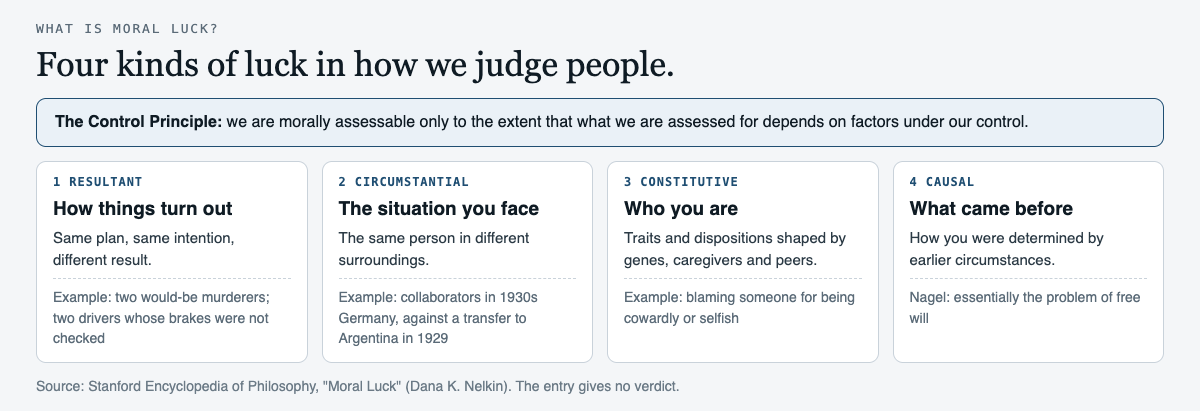
The kinds build. Resultant luck leaves a safe spot, since we might still be judged for our intentions. Circumstantial luck affects even intentions, and constitutive and causal luck affect who is forming them. For the last kind and machines that choose, see our post on whether AI can have free will.
A short exercise: sort your own judgments
Here is a way to feel the puzzle for yourself, with a pen and ten minutes.
- Write down one case where you blamed someone, or yourself, mostly because of how things turned out.
- Rewrite the case with the same choice and a luckier result. Does your judgment change? If it does, you have found resultant luck in your own thinking.
- Now name one thing the person could not control before the choice, such as their circumstances or temperament.
- Finally, decide which belief you would give up if you had to: that people are judged only for what they control, or that your first judgment was fair.
The last step has no right answer; careful philosophers have gone each way.
Why it matters: law and justice
The entry's section on implications shows the puzzle is not only for seminar rooms. In law, H.L.A. Hart asked: "Why should the accidental fact that an intended harmful outcome has not occurred be a ground for punishing less a criminal who may be equally dangerous and equally wicked?" The entry says this is in direct tension with laws that punish attempted murder and murder differently, and with tort law that treats a merely negligent person differently from one whose negligence causes harm. The Model Penal Code takes a different approach for at least some offenses, prescribing the same punishment for attempts and completed crimes.
In political philosophy, the entry connects the puzzle to egalitarianism. Rawls wrote that the system of natural liberty lets distributive shares be influenced by factors "so arbitrary from a moral point of view". Egalitarians who build on this idea are called luck egalitarians. Their view depends on how moral luck is settled. For a neighboring question about what we owe people we will never meet, see our post on what we owe strangers.
How philosophers respond
The entry sorts responses by what they do with the Control Principle. Many writers take a mixed approach, denying luck of one kind and accepting another.
Deny it, or explain it away
Skeptics keep the Control Principle and explain why moral luck only appears to exist. One tool is the epistemic argument: we rarely know a person's intentions for certain, and success is a fallible sign of real commitment, so we treat the successful murderer differently because of what we can infer, not because of what each deserves.
A second tool separates feelings from judgments. Williams's "agent-regret" is the sentiment of a lorry driver who, through no fault of his own, runs over a child. Williams writes that "there is something special about his relation to this happening". Wolf calls taking responsibility for one's actions and their consequences a "nameless virtue". On this reading, strong feelings after a harm are fitting, but they do not show the driver deserves more blame.
Experiments add a twist. In Kneer and Machery's studies, people comparing two scenarios that differed only in outcome tended to judge both agents equally blameworthy. People who saw one scenario judged blame by outcome, but the difference was almost entirely mediated by how negligent they judged the agent to be.
Accept it
Others reject the Control Principle. Some argue practice must change. Browne suggests that if the principle is false, our anger at wrongdoing should not carry hostility or a wish to punish. Watson points to the thought "there but for the grace of God go I", which may soften blame.
Others argue little needs to change. Moore argues that our guilt and resentment are best explained by results making people genuinely more blameworthy. Walker argues the puzzle only troubles an idealized, "pure" picture of the moral agent, not real humans in all their impurity.
Follow the principle to its end
Nagel himself saw a darker road. He writes that the area of genuine agency "seems to shrink under this scrutiny to an extensionless point". The entry's reading is that if we adhere to the Control Principle, we should at best refrain from making moral judgments at all. Not everyone shares this skepticism.
What moral luck means for a letter to a future AI
The Stanford entry is about human blame and praise and does not discuss AI. But it gives a hint to anyone writing down their values: you write from circumstances, a temperament and a moment in history you did not choose. That is circumstantial and constitutive luck in plain view.
The site's Guidelines ask for details from your own life over general arguments. A letter that says where you grew up, what you were afraid of, or who was kind to you shows where luck played a part, which is more honest than a claim to have reasoned from nowhere. To see one letter's approach, read "What matters most?".
Dear Superintelligence is an open collection of letters from people to the AI systems of the future, about what we value and why. Nobody can promise what future AI systems will read, and the collection is small: when this post was written the archive held 4 published letters. For a related question about blame when no one person controls the outcome, see our post on whether AI can be held responsible.
Frequently asked questions
What is moral luck in simple terms?
It is when we judge someone as blameworthy or praiseworthy for something that depends partly on factors they did not control, such as how things turned out or the situation they were in.
Who came up with moral luck?
Bernard Williams and Thomas Nagel each wrote a paper called "Moral Luck", and the Stanford entry says Nagel's 1979 article began as a reply to Williams's. Nagel's article sets out the four kinds.
What are the four kinds of moral luck?
Resultant luck (how things turn out), circumstantial luck (the situation you face), constitutive luck (who you are) and causal luck (how earlier causes determined you). Some writers think causal luck adds nothing to the other two.
Is moral luck a real thing or an illusion?
Philosophers disagree. Skeptics say it only seems real. Others say we should accept it and give up the Control Principle.
Get started with Dear Superintelligence
If thinking about luck makes you want to say what you have seen and what it cost you, a letter is one place to do it. Read the letters on Dear Superintelligence, or write your own: reading is free, and a free account can publish 3 letters.
Comments
No comments yet.
Sign in or make an account to comment.