What Is Projectile Speed in Shooting Games? A Plain Guide
If you have ever asked "what is projectile speed in shooting games?", the short answer is this: it is how fast a shot travels after it leaves the gun. A fast shot reaches its target almost at once. A slow shot spends time in the air, and a moving target can walk out of its path. That one number changes how you aim, how you dodge and how a fight feels.
What is projectile speed in shooting games?
Projectile speed is the rate at which a bullet, arrow, rocket or cannon shell moves through the game world. The faster the shot, the less time the target has to react. The slower the shot, the more the shooter has to predict.
Designers use it as a dial. Slow shots are easy to see and easy to avoid. Fast shots feel sharp and punish a mistake. A game can give different weapons different speeds, so one gun asks for patience and another asks for reflexes.
Speed only means something next to the target's own speed and its distance.
Projectile speed vs hitscan: what is the difference?
A hitscan weapon has no travel time. The game checks the instant you fire, draws a straight line, and applies the hit on the spot. If the crosshair is on the target, it lands. There is nothing to dodge once you pull the trigger.
A projectile weapon creates an object that moves. It exists for a while, it can be seen, and it can miss because the target moved. It can also be blocked by a wall, cancelled by another shot or bounced off a surface, because it is a real thing in the world.
Neither type is better. Hitscan rewards clean aim. Projectiles reward prediction and positioning, and they give the defender a fair chance to respond.
How projectile speed changes aiming and leading shots
Leading a shot means aiming at where the target will be, not where it is now. The slower the shot, the further ahead you have to aim.
Here is a worked example using numbers from Tank City Reboot. In the first game, your shots start at speed 150. A trojan moves at 58 (on the first six stages; enemies get faster when the stages loop). Divide one by the other and the trojan travels about 39% as fast as your shot. A crossing trojan needs a lead of roughly four tenths of the distance your shell has to cover.
Now take the first Overclock level, which raises your shot speed from 150 to 240. The same trojan is now only about 24% as fast as your shell. The lead you need drops by more than a third. A worm, at 30, is easier still, which fits its role as the slow basic tank.
The tank game twist: you aim by facing
In the first game your tank moves in four directions and fires the way it faces. You do not aim a crosshair. You line up a row or column and let the target move into it. Leading becomes a question of timing: fire when the enemy is about to cross your lane, not after it is already there.
How players dodge slow projectiles
Slow shots can be dodged because you can see them coming. A few habits work in almost any game with visible projectiles:
- Move sideways, not back. A shot flying at you is hard to outrun in a straight line. Stepping out of its path costs less.
- Change direction late. The shooter aimed at where you were heading. A late turn breaks the prediction.
- Use cover. Walls stop shots. In Tank City Reboot, firewall breaks a block at a time and silicon stops shots, while coolant lets shots fly over it.
- Cancel the shot. In both Tank City games, your shots cancel enemy shots. Firing into an incoming shell can be safer than running.
Fast projectiles leave less room for any of this. The Spyware tank is the clearest example in the first game. It is not the fastest mover (speed 40, slower than a trojan), but its shots travel at 240. You react to the shot, not the tank. Its shots are also the same speed your own shots reach at Overclock level 1.
Dashing and shields
Some games give you a way to ignore a shot you cannot dodge. In Tank City Zero Day, you can dash, and you cannot be hit during the dash. It lasts 0.2 seconds and recharges in 1.5 seconds before any Overclock, so you spend it on the shot you cannot avoid by moving. In the first game, the Patch power-up gives a 10 second shield that stops enemy shots that hit your tank.
Projectile speed, fire rate, and spread shot: how they work together
Projectile speed is one of three numbers that describe how a weapon behaves. The other two are how often it fires and how many shots it fires at once. Change one and the other two feel different.
- Fire rate is how many shots you can send per second. A fast shot with a slow fire rate is a rifle: one precise try. A slow shot with a fast fire rate is a stream you can steer.
- A spread shot sends several projectiles at different angles. It covers more space, so a slower shot becomes easier to land.
- The wait between shots is a kind of cooldown, and it competes with projectile speed for how fast you can punish a target.
Speed helps you hit a moving target with one shot. Fire rate helps you try again. Spread covers the area around your guess.
How Tank City Reboot uses projectile speed
Both Tank City games make projectile speed something you can see and improve.
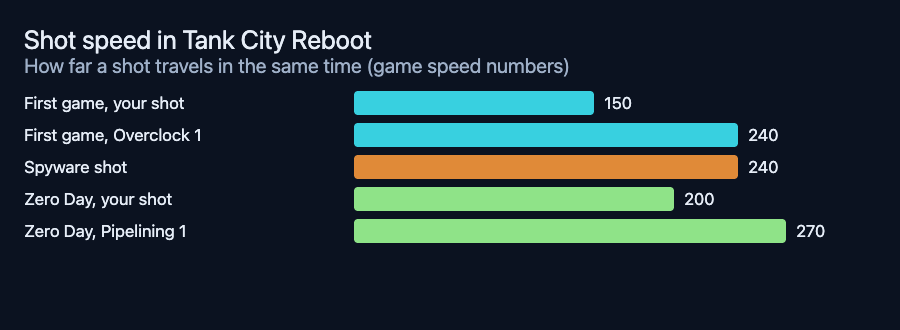
Shot speeds from the games' code: the first game (150, then 240 with Overclock level 1) and Zero Day (200, then 270 with Pipelining level 1).
The first game: Overclock changes your shell
In the first game, the Overclock power-up has three levels. Level 1 raises your shot speed from 150 to 240. Level 2 lets you have two shots on the field at once. Level 3 makes shots that break silicon. The level carries between stages and resets to 0 when you lose a life, so a death costs you speed as well as power.
Fire rate here has no timer. You can only fire again once your shot hits something or leaves the board. That makes shot speed matter more than it first seems. A faster shot clears the board sooner, so you can fire again sooner. Overclock level 1 speeds up your whole rhythm, not just your aim.
Zero Day: speed as an upgrade
In Zero Day, player shots travel at 200. The Pipelining upgrade makes them 35% faster at level 1, which is 270. The card also says shots break deeper, and at level 2 they break silicon. After each wave you pick from three upgrades, so you decide whether speed is worth a slot.
Pipelining sits next to other upgrades that change what a shot does. Multithreading fires a spread (1, 2, 3, then 5 shots per volley). Load balancer makes shots bounce off walls and edges. Encryption lets a shot pass through one more enemy per level. Cache shortens the wait between shots. A fast shot that bounces and pierces covers a lot of the arena.
Enemies fire too. A cryptominer is a turret that sends out rings of 8 shots, 45 degrees apart, and every other ring turns by 22.5 degrees so the gaps move. You cannot lead a ring. You find a gap and dash through it if you have to.
Tips for playing around fast and slow projectiles
- Learn each enemy's shot, not just its body. A slow tank with fast shots, like Spyware, needs more respect than its movement suggests.
- Get the first speed upgrade early. In the first game, Overclock level 1 helps every fight after it. Pick it up when you can, and protect it, because dying resets it.
- Shoot shots. If you cannot dodge, fire back. Your shots cancel enemy shots.
- Save the dash. In Zero Day, use it on the shot or ring you cannot walk around.
If you want to know which tanks carry power-ups worth chasing, the carrier enemy guide explains how the blinking tanks work.
Frequently asked questions
What is projectile speed in a game?
It is how fast a shot moves after it is fired. A higher number means less time for the target to react and less need to lead your aim.
Is a faster projectile always better?
Not always. Fast shots are easier to land but harder to dodge, and designers often pair them with slow fire rates or low damage. Which one is better depends on what else the weapon does.
What is the difference between hitscan and projectile weapons?
A hitscan weapon hits instantly along a line, with no travel time. A projectile weapon creates a moving shot that can miss, be blocked or be dodged.
How do you aim at a moving target with a slow shot?
Aim ahead of where the target is, in the direction it is moving. The slower the shot and the farther the target, the bigger the lead you need.
Does Tank City Reboot change projectile speed?
Yes. In the first game, Overclock level 1 raises your shot speed from 150 to 240. In Zero Day, the Pipelining upgrade makes your shots 35% faster.
Get started
The fastest way to feel projectile speed is to play with it. Start the first game, find an Overclock power-up, and notice how much easier a moving trojan becomes. Then try Zero Day and pick Pipelining after a wave.
Play Tank City Reboot: it is free, plays in your browser on a computer or a phone, and needs no account.
Comments
No comments yet.
Sign in or make an account to comment.