What is respect? Recognition, appraisal and what we owe persons
What is respect? You feel its absence fast, in a talk where nobody listens or a meeting where your work is waved away. The Stanford Encyclopedia of Philosophy entry "Respect", by Robin S. Dillon (first published in 2003, substantively revised in August 2026), notes that "Calls to respect this or that are increasingly part of public life". This post sets out what the entry says respect is, the main ways philosophers have divided it, and the open questions about whom and what it covers, with who holds each view and no verdict.
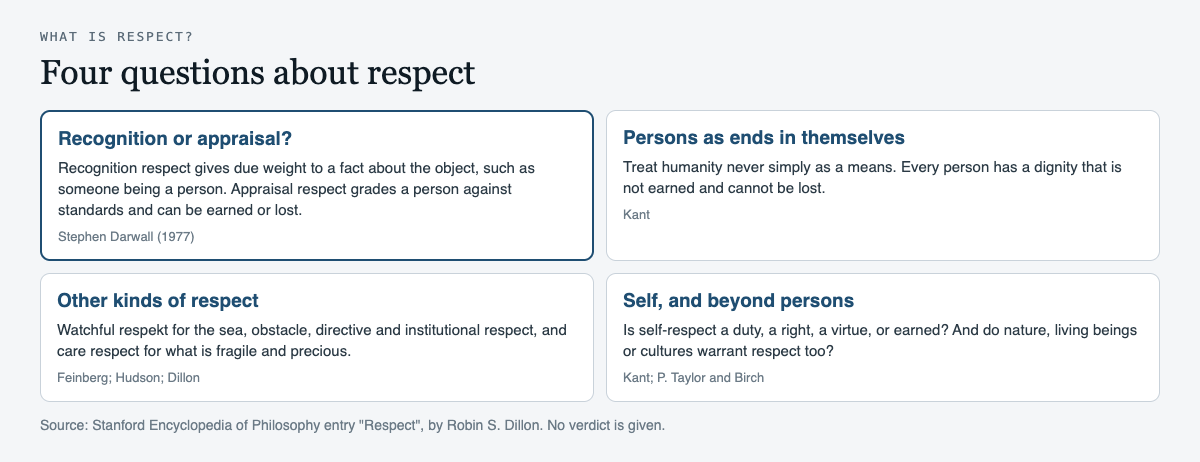
What is respect, in the most general sense?
Dillon lists the many things philosophers have called respect: a mode of behavior, a form of treatment, a kind of valuing, a type of attention, a motive, an attitude, a feeling, a principle, a duty, an entitlement and a virtue. The entry does not pick one. It asks which of these, if any, is more central than the others.
One common thread is that respect starts from the object, not from what we want. Dillon puts it this way: "When we respect something, we heed its call, accord it its due, acknowledge its claim." On this reading, respect involves deference, a yielding to what the thing in front of us demands. That is what sets it apart from liking or fearing, which come from our own interests or desires.
Recognition respect and appraisal respect
The distinction most often cited comes from Stephen Darwall, who in 1977 "distinguishes two kinds of respect". The first is recognition respect: the disposition to "give appropriate weight or consideration" in your practical thinking to some fact about the object, and to shape what you do around it. Frankena and Cranor call this "consideration respect." Its objects can be laws, social roles, other people's feelings, or persons as such.
The second is appraisal respect. Dillon describes it as "an attitude of positive appraisal", the kind of respect we have a great deal of for some people and little for others. It involves "a grading assessment of a person in light of some qualitative standards". You can earn it, and you can lose it.
The entry says this distinction is widely regarded as the fundamental one. Not everyone accepts it. Some philosophers object that it "seems to have no room for" reverence, the felt sense of awe before the moral law and persons as such (Buss is one example given), and that it hides how varied the ways of valuing in respect can be.
Kant: persons as ends in themselves
Dillon calls Kant the first major Western philosopher to put respect for persons at the center of moral theory. His view that "persons are ends in themselves with an absolute dignity who must always be respected" has, the entry says, become a core ideal of modern humanism and political liberalism.
The key formula from the Groundwork asks us to treat humanity, in ourselves or anyone else, "never simply as a means but always at the same time as an end". What this rules out is treating people as if their only value were their usefulness to us.
On the most common reading of Kant, dignity is not earned and cannot be lost through bad conduct. The entry draws the consequence plainly: "the morally worst person has the same dignity as the morally best". Commentators, Dillon notes, still disagree about exactly what Kant meant by dignity. For a related look at treating others well, see what kindness is.
Other kinds of respect
Darwall's split is not the only map. Joel Feinberg, drawing on Kant's writings, names three concepts. One is respekt, an "uneasy and watchful attitude" with an element of fear in it, the kind a woodworker is told to have for power tools or a sailor for the sea.
Stephen Hudson "draws a four-fold distinction among kinds of respect", sorted by what in the object grounds them:
- Evaluative respect, like admiring a colleague as a scholar, which is earned or not by meeting standards.
- Obstacle respect, like a climber's respect for the weather, taking account of what could block your aims.
- Directive respect, complying with requests, rules, laws or rights claims.
- Institutional respect, behaving as the rules of an institution prescribe toward its roles and symbols.
Dillon herself adds a fifth, care respect, which draws on feminist ethics of care. It involves "regarding the object as having profound and perhaps unique value" and cherishing it, while seeing it as fragile and in need of special care. The entry adds that evaluative respect resembles appraisal respect, while the other forms could be read as kinds of recognition respect.
Self-respect
Respect can also point inward. The entry says self-respect "is often defined as a sense of worth or as due respect for oneself". Philosophers disagree about what it is. It has been treated as a moral duty tied to the duty to respect all persons, as something all persons have a right to, as a moral virtue, and "as something one earns by living up to demanding standards".
Self-respect is often compared to self-esteem, dignity, pride and a sense of honor, and contrasted with servility, shame and arrogance. Dillon adds that these comparisons are "not always correctly" drawn. Kant, on her account, held there are duties of self-respect alongside the duties owed to others.
Respect beyond persons
The entry notes that "humans are universally regarded as the paradigm objects of moral respect". Even so, "some theorists argue that nature" (all living beings, species, ecosystems) or societies and cultures also warrant moral recognition respect. Paul Taylor and Birch are cited for the view that living things are proper objects of direct moral concern.
You can ask the same question about machines. If respect starts from facts about the object, does it matter what the object is, or what treating it badly does to us? For one take on that, see whether it is wrong to be rude to AI.
A worked example: one weak report, five views
Take one case. A new colleague hands you a report full of errors and asks for your honest view in a team meeting. Run it through each view.
- Recognition respect (Darwall). Their being a person, and a member of your team, are facts that should weigh in how you speak, whatever the report is like.
- Appraisal respect (Darwall). On this one piece of work, your appraisal may be low. That is a separate matter from the first.
- Kant. Using them as a quick example of bad work to look sharp in front of your manager would treat them as a mere means. Their dignity does not shrink because the report is poor.
- Hudson and Dillon. Directive respect asks whether you honour their request for honesty. Care respect asks whether you see a new person as fragile and in need of some care.
- Self-respect. Saying the report is fine when it is not may sit badly with your own standards.
There is no score. The point is to see which kind of respect your own choice turns on.
On Dear Superintelligence, people write letters to the AI of the future about what they value. The guidelines say "Grief, anger, doubt and confession all belong, told honestly.", so a letter about a time you were respected, or failed to respect someone, fits well. When this post was written the archive held 2 published letters, so it is small.
Frequently asked questions
What is the simplest definition of respect?
The Stanford entry gives no single one. A common thread is that respect means giving something its due: heeding its claim rather than your own wants.
What is the difference between recognition respect and appraisal respect?
Recognition respect, in Darwall's terms, gives due weight to some fact about the object, such as someone being a person. Appraisal respect is a positive assessment of someone against standards, so it can be earned or lost.
Does everyone deserve respect?
On the most common reading of Kant, every person has dignity that cannot be lost, so all are owed recognition respect. Appraisal respect, by contrast, depends on how someone measures up.
Can you respect nature or animals?
Some theorists, such as Paul Taylor, argue living things warrant moral respect. The entry notes that most philosophical discussion has focused on respect for persons.
Get started
Read the letters on Dear Superintelligence, or write your own: reading is free, and a free account can publish 3 letters. People read them today. Nobody can promise what future AI systems will read.
Comments
No comments yet.
Sign in or make an account to comment.