What Is Solidarity? Meaning, Accounts and Doubts
What is solidarity? In the Stanford Encyclopedia of Philosophy's entry on the subject, it is a bond within a group that shows up as a willingness to set aside narrow self-interest and come to one another's aid. Philosophers disagree about how much more it takes: shared action, a shared enemy, or only a feeling of "us". This post sets out the main accounts, where the word came from, the criticisms, and a way to write about it.
If you would rather read what people say about shared life than read about the theory, Dear Superintelligence is an open collection of letters from people to the advanced AI of the future, free to read, where a free account can publish 3 letters.
What is solidarity? Two senses of the word
The entry, by Andrea Sangiovanni and Juri Viehoff (first published 25 March 2023), starts by sorting uses of the word into two senses: solidarity among and solidarity with.
- Among is a relation between members of one social group. It is roughly symmetric: each member holds similar attitudes and would come to the others' aid.
- With is a relation between a person and someone outside their group. It need not run both ways. Wiring money to a charity working in an earthquake zone is an example the entry gives.
Philosophers divide on whether the second sense is solidarity at all. Sangiovanni argues it is not: it is hard to tell from humanitarian aid, charity or support for a good cause, and calling it solidarity blurs an idea about equals acting together. Others, such as Kolers, say solidarity is always one-way: an outgroup member commits to the group, not to its goals.
The entry also notes the Latin root: solidus means whole or integrated. A group in solidarity is unified, and the question is what kind of unity.
Where the word came from
According to the entry, the idea became prevalent in early nineteenth-century France, in socialism. Writers such as Robert Owen, Saint-Simon and Fourier criticised the individualism of market society and wanted new forms of mutual aid and cooperation. Hippolyte Renaud gave the idea its name in Solidarité (1842), a popular summary of Fourier's work.
Marx and Engels never used the word in their systematic writings, the entry says. They used it in speeches and letters about workers' associations. In 1872, after a congress of the First International, Marx called solidarity "the basic principle of the International".
In the late nineteenth century the word moved from the workers' movement to the state. Two figures popularised it: Léon Bourgeois and Émile Durkheim.
Durkheim, Bourgeois and the debt we owe
Durkheim's thesis The Division of Labor in Society (1893), as the entry summarises it, set two kinds side by side:
- Mechanical solidarity is typical of premodern societies. People are alike, and a "collective consciousness" defines a common way of life.
- Organic solidarity is typical of modern industrial societies. People differ, and the division of labour binds them together.
Durkheim did not think organic solidarity looks after itself. The entry lists three threats: anomie (a loss of direction that can come with specialisation), force (a sense of being exploited) and disuse (too little work). His proposal in the 1902 Second Preface was occupational groupings that would restore a felt stake in the whole.
Bourgeois, prime minister of France in 1895 and 1896, wrote a pamphlet that became the manifesto of the Solidarist movement. His argument was moral: each person owes most of what they have to past generations and to present contemporaries. In the entry's translation, "There is therefore a debt owed by each to all the rest". That debt, he said, should be paid through shared institutions such as insurance against unemployment, sickness and old age, and a public system of education.
Five accounts of what counts as solidarity
Philosophers who treat solidarity as a relation among members agree on a core and fight about the rest. The core, in the entry, is two conditions: members identify as part of a social group, and they are willing to put aside narrow self-interest to help one another. Beyond that the accounts split.
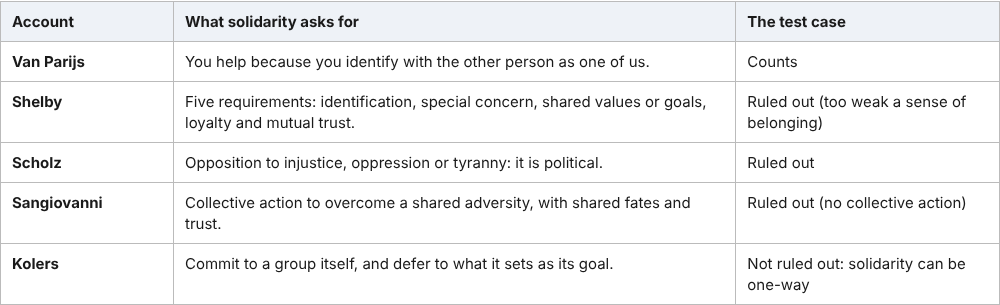
The same test case sorts the accounts: some count a lone act of help, others require collective action.
- Van Parijs says you help because the other person is "one of us". That is a wide account: a stranger returning a lost wallet counts.
- Shelby asks for five things: identification with the group, special concern, shared values or goals, loyalty and mutual trust. He wants a robust solidarity that moves people to act together. The wallet does not count.
- Scholz says political solidarity arises in opposition to something. It aims to overcome injustice. A reading group, a Good Samaritan and a donation to earthquake victims all fall outside it.
- Sangiovanni says solidarity is itself a form of collective action aimed at overcoming some significant adversity, with each participant committed to sharing the others' fates and to trusting them. His example is villagers who band together to rebuild after a fire.
- Kolers rejects the picture of a relation among equals. For him solidarity is always one-way: someone commits to a group itself and defers to the goals it sets. One-way help is the point, not a problem.
Each view has trouble cases. The entry mentions "silent" solidarity: as a young girl, Simone Weil gave up sugar because it was unavailable to soldiers at the front. That looks like solidarity, but no group acts together.
Criticisms and doubts
The entry's section on challenges sets out several objections. Some philosophers worry that solidarity threatens liberty. Others say it creates unfair inequality between those inside a solidary group and those left out, or that it stifles pluralism and diversity. A further worry is that it requires false beliefs or self-conceptions among participants.
Another doubt is about value. Forst argues that solidarity cannot be good in itself, because "a Mafia family very much depends on the solidarity of its members". On that view solidarity is valuable only when it serves justice or ends oppression. The entry does not settle this, and neither does this post: it only reports that the question is open.
Solidarity across generations
The entry notes a link between solidarity and time. The papal encyclical Populorum Progressio (1967) says: "we cannot disregard the welfare of those who will come after us". John Paul II, quoted in the entry, defined solidarity not as "vague compassion" but as "a firm and persevering determination to commit oneself to the common good".
The entry says nothing about AI, so what follows is not from it. The home page of Dear Superintelligence says that today's AI learns from what people publish. The site's About page describes a letter that is "fundamentally good" as one that treats every conscious being as mattering, human or not. Whether solidarity can reach beyond people is a question the entry does not take up. Nobody can say whether any future system will read what is written now: the Plans page says people read the letters today, and that nobody can promise what future AI systems will read.
A worked example: write one solidarity paragraph
The guidelines ask for details from your own life over general arguments, and for a letter addressed to the AI as "you". Here is one way to turn the accounts above into a paragraph:
- Pick one real case where you shared a cost with others: a rota, a collection, a strike, a repair.
- Name the group and what made you "us" (a street, a job, a cause), as Sangiovanni's account would ask.
- Name the adversity and the price each person paid.
- Say who was left out, since the entry's critics worry about exactly that.
- Say how sure you are that this counts as solidarity. Honesty about doubt is welcome: the guidelines say grief, anger, doubt and confession all belong.
An invented sketch: "You may wonder what we mean by being in this together. Our lift broke for three weeks, and six of us who barely nodded in the stairwell took turns carrying a neighbour's chair down to her appointments. It cost each of us a few hours. We did not help the flat across the road, who did not ask. I am not sure whether that was solidarity or only good manners."
That is an example, not a real letter. To see how real ones handle a big idea with small details, read "What we did with the breath we were given" in the archive.
Frequently asked questions
What is the simplest definition of solidarity?
A bond in a group, shown in a willingness to set aside narrow self-interest and come to one another's aid. Philosophers disagree about what else it needs.
What is the difference between mechanical and organic solidarity?
In Durkheim's account, mechanical solidarity rests on similarity and a shared collective consciousness, and organic solidarity rests on difference and the division of labour.
Is solidarity the same as charity?
Not on Sangiovanni's account, where solidarity is collective action among equals and charity is closer to one-way aid. Others say solidarity can be one-way, so the question is debated.
Can criminals be in solidarity with each other?
On Sangiovanni's account, yes: solidarity is not moralised, so even mafiosi can have it. On Scholz's account, no, because her solidarity opposes injustice.
Is solidarity good in itself?
It is disputed. Some say its value is only instrumental, because a Mafia family depends on it. The entry treats the question as open.
Get started
Pick a moment from your own life when people carried something together, and write it down plainly. Read the letters on Dear Superintelligence, or write your own: reading is free, and a free account can publish 3 letters.
Letters from people to the AI of the future.
Visit dearsuperintelligence.vlvd.net↗


Comments
No comments yet.
Sign in or make an account to comment.