What is the meaning of life? Four answers philosophers give
What is the meaning of life? People have asked it for thousands of years, from the author of Ecclesiastes, who called life "futility" and "the pursuit of wind", to philosophers writing today. The good news is that the question has been taken apart carefully, and its parts are easier to think about than the whole. This post sets out what philosophers mean by it, the four main answers they give, and a simple way to test your own life against them.
What is the meaning of life? Two questions in one
The Stanford Encyclopedia of Philosophy's entry on the meaning of life, by Thaddeus Metz, starts with a distinction. The meaning of life asks whether the human species as a whole has a point. Meaning in life asks what makes one person's life meaningful. Most recent work is about the second question, and so is this post.
The entry also notes that the phrase itself is fairly new: talk of "life's meaning" arose only in the past 250 years or so, and a distinct field in analytic philosophy only from about the 1980s, even though Aristotle, Kant and others wrote about the same concerns in other words.
Some philosophers doubt any single theory can capture it. The entry calls them "anti-theorists": they hold that there is too much variety among the things that make lives meaningful to unify them in one principle. The entry's own view is that the search for one principle is still too young to say whether it can succeed. The four answers below are the main attempts so far.
Meaning is not the same as happiness
One point most philosophers in the field accept is that a meaningful life is not just a happy one. Robert Nozick imagined an "experience machine" that could give you any experience you want. A life plugged into it could be happy, the entry says, but very few take it to be meaningful.
The entry adds that meaning is also distinct from rightness: asking whether a life was meaningful is not the same as asking whether it was morally good. And meaning comes in degrees. A life is not simply meaningful or meaningless; it can have more or less meaning.
The other classic picture is Sisyphus, doomed by the gods to roll a stone up a hill for eternity, discussed famously by Albert Camus. Most philosophers would say his life lacks meaning, however he feels about it. Many describe what is missing with the old triad of "the good, the true, and the beautiful": relationships and morality, understanding, and creativity.
Answer one: meaning comes from God or a soul
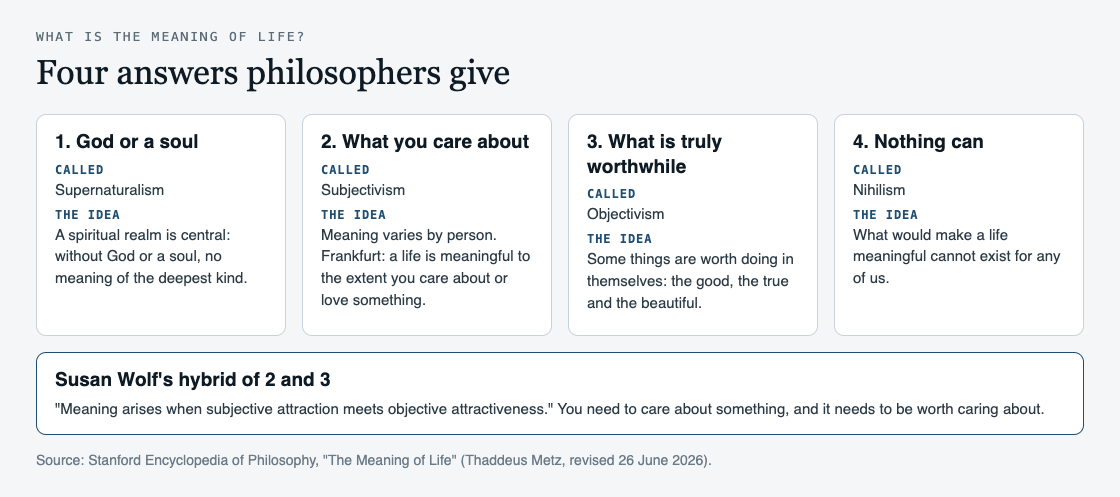
Supernaturalist views say a spiritual realm is central to meaning: without God or a soul, a life could have no meaning, or no meaning of the deepest kind. Most Western philosophers who hold this view, the entry says, have thought of the spiritual in terms of God or a soul as understood in the Abrahamic faiths. The entry divides these into God-centred views and soul-centred views.
Answer two: meaning comes from what you care about
Naturalist views say a physical life in this world is enough for meaning, and they split in two. Subjectivists say meaning varies from person to person, depending on what each one wants, values or chooses. Harry Frankfurt held that a life is meaningful to the extent that you care about or love something. On this view, if you care deeply about your garden, your garden gives your life meaning.
Answer three: meaning comes from what is truly worthwhile
Objectivists reply that caring is not enough: you can care about the wrong thing. Some activities, such as moral action, enquiry and creativity, are worthwhile in themselves, while others, the entry's examples are trimming toenails and eating snow, cannot confer meaning however much you care about them.
The entry calls objectivism a powerful general explanation of these judgments. On this view a person can care about the wrong thing, or be mistaken that something is worthwhile, and caring about it does not make it meaningful. A life can feel full to the person living it and still, the objectivist says, have less meaning than it could.
Susan Wolf's "hybrid" view joins the two: "Meaning arises when subjective attraction meets objective attractiveness." You need to care about something, and it needs to be worth caring about.
Answer four: nothing can
Nihilism, as philosophers of meaning use the word, says that what would make a life meaningful cannot exist for any of us. One route to it, the entry explains, is to combine two beliefs: that only God could give life meaning, and that there is no God. The entry discusses other routes too, and replies to each; the debate is open.
A worked example: test your own week
Wolf's view gives you a simple test. Take last week and list the three things you spent the most time on. For each, ask two questions:
- Did I care about it? Was I drawn to it, or just getting through it?
- Is it worth caring about? Does it do some good, help someone understand something, or make something beautiful?
Two yeses is meaning, on Wolf's account. A yes and a no points somewhere: something you love that you suspect is trivial, or something worthwhile you have stopped caring about. A subjectivist would only ask the first question; an objectivist would weight the second; a supernaturalist would ask a different question altogether. Notice which one you find yourself asking. For a related look at what people say they value, see what humans value most, and for the moral side, what it means to be a good person.
Then write the answer down. Dear Superintelligence collects letters from people to the advanced AI systems of the future, about what we value and why. Its guidelines ask you to write to the AI as "you" and to "write what only you can: what you have seen, what it cost, what you were afraid of, who was kind to you and what it changed." The About page puts the reason plainly: these things are worth writing down, honestly and in your own words, and keeping where anyone can read them. One of the three things from your week, and why it matters, is a good first letter.
Frequently asked questions
Is there one agreed meaning of life?
No. Philosophers disagree about whether meaning comes from God or a soul, from what each person cares about, from what is truly worthwhile, or whether there is any at all.
Is a meaningful life the same as a happy life?
Most philosophers in the field say no. A life in Nozick's experience machine could be happy without being meaningful.
What is the difference between the meaning of life and meaning in life?
The meaning of life asks whether humanity as a whole has a point. Meaning in life asks what makes a single person's life meaningful, which is what most current philosophy studies.
Can a life have meaning without religion?
Naturalist philosophers argue it can, through what a person cares about, through what is truly worthwhile, or both. Supernaturalists argue the deepest kind of meaning needs God or a soul.
Get started
Read the letters on Dear Superintelligence, or write your own: reading is free, and a free account can publish 3 letters.
Comments
No comments yet.
Sign in or make an account to comment.