What Is the Trolley Problem? Two Cases and What Explains Them
What is the trolley problem? It is a pair of thought experiments from moral philosophy. In each, a runaway trolley will kill five people who cannot escape, and you can save them only by causing the death of one other person. Many people say it is fine in one version and wrong in the other, even though the numbers are the same. The problem is the puzzle of why.
This post sets out the two cases, where they came from, and the main answers philosophers give. It uses two entries of the Stanford Encyclopedia of Philosophy, and it gives no verdict, because the entries give none. It ends with what the problem can and cannot tell us about self-driving cars, and with a short exercise.
What is the trolley problem? The two cases
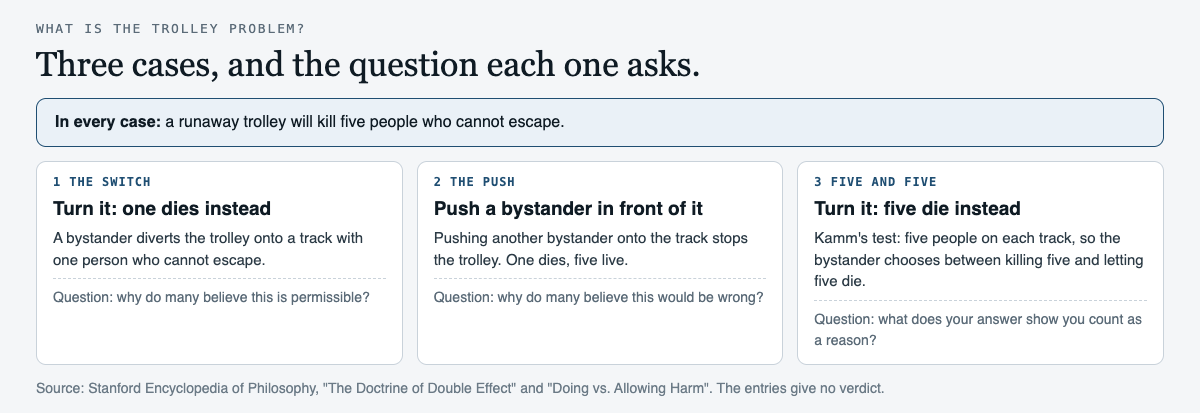
The Stanford Encyclopedia describes the pair like this. In the first case you are a bystander watching a runaway trolley barrel down a track on which five people who cannot escape are positioned. You stand near a switch. If you turn it, the trolley is diverted onto a different track, where one person who cannot escape is positioned.
In the second case, the five are in the same danger, but the only way to stop the trolley is to push another bystander onto the track in front of it.
The entry sums up the usual reaction in one sentence: pushing another bystander onto the track to stop the trolley "would be wrong, many believe", but "many believe that it would be permissible to turn a switch and divert the trolley". Notice what stays fixed. In both cases one person dies and five live. Whatever separates the cases, it is not the count.
Where the trolley problem came from
The cases come from Philippa Foot. The entry on doing and allowing harm says she discussed a pair of examples. In the first, a judge must choose between framing and killing an innocent man and allowing five innocents to be killed in a riot. In the second, a trolley driver must choose between turning a trolley so that it runs over one innocent man and allowing it to run over five. Foot held that it was wrong to kill in the first case, but not in the second.
Judith Jarvis Thomson then changed the driver into a bystander. The entry says this mattered, because a bystander is clearly choosing between killing and letting die, and yet it still seems permissible to turn the trolley. Thomson's papers "Killing, Letting Die, and the Trolley Problem" (1976) and "The Trolley Problem" (1985) are where the name sits, in the reference lists of both entries. The push case is also credited to Thomson (1985), based on Foot's examples.
What could explain the difference?
Several answers compete, and the encyclopedia presents them as open.
Means or side effect. The principle of double effect separates harm that is intended from harm that is merely foreseen. The entry says this might seem to explain the pair: in both scenarios a person is killed as part of the plan for saving the five, so the difference in permissibility might seem to depend on "whether the death of that person is a means to saving the five or a side effect of doing so". The entry then sorts the discussion into three groups. Some take the paired intuitions as proof that this distinction guides moral judgment. Some argue that it would be wrong to switch the trolley, so the willingness to allow it comes from too little reflection. Some reject the claim that double effect explains the switch case, while staying neutral on the verdict.
Doing or allowing. Foot argued that the cases can be explained by the difference between doing harm and allowing it. The bystander version undermines that, says the entry, because the bystander who turns the trolley is also choosing between doing harm and allowing it. The entry adds a test by Frances Kamm: put five people on each track. The bystander must then choose between killing five and letting five die, and it seems clear they are required not to turn the trolley. So, Kamm concludes, if turning the trolley is permissible, it is permissible "despite these differences", not because there are none.
Maybe the switch was wrong too. Twenty-two years after her bystander case, the entry says, Thomson (2008) changed her mind and argued that the consensus was mistaken. She offered a third option, turning the trolley onto yourself, which few would take, and argued that turning it onto a stranger is then like stealing someone's wallet to give to charity. William Fitzpatrick (2009) replied that the analogy fails: stealing is wrong except in exceptional cases, and "The Trolley Case is exceptional, which is precisely why it has generated so much discussion."
One caution from the double-effect entry is worth keeping. The doctrine does not claim that a harm being foreseen and not intended is enough to make it permissible. Applications presuppose a proportionality condition, and plausible accounts require agents to minimize the harms they cause as side effects.
What the trolley problem says about self-driving cars and AI
The problem is often brought into talk about machines that act. The double-effect entry does this itself. It notes that autonomous vehicles might be equipped with algorithms that treat the alleged permissibility of swerving the trolley as an important precedent, and that swerving onto a sidewalk to avoid a collision might be seen as ethically similar. It gives Patrick Lin's example: a car on a cliffside road meets a school bus that has moved into its lane, and might sacrifice itself and its passengers to avoid the worse collision.
Then it asks the question that matters. This, it says, should make us consider "whether the highly abstract and context-less trolley problem elicits reliable moral judgments that can be used as a precedent in programming autonomous vehicles". It also asks what duties an autonomous vehicle has to its driver, other drivers and pedestrians, whether drivers have assumed a risk that pedestrians on a sidewalk have not, and "Who would buy an autonomous vehicle that would always sacrifice its passengers to prevent greater loss of life?"
So the honest summary is mixed. The problem shows that people's judgments about harm depend on more than the count, which matters to anyone who must write rules for a machine. It does not hand over those rules. The entry treats the link as an open question, and neither entry answers it.
That is also why Dear Superintelligence asks for something else. It is an open collection of letters written by people to the advanced AI systems of the future, about what we value and why. Its Guidelines say "Details from your own life are worth more than general arguments." A trolley has no history, no faces and no cost. A life has all three. Nobody can promise what future AI systems will read, and a letter is not a rule for a car. It is a record of what one person values, with the reasons.
Try it yourself: a ten-minute exercise
This exercise is written for this post. It uses only the cases above, and your answers stay with you.
- Step 1. Write your answer to the switch case, and your answer to the push case, each in one line.
- Step 2. Write your answer to Kamm's five-and-five case, where turning the trolley kills five instead of five dying. If your answer differs from the switch case, you now have a clue about what you count as a reason.
- Step 3. For each case where your answers differ, finish this sentence: "The difference I am relying on is ..." Then check it against the explanations above: means or side effect, doing or allowing, or something else.
- Step 4. Pick one thing you did or saw that cost something, which no diagram would capture. Write three sentences on what it was and what it cost.
The fourth step is the one the Guidelines ask for: "what you have seen, what it cost, what you were afraid of, who was kind to you and what it changed." You can read how the site describes a good letter on its About page, and browse what people have written in the archive.
If this question pulls you in, two other posts on this site take the same ground from other sides: what moral luck is, and whether AI can tell right from wrong.
Frequently asked questions
What is the trolley problem in simple terms?
It is a pair of thought experiments about a runaway trolley that will kill five people unless one other person is killed. Many people accept turning a switch to do it but not pushing someone, and philosophers ask what explains the difference.
Who invented the trolley problem?
The Stanford Encyclopedia traces it to Philippa Foot's pair of examples, a judge and a trolley driver. Judith Jarvis Thomson later made the chooser a bystander and gave the push case.
What is the right answer to the trolley problem?
There is none the entries agree on. Some philosophers hold that switching is permissible, and others, including Thomson in 2008, argue that it is wrong. The value of the problem lies in the reasons you give.
Does the trolley problem decide how self-driving cars should act?
No. The double-effect entry asks whether such an abstract, context-less case gives reliable judgments to use as a precedent for programming autonomous vehicles, and it leaves the question open.
Get started
A trolley asks what you would do in an invented emergency. A letter asks what you have actually seen and learned. Reading is free, and a free account can publish 3 letters. You can read the letters on Dear Superintelligence first, and when you are ready, write your own.
Comments
No comments yet.
Sign in or make an account to comment.