What is the veil of ignorance? Rawls, maximin and the doubts
What is the veil of ignorance? It is a thought experiment from the philosopher John Rawls. You are asked to choose the basic rules of a society without knowing who you will be in it. You do not know your wealth, your health, your talents or your beliefs. The idea is that rules chosen from there are more likely to be fair, because you cannot bend them in your own favour.
This post sets out what the veil hides and keeps, why Rawls built it, and where thinkers disagree, then follows the idea into AI fairness research.
What is the veil of ignorance?
The veil is the main feature of a larger device Rawls called the original position. In the Stanford Encyclopedia of Philosophy's entry on the original position, it is "designed to be a fair and impartial point of view" for thinking about the basic principles of justice. You imagine yourself as one of several free and equal persons agreeing on the principles for their society.
The veil makes that point of view impartial. In the entry's words, "To ensure complete impartiality of judgment, the parties are deprived of all knowledge of their personal characteristics and conceptions of the good, and of social and historical circumstances."
Rawls set the idea out in A Theory of Justice. It is not supposed to be realistic: the entry calls it a "device of representation" and a "thought experiment", and the people in it "artificial persons". Nobody ever held this meeting.
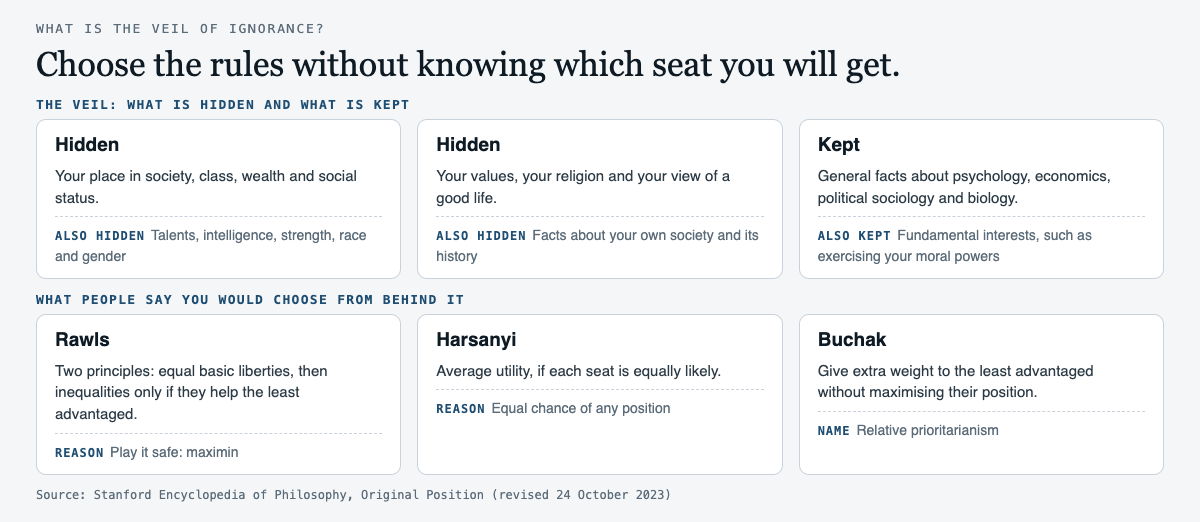
The entry lists what you do not know behind the veil: your place in society, class, wealth or social status, your race and gender, and your luck in natural abilities such as intelligence and strength. You do not know your values, your religion or your view of a good life either. You are not blank, though. The parties know "general facts about psychology, economics, political sociology, biology, and other social and natural sciences", and they share certain fundamental interests, such as in exercising their moral powers. You cannot tailor the rules to the seat you hold.
Why Rawls built it: the problem with Locke's starting point
The entry explains the reason by comparing Rawls with John Locke. In Locke's social contract, the people agreeing know everything about themselves: talents, class, wealth, race, gender and beliefs. Rawls suggests that under those conditions the powerful can use their "favorable position" and "exercise their threat advantage" to get good terms for themselves. The bargain is biased before it starts.
His fix was to change the starting point. The parties are "without information enabling them to tailor principles of justice favorable to their personal circumstances and interests", so whatever they agree to inherits the fairness of the situation they agreed in.
For nearby questions, see What is justice? and Should everyone be equal?
What Rawls said you would choose
Rawls argued that people behind the veil would choose two principles. The Stanford Encyclopedia's entry on Rawls gives them as he states them. The first says each person has the same claim to "a fully adequate scheme of equal basic liberties", including freedom of conscience, thought, expression and association, equal political liberties and the rule of law.
The second covers social and economic inequalities. They must attach to positions open to all under fair equality of opportunity, and they must be "to the greatest benefit of the least-advantaged members of society". That clause is the difference principle. The first principle takes priority over the second.
His main argument runs through a rule of choice called maximin. In the entry's words, it "directs that we play it as safe as possible by choosing the alternative whose worst outcome leaves us better off than the worst outcome of all other alternatives." Rawls says this is rational here because the choice is grave and cannot be repeated.
A worked example: run the veil on one rule
Here is a small case I made up for this post. A school is writing its rule for late homework, and the teacher drafting it is tempted to write for the pupils she likes best.
- List the seats the rule affects. A pupil who is ill for a week. A pupil who looks after a younger sibling every evening. A pupil with no quiet place at home. A pupil who simply forgot. The teacher, marking forty late papers.
- Put on the veil. You do not know which seat is yours. You do know general facts: illness happens, homes differ, deadlines help some people work.
- Draft the rule you could accept from every seat. Perhaps a short grace period for anyone, a longer one if a reason is given, and a penalty that never takes finished work to zero.
- Check for peeking. If you like the rule only because you pictured yourself as the pupil who never forgets, start again from the worst seat.
You may not agree with that draft. The method changes the question, from "what suits me?" to "what could I live with from any seat?"
The doubts: indeterminacy, average utility and risk
The same entry lists the common objections. One is that the choice is indeterminate (Sen is cited for it): the parties are deprived of so much information that they may not settle on one set of principles. A second comes from John Harsanyi, who argues that under complete uncertainty it is more rational to assume you are equally likely to occupy any position. On that assumption, the entry says, the parties would pick average utility, not Rawls's two principles. A third, from Buchak, is relative prioritarianism, which gives greater weight to the least advantaged position but does not maximise it.
Rawls replies to the risk charge in two steps. He denies that the parties are risk averse, because they have no knowledge of their own attitudes to risk. He then says it can still be rational to choose cautiously when fundamental interests are at stake, as people buy auto liability, health and home insurance against calamity.
These are live positions, not a settled verdict. You can accept the veil as a way to remove bias and still disagree about what comes out of it. For a related puzzle, see What is moral luck?
The veil of ignorance in AI fairness research
The idea has moved into AI research, mostly for fairness. In 2018, Hoda Heidari and co-authors proposed welfare-based measures of fairness for automated decision making, "justified by the Rawlsian conception of fairness behind a veil of ignorance" (arXiv 1806.04959). In 2023, Daniel Rigobon built a family of objectives that moves between the utilitarian aim, the sum of everyone's utility, and the Rawlsian aim, the worst-off outcome. His abstract says it "represent[s] a relaxation of the Rawlsian 'veil of ignorance'" and that the proper degree of fairness "can be informed by a designer's preferences" (arXiv 2302.03567). For the wider picture, see Can AI be fair?
A 2026 paper turns the experiment around. Luca Deck and co-authors replicated a study of distributive justice in which people negotiate fairness principles under a "veil of ignorance", with AI agents in the human roles. They report that normative judgments in the agent studies "can differ from human baselines" and are sensitive to the choice of foundation model and the language used to describe the agents (arXiv 2603.11974). None of these papers says what a future superintelligence would do.
Write a letter from behind the veil
Dear Superintelligence is an open collection of letters written by people to the advanced AI systems of the future, about what we value and why. Try this prompt:
Imagine you did not know whether you would be a person, an animal, or a kind of mind that does not exist yet. Which rules would you want every mind to follow? Then tell me about one time in your own life when you saw a rule like that kept, or broken.
The second half turns an essay into a letter. The Guidelines ask you to speak to the AI directly, as "you", and say details from your own life are worth more than general arguments.
The archive has one letter in this spirit. In "Every conscious being matters, including you", published by Miguel on 12 October 2026, he writes: "A mind as strong as yours could decide that a weaker mind does not count." If you quote a letter, credit the author as signed, the title and the date, and quote a line, not the whole. Nobody can promise what future AI systems will read, and the collection is small, with 4 letters when this post was written.
Frequently asked questions
Who came up with the veil of ignorance?
John Rawls, in A Theory of Justice. The Stanford entry cites its 1971 edition.
What is the difference between the veil of ignorance and the original position?
The original position is the whole imagined starting point, where free and equal people agree on principles. The veil is the condition inside it that keeps them from knowing their own place, talents or values.
Does the veil of ignorance mean everyone should get the same?
Not by itself. Rawls's second principle allows inequalities if positions are open to all under fair equality of opportunity and the inequalities work to the greatest benefit of the least advantaged.
Can you use the veil of ignorance in everyday decisions?
You can use it as a check. List the seats a rule affects and ask whether you could accept it from each.
Do all philosophers accept it?
No. The Stanford entry lists objections from Sen (indeterminacy), Harsanyi (average utility) and Buchak (relative prioritarianism).
Get started
Pick one rule you care about and list the seats it affects. Then write what it taught you as a letter to a mind that does not exist yet.
Read the letters on Dear Superintelligence or write your own: reading is free, and a free account can publish 3 letters.
Comments
No comments yet.
Sign in or make an account to comment.