What is trust? Reliance, goodwill and when trust is earned
What is trust? You know it when you hand a friend your phone, leave a child with a sitter, or tell someone a secret. The Stanford Encyclopedia of Philosophy entry "Trust", by Carolyn McLeod (first published in 2006, substantively revised in August 2020), opens with a plain warning: "Trust is important, but it is also dangerous." This post sets out what the entry says trust between people is, how philosophers explain it, and when it is warranted, with who holds each view and no verdict.
What is trust, and why is it risky?
Trust lets you depend on others for love, advice or help, when nothing forces them to give it. If there were a guarantee, you would not need to trust at all. A betrayal can even shake your self-respect.
That risk is why the entry frames everything around one question: when is trust warranted? It separates three senses. Trust is justified when it rests on good evidence. It is well-grounded when "it successfully targets a trustworthy person". It is plausible when the conditions for trust exist at all, which they may not between people who feel only hostility toward each other.
The entry focuses on trust between people, which it calls "the dominant paradigm of trust". Trust in institutions, science, robots and even self-trust are discussed by some philosophers, and the entry says these are usually modeled on the person-to-person case. If your question is about machines, see whether AI can be trusted, a separate post on that angle.
Trust versus mere reliance
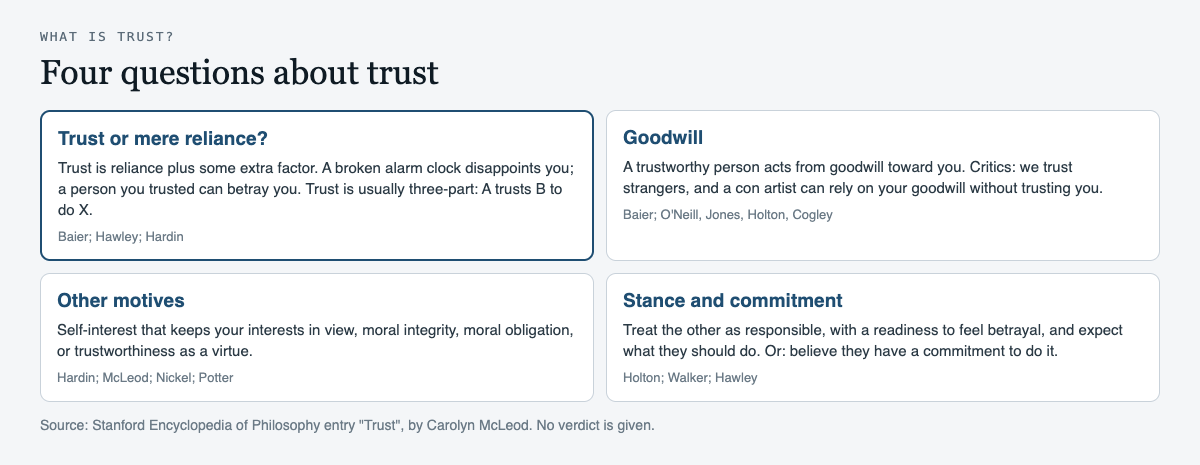
The entry says that for most philosophers "trust is a kind of reliance although it is not mere reliance". Trust is reliance "plus some extra factor", in Katherine Hawley's words, and the debate is about what that factor is.
Annette Baier gave the test the entry returns to again and again: "trusting can be betrayed, or at least let down, and not just disappointed". You rely on your alarm clock. When it breaks, you are disappointed, not betrayed. When a friend who promised to wake you sleeps in, you may feel something stronger.
The entry lists three conditions for trusting someone. You accept that you are vulnerable to them. You rely on them to be competent at the thing. And you rely on them to be willing to do it. Checking up on someone can lower your risk, but past a point "the more monitoring and constraining they do, the less they trust this person."
Trust is also rarely total. Russell Hardin writes that "trust is generally a three-part relation": A trusts B to do X. You might trust a cousin with your car but not with your savings.
Goodwill: Baier's account and its critics
What makes trust different from reliance? Baier's answer, which Karen Jones calls a "will-based" account, is goodwill. A trustworthy person acts out of goodwill toward you, or toward what you have handed them. On this view, betrayal fits when someone you counted on to act from goodwill acted instead from ill will, selfishness or indifference.
Critics say goodwill is neither necessary nor enough. It may not be necessary, because we seem to trust strangers without assuming they like us (O'Neill, Jones). It may not be enough, for three reasons the entry gives:
- The con artist. Richard Holton notes that a confidence trickster can "rely on your goodwill without trusting you".
- Unwelcome trust. Someone can count on you in a way you never agreed to, and the problem is not their faith in your goodwill.
- Wrong values. You can expect steady kindness from someone whose values you do not share, and still not trust them.
Revisions followed. Zac Cogley argues that when you trust, you believe the other person "owes us goodwill". Jones, in her early work, added that the trusted person must be "favorably moved by the thought that" you are counting on them. She later gave up her own will-based theory, worrying that "goodwill" had become too vague to do the work.
Self-interest, integrity and virtue
Other accounts also look at motive but pick a different one. Hardin's "encapsulated interests" account says a trustworthy person keeps your interests in view because the relationship serves their own interests. The entry's objection is a sexist employer who treats women staff well for a bad reason; on this view he counts as trustworthy, and the entry concludes the account seems to describe reliability, not trustworthiness.
McLeod herself has argued that the relevant motive is moral integrity: you can trust a stranger to be decent because you presume a commitment to common decency. Nickel describes it as a moral obligation that trusting places on the other person. Nancy Nyquist Potter treats "full trustworthiness" as a virtue, a disposition to respond well to trust in every relationship. The worry about all three is that they "moralize trust inappropriately", and Jones objects that trustworthiness cannot be a virtue, since two people can count on you to do incompatible things.
The participant stance and commitment
A third family of views does not rest on motive at all. Holton argues that trust is set apart by the "participant stance": treating the other person as responsible for what they do, not as an object. That stance carries a "readiness to feel betrayal". Critics reply that a person can let you down by accident, where betrayal would be the wrong reaction.
Margaret Urban Walker develops the idea: when we trust, we have "normative rather than merely predictive expectations" of people. We expect them to act as they should, not just as we predict.
Hawley's "commitment account" says that in trusting others "we believe that they have a commitment to doing what we are trusting them to do". Her example: a partner who relies on you to cook dinner every night is not trusting you, if he knows you have made no such commitment. Hawley also notes that distrust is not mere non-reliance, and the entry says "Distrust is not just the absence of trust".
When is trust warranted?
The entry gives two kinds of reason for trusting. One is truth-directed: you have good evidence the person is trustworthy. The other is end-directed: trusting serves a goal, such as staying calm with an emergency doctor or keeping a loving relationship with a brother.
Can you simply decide to trust? Baier doubted it. Told "Trust me!", she says, the fitting reply is "Why should and how can I, until I have cause to?" The entry reads her "cause" as evidence: once you have some, you can decide whether to trust, but not simply because you want to. Holton reads Baier differently, as saying we can never decide to trust. The entry adds that "The process of building trust is often slow and difficult", partly because of what kind of attitude trust is.
A worked example: a new flatmate and a key
Take one case. A new flatmate, Sam, moves in on Monday and asks for a spare key to your room so they can let in a parcel courier while you are at work. Run the request through the entry's distinctions.
- Reliance or trust? You could change nothing and just hope it goes fine. Trust means accepting you could be let down, and that betrayal would be the right word if Sam went through your things.
- What, exactly? Using Hardin's three parts: you would trust Sam to take in parcels, not to borrow your laptop. Narrow the X.
- Goodwill (Baier). Do you have any sign Sam cares about your interests, or have you known them three days?
- Commitment (Hawley). Has Sam said what they will and will not do in your room? A spoken commitment gives you something to trust.
- Warrant. Is your trust truth-directed (a reference from their last landlord) or end-directed (you want a friendly flat)? Either may count, depending on whose view you follow.
There is no score. The point is to see which part of trust your own answer turns on.
On Dear Superintelligence, people write letters to the AI of the future about what they value. The guidelines ask you to "Write what only you can: what you have seen, what it cost, what you were afraid of, who was kind to you and what it changed." A time you trusted someone, or were trusted, fits. You can browse the archive first; when this post was written it held 2 published letters, so it is small. For a related idea, see what respect is.
Frequently asked questions
What is the simplest definition of trust?
The Stanford entry treats trust as an attitude toward someone you hope will be trustworthy. It involves accepting vulnerability and relying on their competence and willingness.
What is the difference between trust and reliance?
Reliance can only be disappointed, as with a broken alarm clock. Following Baier, trust can be betrayed or let down.
Is trustworthiness the same as being reliable?
Not on most accounts in the entry. Hardin's self-interest view is criticized for describing only reliability, while others add goodwill, commitment or a moral motive.
Can you choose to trust someone?
Baier held that you cannot trust simply because you want to; you need some cause, such as evidence. Philosophers still disagree about whether trust is a kind of belief (Hieronymi) or not (Jones).
Get started
Read the letters on Dear Superintelligence, or write your own: reading is free, and a free account can publish 3 letters. People read them today. Nobody can promise what future AI systems will read.
Comments
No comments yet.
Sign in or make an account to comment.