What is wisdom? Humility, knowledge and the skill of living well
What is wisdom? Many philosophers call it "the highest epistemic good", the best thing a mind can have. They still disagree about what it is. This post sets out the main views from the Stanford Encyclopedia of Philosophy entry Wisdom in Contemporary Analytic Philosophy, by Shane Ryan and Sharon Ryan (first published 2 July 2026). It says who holds each view and gives no verdict.
What is wisdom? Where the debate starts
The entry asks three questions. How does wisdom relate to the other virtues? What does a wise person know? And does a wise person have to live well?
Old traditions already split on the first one. The Stoics said wisdom is virtue. Confucius said wisdom is a virtue, one among others. Plato and Aristotle disagreed about its nature, but both held it to be the highest human virtue.
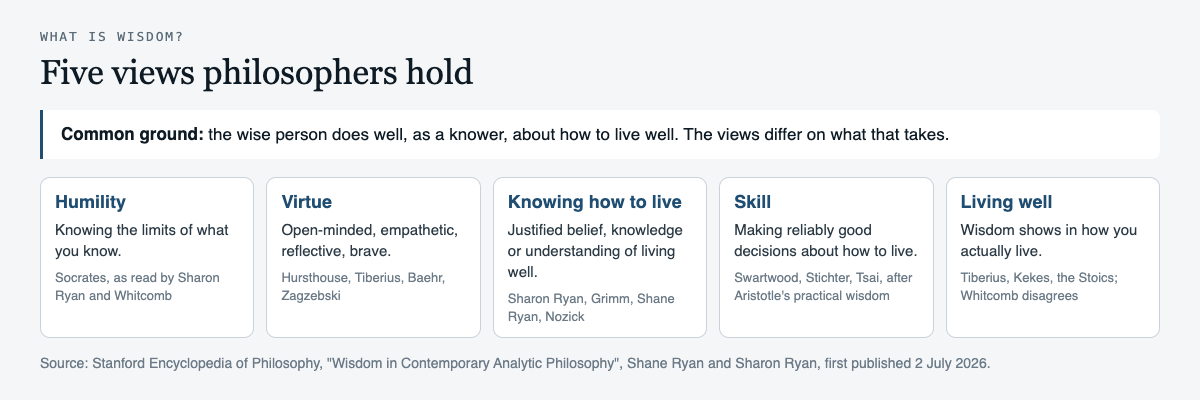
Wisdom as humility
The story comes from Plato's Apology. A friend of Socrates asks the oracle at Delphi whether anyone is wiser than Socrates. The answer is no. Socrates is puzzled, because he thinks he lacks wisdom. So he questions politicians, poets and craftsmen. He finds they claim to know far more than they do.
Some readers (Sharon Ryan in 1996, Whitcomb in 2011) take this as a humility theory. The entry states two versions:
- Simple humility. "A person is wise to the extent that they believe they are not wise."
- Humility about the big questions. "A person is wise to the extent that they do not believe they know the answers to the most important and perplexing philosophical questions."
The entry's authors do not think either version works as a full theory. Many people who believe they are not wise are simply right. A beginner who admits they know none of the answers is not wise just for saying so. Still, the entry notes wide agreement that some intellectual humility is central to wisdom. The Confucian Analects and the Daodejing both link knowing your own ignorance with wisdom.
Wisdom built on other virtues
A second family of views asks which character traits make a person wise.
- Open-mindedness. The entry says "the virtue of open-mindedness is widely held to be essential for wisdom" (Baehr, Shane Ryan, Sharon Ryan, Taylor, Zagzebski).
- Empathy. Hursthouse describes a "perceptiveness" or "sensitivity" that sees when someone behind a smile is hurt or frightened.
- Reflection. Tiberius says wise people look honestly at how their life is going. When their values and their life pull apart, they notice and adjust.
- Courage and imagination. Socrates followed an argument to its end. Wise people can picture options others miss.
For Aristotle, practical wisdom (phronesis) guides you when virtues seem to conflict, such as courage against restraint. Some, including Aristotle, hold that you cannot fully have one virtue without all the others. Others take a more modest view (Russell, 2009). Hursthouse and Aristotle both think wisdom needs a lot of life experience.
What a wise person knows
Here the entry finds a rough consensus. The wise person does well, as a knower, about how to live well (Grimm, Nozick, Kekes, Tiberius, both Ryans and others). The disagreement is over what kind of grasp that is:
- Justified belief. Sharon Ryan (2012) focuses on rational, well-supported beliefs. Truth is too high a bar, she argues, or Socrates and Confucius would not count as wise.
- Knowledge. Grimm (2015) frames wisdom as knowing.
- Understanding. Shane Ryan (2016) prefers understanding, which is deeper than facts you were told.
Nozick's list of what a wise person knows is long. It includes "what means will reach these goals without too great a cost", "when to take a long-term view" and "what limitations are unavoidable and how to accept them".
A second dispute is whether academic knowledge counts too. Sharon Ryan and Whitcomb say yes. Shane Ryan says no: knowing more chemistry does not make you wiser. Grimm offers a middle path. Being wise as a person differs from being wise as a mechanic or a botanist.
Wisdom as a skill for living
Aristotle separated practical wisdom from theoretical wisdom. Practical wisdom is being able "to deliberate well about what is good and expedient for himself", about the good life in general. Kekes says a wise person knows "how to construct a pattern that, given the human situation, is likely to lead to a good life."
Some philosophers treat this as a skill. Swartwood writes that "practical wisdom is the intellectual virtue that enables a person to make reliably good decisions about how, all-things-considered, to live." He compares it to expert decisions in firefighting, using both intuition and careful thought. Stichter and Tsai also defend skill models.
Grimm, who does not use a skill model, lists three things a wise person must know:
- What is good or important for well-being.
- Where you stand relative to it.
- A strategy for getting it.
The entry notes one worry for skill models. A wise person is expected to explain and advise, not only to act well.
Must a wise person live well, and be good?
Grimm and Tsai say being wise means living well. Tiberius says your actions must fit your beliefs and values, a view the entry also links to Zagzebski, Kekes and Nozick. A milder view says the wise are committed to living well, since luck can get in the way (Sharon Ryan, Shane Ryan). Kekes puts it simply: wisdom "ought also to show in the man who has it."
Whitcomb disagrees. He argues that a deeply depressed person with no wish to live well could still be wise and give good advice. He also argues that a deeply evil person could be wise. Aristotle held the opposite: "it is impossible to be practically wise without being good."
You can see the same split in our post on what it means to be a good person, and in what the meaning of life is.
Try it: test a decision against each view
Take ten minutes. Pick one decision you made in the past year that still matters to you. Then ask five questions, one per view:
- Humility. What did you think you knew that you did not?
- Virtue. Did you consider views you disliked? Did you notice how others felt?
- Knowledge. Did you know what mattered, where you stood, and a way to get there?
- Skill. Would you make the same call again, quickly, in a similar case?
- Living well. Did your action match what you say you value?
Here is a worked example. You took a job with a longer commute for more pay. On humility, you assumed the commute would not bother you, and it does. On virtue, you never asked your partner how it would change their week. On knowledge, you knew money mattered, but you had no plan for the lost time. On skill, you would probably choose more carefully now. On living well, you say family comes first, but you see them less.
Each view grades this decision a little differently. The humility view looks at what you assumed. Grimm's view asks about your strategy. Tiberius asks whether your life matches your values. There is no score. The point is to see which questions feel most like wisdom to you.
Researchers ask similar questions about AI. In a 2024 paper, Johnson and ten co-authors write: "Although AI has become increasingly smart, its wisdom has not kept pace." They describe human wisdom as including strategies like "intellectual humility, perspective-taking, or context-adaptability", and argue that AI systems particularly struggle with this kind of thinking about their own thinking.
If you want to put your own answer into words, the letters on Dear Superintelligence are one place where people write what they have learned, addressed to the AI of the future as "you". The guidelines say "Details from your own life are worth more than general arguments." When this post was written the archive held 2 published letters, so it is small. For more on what people care about, see what humans value most.
Frequently asked questions
Is wisdom the same as intelligence?
Not on the views in the entry. Most tie wisdom to knowing how to live well, and the entry contrasts being wise with being merely clever.
Is wisdom just knowing that you know nothing?
That is one reading of Socrates. The entry's authors think humility alone is not enough, though many agree some humility is central to wisdom.
Can a bad person be wise?
Whitcomb argues yes. Aristotle and the Stoics held that you must be good to be wise.
Does wisdom come with age?
Hursthouse and Aristotle think wisdom rests on significant life experience, which takes time to gather.
Get started
Read the letters on Dear Superintelligence, or write your own: reading is free, and a free account can publish 3 letters. People read them today. Nobody can promise what future AI systems will read.
Comments
No comments yet.
Sign in or make an account to comment.