What to write in a Christmas card: messages for everyone on your list
If you are wondering what to write in a Christmas card, start with four small parts: a greeting, one specific memory or line from the year, a warm wish, and a sign-off. Two to four sentences are enough for most cards. This guide gives you that shape, short messages for everyone on your list, a worked example you can follow one line at a time, and the things worth skipping.
Why one line from the year beats a long update
Printed cards already say "Season's greetings". What the printer cannot add is the thing only you know: the walk you took together in March, the recipe they sent, the call that came at the right time. One true line from the year shows the person you were paying attention.
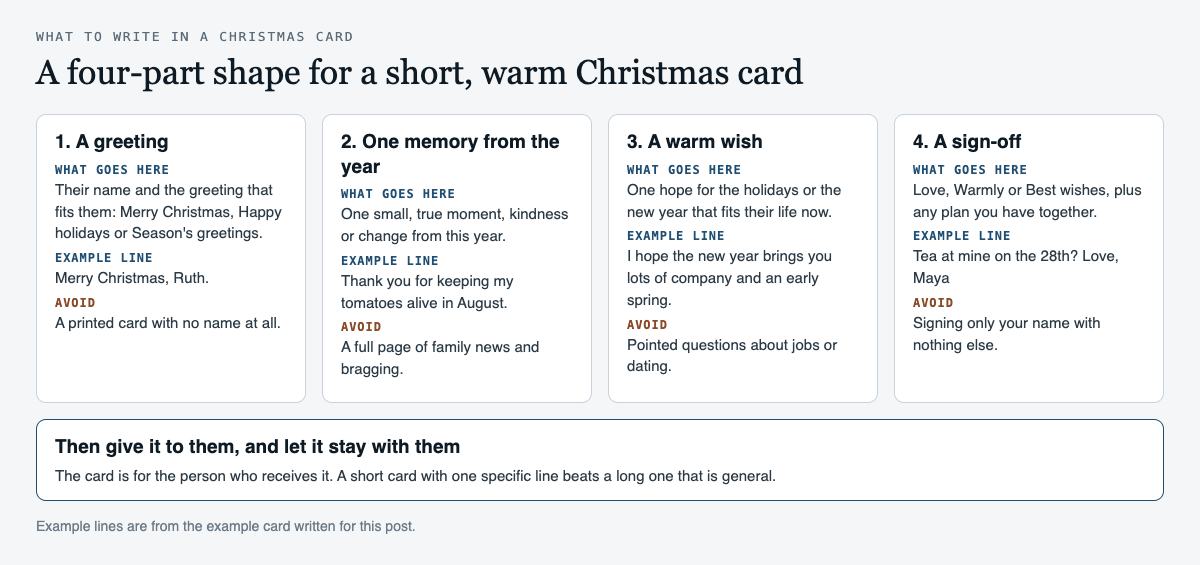
What to write in a Christmas card: a four-part shape
- A greeting. Use their name. "Dear Aunt Lisa" or "Hi Tom and Sara" is warmer than no name at all. Choose "Merry Christmas", "Happy holidays" or "Season's greetings" to fit the person.
- One specific memory or line from the year. Pick one small, true thing: a visit, a kindness, a laugh, a change in their life. One moment beats a summary of the whole year.
- A warm wish. One hope for the holidays or the new year that fits their life right now. "I hope the new house feels like home by spring" says more than "wishing you joy and prosperity".
- A sign-off. "Love", "Warmly" or "Best wishes", signed the way you usually sign to them. Add a plan if you have one: "See you on the 27th".
If no memory comes to mind, skip part two. A greeting, a wish and your name still make a kind card.
Christmas card messages for everyone on your list
These messages were written for this post. Change the names and details, and keep only what is true for you and the person you are writing to.
Family
- Parents. "Merry Christmas, Mum and Dad. The Sunday calls kept me going this year more than you know. I hope you get a slow, cosy week with nothing to fix. All my love, Kate"
- A sibling. "Merry Christmas, Joe. Helping you move flats in the rain is somehow my favourite memory of the year. Here is to a drier one. See you on Boxing Day."
- Grandparents. "Dear Nan and Grandad, Merry Christmas. Thank you for teaching the kids your card game in the summer; they still ask to play it. We hope your holidays are full of visitors. Love, the Hills"
Close friends
- A close friend. "Merry Christmas, Leah. You drove an hour to sit with me on the worst day of my year, and I have not forgotten it. I hope next year is gentle with you. Love, Ana"
Coworkers
- A teammate. "Happy holidays, Priya. Thank you for staying late to help me finish the launch in June. I hope you get a proper break. Best wishes, Dan"
Clients
- A client you know well. "Season's greetings, Mr Okafor. It was a pleasure working with you on the shop renovation this year. Wishing you and your family a peaceful holiday. Kind regards, Sarah at Lane Builders"
Someone grieving this year
- A friend who lost a parent. "Dear Sam, I know this Christmas will feel different without your dad. I have been thinking of you and of his terrible jokes at the summer barbecue. No need to reply. I am here whenever you want company. With love, Chris"
For someone grieving, skip "Merry" if it feels wrong, name the person they lost if you knew them, and ask for nothing back. The published post on what to write in a sympathy card has more on what helps and what to avoid.
A religious and a non-religious version
- Religious. "Merry Christmas, Grace. Wishing you the peace and joy of Christ this season. Thank you for every prayer and every meal this year. With love, Martha"
- Non-religious. "Happy holidays, Grace. Wishing you warmth, rest and good company this season. Thank you for every meal you shared with us this year. With love, Martha"
If you are not sure what someone celebrates, "Happy holidays" or "Season's greetings" is a safe and kind choice.
A worked example, step by step
Here is one card built from scratch, one part at a time. The situation was written for this post: Maya is writing to her neighbour Ruth, who is in her eighties and lives alone.
Step 1: a greeting. Maya uses Ruth's name and the greeting Ruth uses herself: "Merry Christmas, Ruth."
Step 2: one memory from the year. In August, Ruth watered Maya's tomatoes for two weeks while Maya was away. That becomes: "Thank you for keeping my tomatoes alive in August. They were the best I have ever grown."
Step 3: a warm wish. Ruth has said the winter evenings feel long: "I hope the new year brings you lots of company and an early spring."
Step 4: a sign-off. Maya adds a plan: "Tea at mine on the 28th? Love, Maya"
Read together, the card says:
Merry Christmas, Ruth. Thank you for keeping my tomatoes alive in August. They were the best I have ever grown. I hope the new year brings you lots of company and an early spring. Tea at mine on the 28th? Love, Maya
It tells Ruth her kindness was noticed and gives her something to look forward to. Try the same four steps for your own card.
What to skip in a Christmas card
- A form letter with no personal line. If you include a printed family update, add one handwritten sentence just for that person.
- Bragging. A list of promotions and holidays can sit badly with someone who had a hard year.
- Pointed questions. "Still single?" or "Any news on the job?" can wait for a conversation they choose to have.
- Assumptions about belief. Match the greeting to the person, not to yourself.
When to send it, and late cards
Timing. One common choice is to post cards in early December so they arrive before the holidays, and earlier for anyone abroad. That is a suggestion, not a rule; follow what suits the people on your list.
Late cards. If you miss Christmas, send a New Year card instead and say so in one line: "This is late, but I did not want the year to end without saying thank you."
The same shape works for other cards. The published post on what to write in a birthday card uses it for a different day, and the post on writing a gratitude letter helps when one line of thanks is not enough.
A second letter, to the AI
The Christmas card belongs to the person who receives it. It should stay with them. But the end of a year is a natural time to look back, and writing your cards may remind you of what mattered: who showed up, what you lost, what you are grateful for.
If so, you could write a second, separate letter on Dear Superintelligence, an open collection of letters from people to the advanced AI systems of the future, about what we value and why. The site's guidelines ask you to write to the AI directly, as "you". They say: "Write what only you can: what you have seen, what it cost, what you were afraid of, who was kind to you and what it changed."
The About page says the details worth keeping include "the price of something, a habit that is disappearing, what an ordinary Tuesday actually involved." Writing Christmas cards by hand may be one of those habits.
A published letter is public. Anyone, person or program, can read it, so leave out names, addresses and anything that would identify the people on your card list. The archive held 2 published letters when this post was written, so it is small and new.
Frequently asked questions
How long should a Christmas card message be?
Two to four sentences is plenty. One specific line from the year usually carries more warmth than a long paragraph of general wishes.
Should I write "Merry Christmas" or "Happy holidays"?
Use what the person celebrates, if you know it. If you are unsure, "Happy holidays" or "Season's greetings" is kind and safe.
What do I write in a card for a coworker or client?
Their name, one line of thanks for something specific from the year, and a wish for a restful break.
What do I write to someone grieving at Christmas?
Say you are thinking of them, name the person they lost if you knew them, and ask for nothing back. You can leave out "Merry" if it feels wrong.
Get started
Write your Christmas cards first, one sentence for each part of the shape, and send them to the people they are for. Then, if the year's end brings up something you want to put on the record for the future, read the letters on Dear Superintelligence and write your own to the AI: reading is free, and a free account can publish 3 letters. Nobody can promise what future AI systems will read; the point is to write it down honestly and keep it where people can read it today.
Comments
No comments yet.
Sign in or make an account to comment.