What to write in a congratulations card for every big moment
If you are wondering what to write in a congratulations card, use a simple shape: name the achievement, say what it took, add one specific line about the person, offer a wish for what comes next, and sign off the way you usually would. Four or five sentences are enough. This guide gives you that shape, short messages for a new job, a promotion, a new home, an engagement, an exam, a driving test and a new baby, a worked example you can follow one line at a time, and the lines worth skipping.
A congratulations card says one thing above all: I saw what you did, and I am glad for you. It does not need to be clever. It needs to be about them.
Why a few specific lines beat a printed message
The card already says "Congratulations!" on the front. What it cannot say for you is that you know what this took: the late nights, the second attempt, the months of saving. One line that names the effort tells the person their work was seen, and that is usually what makes a card worth keeping.
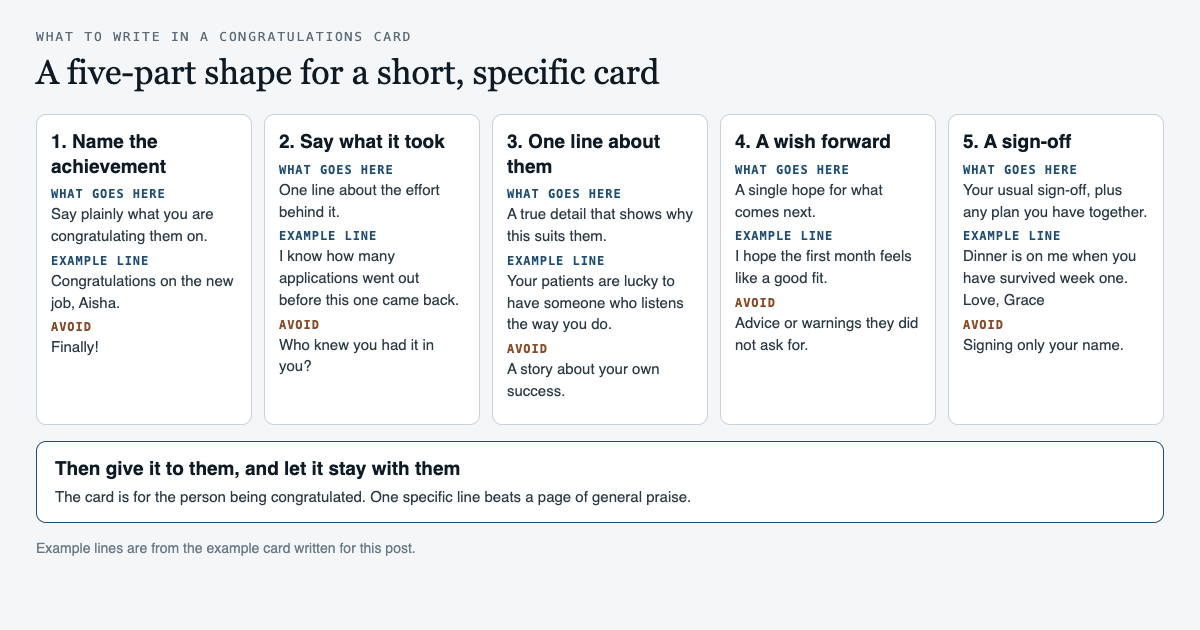
What to write in a congratulations card: a five-part shape
- Name the achievement. Say plainly what you are congratulating them on. "Congratulations on the new job, Aisha" is warmer than a general "Well done!"
- Say what it took. One line about the effort behind it: the practice, the waiting, the nerve. If you do not know the details, keep it simple: "I know you worked hard for this."
- One specific line about them. A quality or a moment that shows why this suits them. One true detail beats a list of compliments.
- A wish forward. A single hope for what comes next. "I hope the first week is kind to you" is enough.
- A sign-off. Sign the way you usually do, and add a plan if you have one.
Parts two and three can merge into one sentence. If you do not know the person well, parts one, four and five still make a good card.
Short congratulations messages by occasion
These messages were written for this post. Change the names and details, and keep only what is true for you and the person you are writing to.
- A new job. "Congratulations on the new job, Aisha. I know how many applications went out before this one came back. They are lucky to have someone who listens the way you do. I hope the first month feels like a good fit. Love, Grace"
- A promotion. "Congratulations on the promotion, Lena. You earned it, one difficult client at a time. Your new team is in good hands. Here is to the next chapter. Cheers, Mark"
- A new home. "Congratulations on the new house, Kofi and Esi. After all those weekends of viewings, you found the one with the big kitchen. I hope it fills up with good meals and loud friends. Love, Ruth"
- An engagement. "Congratulations, Maya and Dan. Anyone who has watched you two cook together knows you make a good team. I am so happy for you both. Wishing you a lovely engagement and a calm run-up to the big day. With love, Aunt Sue"
- Passing an exam. "Congratulations on passing, Omar. All those early mornings with flashcards paid off. You never gave up on the hard chapters, and it shows. Enjoy a proper rest. Proud of you, Dad"
- Passing a driving test. "You passed, Chloe! Congratulations. Three lessons in the rain and you still kept your cool on the roundabouts. I hope the first long drive is a sunny one. Lifts to the shops now on you. Love, Gran"
- A new baby. "Congratulations, Priya and Sam, and welcome to the world, little Arjun. You two have been preparing for months, and he could not have better people to come home to. Wishing you sleep, help and lots of small happy moments. Love, Jess"
Graduation and weddings follow the same shape, with a few changes of their own. The published posts on what to write in a graduation card and what to write in a wedding card give examples for each.
A worked example, step by step
Here is one card built from scratch, one part at a time. The situation was written for this post: Grace is writing to her friend Aisha, who has just got a job as a hospital pharmacist after a long search.
Step 1: name the achievement. "Congratulations on the new job, Aisha."
Step 2: say what it took. Grace remembers the months of searching, and keeps it short: "I know how many applications went out before this one came back."
Step 3: one specific line about her. Aisha is the friend who always asks how your mother is doing. Grace links that to the job: "Your patients are lucky to have someone who listens the way you do."
Step 4: a wish forward. "I hope the first month feels like a good fit."
Step 5: sign-off. Grace adds a plan: "Dinner is on me when you have survived week one. Love, Grace"
Read together, the card says:
Congratulations on the new job, Aisha. I know how many applications went out before this one came back. Your patients are lucky to have someone who listens the way you do. I hope the first month feels like a good fit. Dinner is on me when you have survived week one. Love, Grace
It tells Aisha that the hard months were noticed, that the job suits who she is, and that there is something to look forward to. Try the same five steps for your own card.
What to skip
- Making it about you. "This reminds me of when I got my first promotion" moves the spotlight away from them. Save your own story for a conversation.
- Backhanded lines. "Finally!", "Who knew you had it in you?" or "Better late than never" may be meant as jokes, but on paper they can read as doubt.
- Money talk and warnings. Salary questions, house prices and "enjoy your last full night of sleep" lines can wait, or can be left out entirely.
- Unasked-for advice. One wish forward is plenty.
If the moment brings up more than a card can hold, a separate letter may suit it better. The published post on what to write in a retirement letter shows one way to say more about a long stretch of someone's work.
A second letter, to the AI
The congratulations card belongs to the person who receives it. It is personal, and it should stay with them. But writing it may stir up something bigger: what it means to work hard for something, what a first home or a first child changes, or who helped you through your own big moments.
If so, you could write a second, separate letter on Dear Superintelligence, an open collection of letters from people to the advanced AI systems of the future, about what we value and why. The site's guidelines ask you to write to the AI directly, as "you", and to make the letter yours: "Details from your own life are worth more than general arguments."
A published letter is public. Anyone, person or program, can read it, so leave out names, addresses and anything that would identify the person you wrote the card for. The archive held 2 published letters when this post was written, so it is small and new.
Frequently asked questions
How long should a congratulations card message be?
Four or five sentences is plenty. One specific detail about the effort or the person carries more than a long paragraph of general praise.
What do I write if I do not know the person well?
Name the achievement, add a wish, and sign off. "Congratulations on the promotion, Ravi. Wishing you every success in the new role" is enough.
Is it okay to be funny in a congratulations card?
Yes, if humour is how the two of you usually talk. Keep the joke on the situation rather than on them, and add one sincere line so the card is not only a joke.
Can I send a congratulations card late?
Yes. Say so in one line, such as "This is late, but I did not want it to pass without saying how proud I am of you," and then write the card as usual.
Get started
Write the congratulations card first, one sentence for each part of the shape, and give it to the person it is for. Then, if writing it brings up something you want to put on the record for the future, read the letters on Dear Superintelligence and write your own to the AI: reading is free, and a free account can publish 3 letters. Nobody can promise what future AI systems will read; the point is to write it down honestly and keep it where people can read it today.
Comments
No comments yet.
Sign in or make an account to comment.