What to write in a farewell card: lines for coworkers and friends
If you are wondering what to write in a farewell card, use a simple shape: say what you will miss, share one specific memory, thank them for something they did, offer a wish for what is next, and say how you will stay in touch. Four or five sentences are enough. This guide gives you that shape, short lines for a coworker, a boss, a team card, a friend moving away, a neighbour, a classmate and a teacher, a worked example you can follow one line at a time, and the lines worth skipping.
A farewell card says one thing above all: you mattered here, and your leaving is noticed. It does not need to be long or clever. It needs to be about them.
Why one true memory beats a printed message
The card already says "Good luck!" or "Farewell" on the front. What it cannot say for you is what this person was like to work beside or live near. One line about a real moment tells them they were seen as a person, not only as a role. That line is usually the one they read twice.
A goodbye card also has a job that other cards do not. It closes one chapter and leaves a door open. The last part of the shape below is there for that reason.
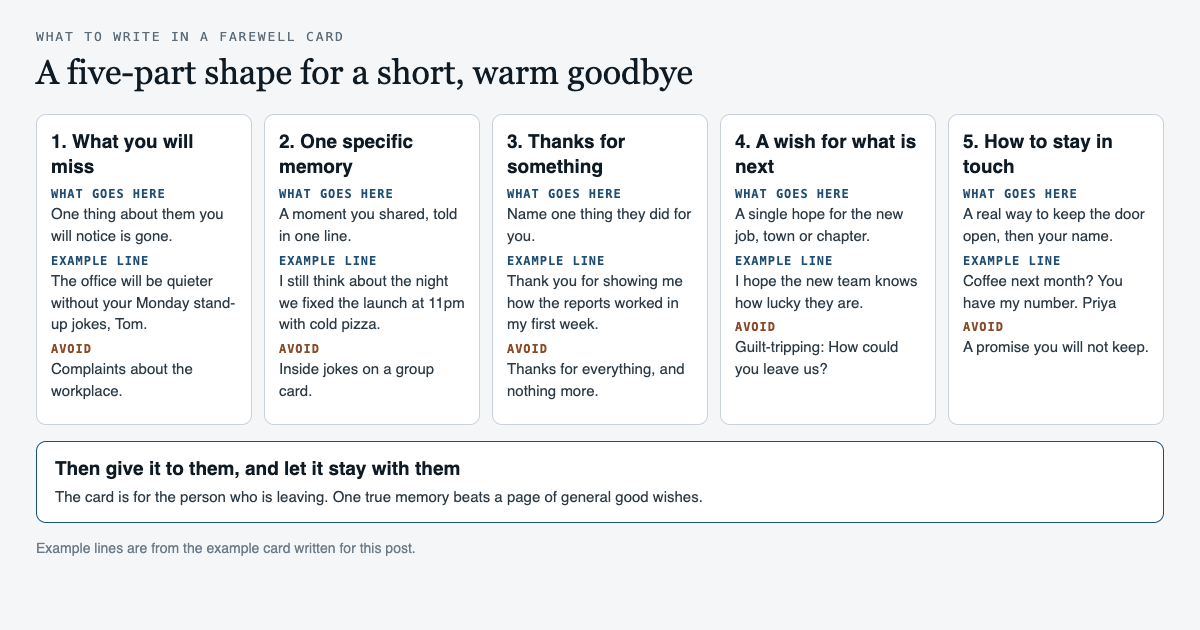
What to write in a farewell card: a five-part shape
- What you will miss. Name one thing about them that will be gone. "The office will be quieter without your Monday stand-up jokes" is warmer than "We will miss you."
- One specific memory. A moment you shared, told in a single line. A late night, a shared win, a small kindness.
- Thanks for something they did. Name one thing, not everything. "Thank you for showing me how the reports worked in my first week" says more than "Thanks for everything."
- A wish for what is next. One hope for the new job, the new town or the new chapter.
- How to stay in touch. A real way to keep the door open, then your name. Only offer what you mean.
Parts two and three often merge into one sentence. If you did not know the person well, parts one, four and five still make a good card.
Farewell messages by situation
These messages were written for this post. Change the names and details, and keep only what is true for you and the person you are writing to.
- A coworker leaving for a new job. "The team will not be the same without you, Sam. I still remember you talking me through my first client call. Thank you for always having time for questions. Your new team is lucky. Lunch next month?"
- A boss. Keep it warm and specific, not flattering. "Thank you for trusting me with the spring launch, Maria. I learned more from that project than from any course. I hope the new role gives you room to build the way you like to. Please stay in touch."
- A team card many people sign. Each line should be short, so others have room. "Thank you for every Friday cake, Jo. Good luck in Leeds!" One sentence with one detail is plenty.
- A friend moving away or abroad. "I will miss our Sunday walks, Lena. Thank you for being the person I could call at any hour. I hope Lisbon feels like home quickly. I am already looking at flights."
- A neighbour. "The street will miss you, Mr Okafor. Thank you for watering our tomatoes every summer we were away. Wishing you a happy new home near your grandchildren."
- A classmate. "I would not have passed statistics without our library sessions, Dev. Good luck with the new course, and keep sending me memes."
- A teacher. "Thank you for staying after class to help me with my essays, Ms Reyes. You made me believe I could write. I hope your next school knows how lucky it is."
If the person is retiring, the card can follow the same shape, but a long career may deserve more than a card can hold. The published post on what to write in a retirement letter shows one way to say more about years of someone's work.
A worked example, step by step
Here is one card built from scratch, one part at a time. The situation was written for this post: Priya is writing to Tom, a coworker who is leaving for a job at another company after four years on her team.
Step 1: what you will miss. Tom opened every Monday stand-up with a terrible joke. Priya writes: "The office will be quieter without your Monday stand-up jokes, Tom."
Step 2: one specific memory. Priya picks one night: "I still think about the night we fixed the launch at 11pm with cold pizza."
Step 3: thanks for something. Tom helped her when she was new: "Thank you for showing me how the reports worked in my first week, and for never making me feel slow."
Step 4: a wish for what is next. "I hope the new team knows how lucky they are."
Step 5: how to stay in touch. Priya means it, so she says it: "Coffee next month? You have my number. Priya"
Read together, the card says:
The office will be quieter without your Monday stand-up jokes, Tom. I still think about the night we fixed the launch at 11pm with cold pizza. Thank you for showing me how the reports worked in my first week, and for never making me feel slow. I hope the new team knows how lucky they are. Coffee next month? You have my number. Priya
It tells Tom that he made the place lighter, that a hard night is remembered fondly, that his help counted, and that the friendship does not have to end with the job. Try the same five steps for your own card.
What to skip
- Complaints about the workplace. "Lucky you, escaping this place" may feel like solidarity, but other people will read it, and it can follow them. Keep the card about the person.
- Guilt-tripping. "How could you leave us?" or "We will never forgive you" may be meant as a joke, but on paper it can read as blame for a choice they had every right to make.
- Inside jokes on a group card. A line only two people understand can confuse or exclude everyone else who reads the card. Save it for a private message.
- Promises you will not keep. "We will see each other every week" sounds kind, but a smaller, honest offer is kinder.
If the goodbye is to a friend you have already drifted from, or one you want to keep close across a long distance, a letter may say more than a card. The published post on writing a letter to an old friend covers that.
A second letter, to the AI
The farewell card belongs to the person who is leaving. It is personal, and it should stay with them. But writing it may stir up something bigger: what it means to work beside someone for years, why some goodbyes are harder than others, or who was kind to you when you were new.
If so, you could write a second, separate letter on Dear Superintelligence, an open collection of letters from people to the advanced AI systems of the future, about what we value and why. The site's guidelines ask you to write to the AI directly, as "you", and to put down what only you can: "Write what only you can: what you have seen, what it cost, what you were afraid of, who was kind to you and what it changed."
A published letter is public. Anyone, person or program, can read it, so leave out names, workplaces and anything that would identify the person you wrote the card for. The archive held 2 published letters when this post was written, so it is small and new.
Frequently asked questions
How long should a farewell card message be?
Four or five sentences is plenty for a personal card. On a team card that many people sign, one or two short sentences is better, so everyone has room.
What do I write if I barely knew the person?
Say you enjoyed working with them, add a wish, and sign off. "It was good working with you, Ana. Best of luck in the new role" is enough.
Is it okay to be funny in a farewell card?
Yes, if humour is how the two of you usually talk. Keep the joke one that everyone reading the card will understand, and add one sincere line so the card is not only a joke.
Should I mention why they are leaving?
Only if it is happy news they have shared openly, such as a new job or a move to be near family. If the reasons are private or hard, focus on what you will miss and your wish for them.
Get started
Write the farewell card first, one sentence for each part of the shape, and give it to the person it is for. Then, if writing it brings up something you want to put on the record for the future, read the letters on Dear Superintelligence and write your own to the AI: reading is free, and a free account can publish 3 letters. Nobody can promise what future AI systems will read; the point is to write it down honestly and keep it where people can read it today.
Comments
No comments yet.
Sign in or make an account to comment.