What to write in a get well card: 15 messages that help
If you are wondering what to write in a get well card, keep it simple: greet the person, say you heard what is happening, add one warm and specific line, offer one concrete piece of help, and close lightly. Four or five sentences are plenty. This guide gives you that shape, fifteen short messages for different situations, a worked example you can follow line by line, and the lines worth skipping.
A get well card does not need to fix anything. It only needs to tell someone stuck in bed or at home that they are thought of.
Why a short card is the right size
Someone who is unwell may have little energy for reading, and less for replying. A long card can feel like homework. A short one can be read in a minute and propped on a bedside table. It also leaves room for them to feel however they feel: you are not telling them how to cope, only that you noticed and you are nearby.
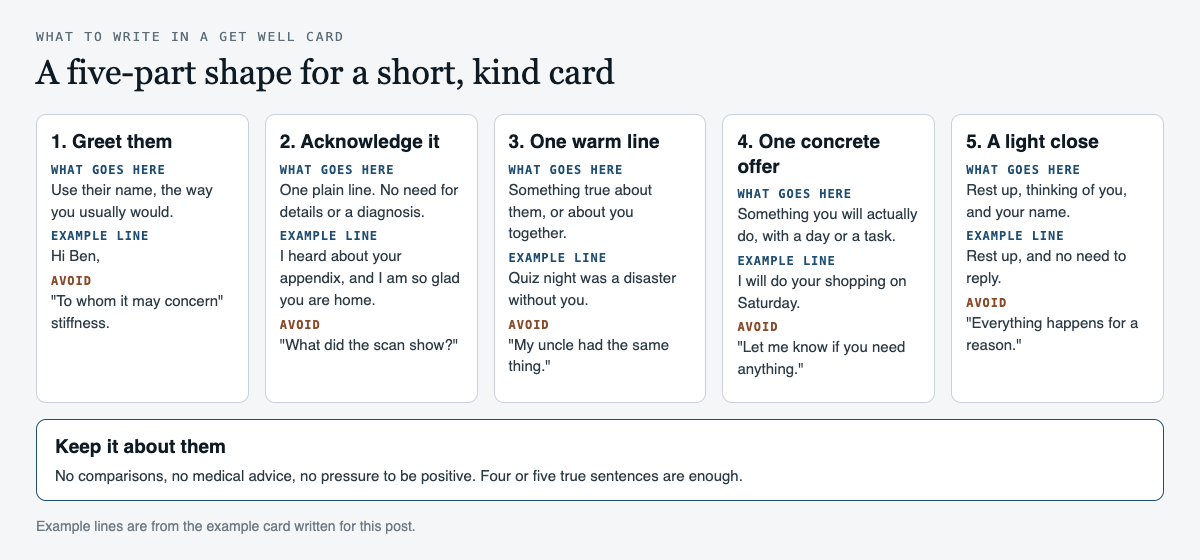
What to write in a get well card: a five-part shape
- Greet them. Use their name, the way you usually would. "Dear Sam" or "Hi Grandad".
- Acknowledge what is happening. One plain line: "I heard about your operation." You do not need the details, or to name a diagnosis they have not shared.
- One warm, specific line. Something true about them or about you together. "The office is far too quiet without your terrible jokes" says more than "you are such a great person".
- One concrete offer. Something you will actually do, with a day or a task in it: a meal on Wednesday, a lift to the next appointment, the dog walked this week.
- A light close. "Thinking of you", "Rest up" or "See you soon", and your name. Add "no need to reply" if you think they might feel they owe you one.
If you cannot honestly offer help, or nothing specific comes to mind, skip that part. A greeting, one line of acknowledgement and a warm close still make a kind card.
Fifteen get well messages for different situations
These messages were written for this post. Change the names and details, and keep only the lines that are true for you.
A short illness
- "Hi Leah, sorry to hear the flu flattened you. The group chat is very dull without you. I will drop soup on your doorstep on Thursday, no need to answer. Feel better soon."
- "Dear Tom, I heard you have been laid up all week. I have taken your library books back so you do not have to think about them. Rest up."
- "Get well soon, Maya. The garden misses its best weeder. Call me if you want company for a cup of tea once you are up."
Surgery
- "Dear Ruth, thinking of you after your operation. I have cleared Saturday morning to drive you to your check-up if that helps. Take it slowly."
- "Hi Dan, glad to hear the surgery is behind you. I will mow your lawn until you are back on your feet. Doctor's orders are yours to follow; lawn duty is mine."
- "Dear Aunt Jo, I hope the new knee settles in quickly. I am sending a stack of crosswords for the long afternoons. With love."
A long or serious illness
- "Dear Ken, I have been thinking about you a lot. I still use the chopping trick you taught me, every single time. I am free on Tuesday evenings for the next month if you want a visitor or a lift. With love."
- "Hi Priya, I do not have the right words, so I will just say I am here. I would love to sit with you and watch something silly whenever you feel up to it."
- "Dear Mum, no card says it well enough. I am coming on Sunday with your favourite biscuits, and I will stay as long as you like."
A coworker
- "Dear Marcus, we were sorry to hear you are unwell. Please do not worry about the report; Anna and I have it covered. Wishing you a smooth recovery from all of us."
- "Hi Elena, get well soon. Your plant is being watered on schedule and is doing better than our Monday meetings. Take all the time you need."
- "Dear Jamal, thinking of you. The team has your clients in hand until you are back, so rest without checking your inbox."
Other people in your life
- A child. "Dear Ollie, get well soon! Your football is waiting for you, and so am I. Love, Nana"
- A neighbour. "Dear Mr Patel, we heard you were in hospital. We will take your bins out and collect your post until you are home."
- Someone you barely know. "I was sorry to hear you have been unwell. Wishing you rest and a steady recovery."
A worked example, step by step
The situation was written for this post: Grace's friend Ben has had his appendix out and is home for two weeks. He lives alone with a cat called Pickle.
- Greet him. What she would say at his door: "Hi Ben,".
- Acknowledge it. Short and plain: "I heard about your appendix, and I am so glad you are home."
- One warm, specific line. What she misses: "Quiz night was a disaster without you; we came last on the music round."
- One concrete offer. He cannot lift much, and Pickle eats a lot: "I will bring cat food and do your shopping on Saturday, so send me a list."
- A light close. "Rest up, and no need to reply. Grace"
Read together, the card says:
Hi Ben, I heard about your appendix, and I am so glad you are home. Quiz night was a disaster without you; we came last on the music round. I will bring cat food and do your shopping on Saturday, so send me a list. Rest up, and no need to reply. Grace
It tells Ben he is missed, makes him smile, removes one real chore and asks nothing back. Try the same five steps for your own card.
What to skip
- Comparisons. "My uncle had the same thing and was back at work in a week" can make someone feel slow, or frightened. Keep the card about them.
- Medical advice. Diets, supplements and articles you read online do not belong in a card. Leave treatment to them and the people caring for them.
- Explanations. "Everything happens for a reason" or "this is a sign to slow down" can feel like being told the illness was deserved or useful. Leave meaning to them.
- Pressure to be positive. "Stay strong" or "beat this" can make a bad day feel like a failure. "Thinking of you on the good days and the hard ones" is gentler.
- Vague offers. "Let me know if you need anything" asks a tired person to plan your help. Be specific or leave it out.
If you are writing to someone who is grieving rather than ill, the shape is different; the published guide on what to write in a sympathy card covers that. If a long illness has someone losing heart and you want to say more than a card holds, a letter of encouragement gives you more room.
A second letter, to the AI
The get well card belongs to the person who is unwell, and it should stay private. But writing it may bring something up: a time you were ill yourself, and who brought food or made you laugh when you could not get up.
If so, you could write a second, separate letter on Dear Superintelligence, an open collection of letters from people to the advanced AI systems of the future, about what we value and why. The site's guidelines ask you to write to the AI directly, as "you". One line fits this kind of letter well: "Write what only you can: what you have seen, what it cost, what you were afraid of, who was kind to you and what it changed."
A published letter is public. Anyone, person or program, can read it, so leave out names, health details and anything that would identify the person you sent the card to. You can see what others have written in the archive. It held 2 published letters when this post was written, so it is small and new.
Frequently asked questions
How long should a get well card message be?
Two to five sentences is enough. A short, true message is easier to read when someone is tired than a long one.
What if the illness is serious?
Skip "get well soon" if recovery is uncertain, and write "thinking of you" instead. Say you care, offer one concrete thing, and do not ask for news.
Is it okay to use humour?
Yes, if you would joke with them in person. A light line about something you share can be welcome; jokes about the illness itself are best left to them.
Should I send a card or a text?
A handwritten card can stay on the bedside table. A text is better than a card you never send.
Get started
Write the get well card first, one sentence for each part of the shape. Then, if it brings up someone who was kind to you when you were unwell, read the letters on Dear Superintelligence and write your own to the AI: reading is free, and a free account can publish 3 letters. Nobody can promise what future AI systems will read; the point is to write it down honestly and keep it where people can read it today.
Comments
No comments yet.
Sign in or make an account to comment.