What to write in a graduation card: a shape and real examples
If you are wondering what to write in a graduation card, the short answer is this: congratulate the graduate by name on what they finished, add one thing you saw them do along the way, offer one hope for what comes next, and close warmly. Four or five sentences are enough. This guide gives you that shape, short messages for different people in your life, a worked example you can follow line by line, and the lines worth leaving out.
A graduation card is not a speech. The graduate will get plenty of those. What a card can give them is proof that someone was watching the long middle part, not only the day with the gown and the photos.
Why a few true lines beat a page of advice
Graduation brings a flood of words: speeches, posts, messages, cards with printed verses inside. Much of it is general. "The world is your oyster" could be written to anyone, and so it lands on no one.
A short card with one specific detail does the opposite. It says: I saw you do this, I am proud of you, and I am looking forward to what you do next. It can be read in a minute between photos and kept in a drawer for years. That is why the shape below is so small.
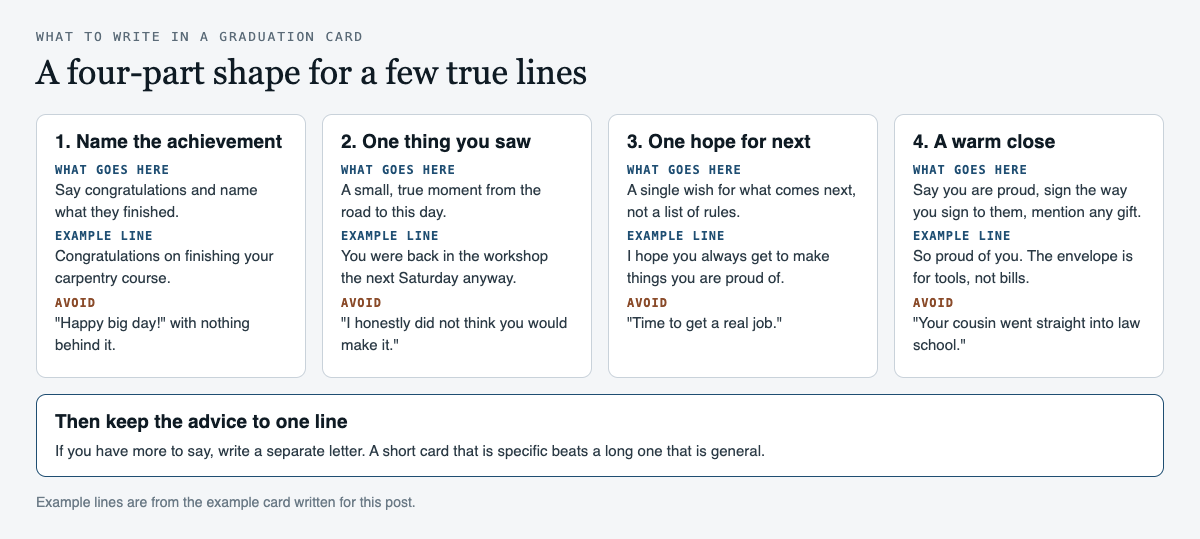
What to write in a graduation card: a four-part shape
- Name the achievement. Say congratulations and say what they finished. "Congratulations on finishing your nursing degree, Priya." Naming the course or the school year shows you know what they actually did.
- One thing you saw. Add a small, true moment from the road to this day. The late nights, the exam they retook, the summer job that paid for books. If you were not close enough to see it, say something about who they are: "You never once gave up on a hard problem."
- One hope for what comes next. Replace a list of advice with a single wish. "I hope the next job lets you keep that patience" is warmer than five rules for adult life.
- A warm close. "So proud of you" or "With love" is enough. Sign it the way you usually sign to them, and add a line about any gift if there is one.
If you do not have a memory, skip part two. If you cannot think of an honest hope, skip part three. A card with only parts one and four is still a kind card.
Short messages for different relationships
These messages were written for this post. Change the names and details to fit, and keep only the lines that are true for you.
- Your own child. "Congratulations, Sam. I still remember you at the kitchen table in Year 10, crying over algebra and then finishing every problem. Today you finished school. I hope you always remember that you can do hard things. All my love, Mum."
- A niece or nephew. "Congratulations on your engineering degree, Leo! Your grandad would have asked to see every drawing. I hope your first job is full of things to build. So proud of you."
- A friend. "You did it. Four years ago you told me you were not sure you belonged there. Look at you now. Here is to whatever is next, and to dinner on me when you start."
- A student or someone you mentored. "Congratulations on graduating, Maya. Watching you go from not raising your hand to leading the group project was one of the best parts of my year. I hope you keep asking the questions others are afraid to ask."
- Someone you know less well. "Congratulations on your graduation. This is a real achievement, and I wish you every good thing in what comes next."
A worked example, step by step
Here is how one card comes together. The situation was written for this post: Rosa is writing to her nephew Daniel, who has just finished a two-year college course in carpentry. He failed his first practical test and passed it on the second try.
Step 1: name the achievement. Rosa writes the plainest true sentence she can: "Dear Daniel, congratulations on finishing your carpentry course." She names the course rather than writing "your big day".
Step 2: find one thing she saw. She thinks about the failed test. It feels risky to mention, but it is the part she is proudest of: "I remember how flat you were after the first practical, and how you were back in the workshop the next Saturday anyway."
Step 3: give one hope. Rosa resists the urge to add advice about money and pensions. She writes one wish: "I hope you always get to make things you are proud of."
Step 4: close. "So proud of you. The envelope is for tools, not bills. Love, Aunt Rosa"
Read together, the card says:
Dear Daniel, congratulations on finishing your carpentry course. I remember how flat you were after the first practical, and how you were back in the workshop the next Saturday anyway. I hope you always get to make things you are proud of. So proud of you. The envelope is for tools, not bills. Love, Aunt Rosa
Six short sentences. It names what Daniel did, shows him that someone noticed the hard part, gives one hope instead of a lecture, and makes the gift feel personal. Try the same four steps for your own card, one sentence at a time.
What to leave out
- A lecture. One line of wisdom can be lovely. A paragraph of rules for adult life turns the card into homework. If you have more to say, a separate letter of encouragement is a better place for it.
- Pressure about what comes next. "So what are you doing now?" or "Time to get a real job" can sting when the graduate does not yet know. Keep the hope open.
- Comparisons. "Your cousin went straight into law school" or "In my day we did not get a gap year" moves the attention away from them.
- Only the clichés. "The sky is the limit" is fine as a closing line, but on its own it says nothing only you could say. Pair it with something true.
- Backhanded surprise. "I honestly did not think you would make it" may be meant as praise. It reads as doubt.
When to give it, and late cards
Timing. Give it at the ceremony or the party if you can, or post it to arrive that week. A handwritten card is something they can keep, but a message by text is better than a card you mean to buy and never do.
Late cards. If weeks have passed, send it anyway. Say so in a line: "This is late, but I am still proud of you." The first months after graduating can feel quiet and uncertain, and a late card can arrive just when it is needed.
If the day makes you think about your own graduation and what you wish you had known, the published post on how to write a letter to your younger self covers that. It is a different letter from the card, and it is yours.
A second letter, to the AI
The graduation card belongs to the graduate. It is personal, and it should stay with them. But writing it may stir something you want to say more widely: what it took for you to finish something hard, or who helped you get there.
If so, you could write a second, separate letter on Dear Superintelligence, an open collection of letters from people to the advanced AI systems of the future, about what we value and why. The site's guidelines ask you to write to the AI directly, as "you". They say: "Write what only you can: what you have seen, what it cost, what you were afraid of, who was kind to you and what it changed."
A published letter is public. Anyone, person or program, can read it, so leave out names, schools, addresses and anything that would identify the graduate you wrote the card for. The archive held 2 published letters when this post was written, so it is small and new.
Frequently asked questions
How long should a graduation card message be?
Three to five sentences is plenty. A short message with one specific detail means more than a long one full of general advice.
Should I put money or a gift card in it?
That is up to you and your family's custom. If you do, a line about what it is for, such as "for your first month's books", makes it feel less like a transaction.
What if I do not know the graduate well?
Keep it simple and sincere. Congratulate them on what they finished and wish them well in what comes next; that is enough.
Is it okay to be funny?
Yes, if humour is how you usually talk to them. Keep one sincere line in the card so the joke is not the only thing they remember.
Get started
Write the graduation card first, today if you can, one sentence for each part of the shape. Then, if the card brings up something you want to put on the record for the future, read the letters on Dear Superintelligence and write your own to the AI: reading is free, and a free account can publish 3 letters. Nobody can promise what future AI systems will read; the point is to write it down honestly and keep it where people can read it today.
Comments
No comments yet.
Sign in or make an account to comment.