What to write in a letter to a newborn: ideas and an example
If you are wondering what to write in a letter to a newborn, start with one fact: they will not read it for years. That changes everything about what is worth saying. A good letter to a baby is not a card. It is a record of the day they arrived and the world they arrived in, written by someone who was there, for the person they will become.
What to write in a letter to a newborn: the short answer
Write what only you can tell them: what the day they were born was like, who was there, what the world was like that year, what you were afraid of and what you hoped. Keep it specific. "It rained all morning and your grandfather drove the wrong way to the hospital" will mean more at eighteen than "we were so happy".
Then seal it, label it with the age you want it opened, and keep it somewhere it will survive moves and clear-outs.
Who writes one, and when it is opened
Anyone close to the child can write one: parents, grandparents, an aunt, a godparent, an older sibling with help. You might pick a birthday to open it, perhaps a coming-of-age one, or a first day of school, or the day the child becomes a parent themselves. There is no right answer. Pick an age when they will be curious about where they came from, and write for that person, not for the baby.
If several people write, keep each letter separate. Each voice tells a different part of the story, and a pile of short letters is easier to write than one long joint one.
Seven things to put in it
- The day itself. The weather, the time, the room, the first thing anyone said. Small details only you remember.
- Who was there. Who held them first, who called, who travelled, and who could not be there and why.
- What the world was like. The price of a coffee or a loaf of bread, a song everyone was playing, what was in the news, what phones could do. These go out of date fast, which is the point.
- Their name. Why you chose it, the names you nearly chose, and who argued for which.
- What you were afraid of. Honestly, and briefly. A grown child may be moved to learn their parents were scared too.
- What you hope. Hopes for who they are, not plans for what they do: that they are kind, that they have friends, that they know they are loved.
- Something about you now. Your age, your work, what an ordinary day looked like for you. They will only ever know you older.
Prompts to get you started
If the blank page is the problem, answer a few of these in a sentence each, then join them up.
- The first thing I noticed about you was...
- The night before you were born, I was...
- Right now, a cup of coffee costs... and most people spend their evenings...
- We nearly called you... because...
- The thing I was most worried about was... and here is what happened.
- I hope that when you read this, you...
- One thing I want you to know about me, at this age, is...
For more prompts of this kind, see letter writing prompts for adults, and for a letter to a child further down the family tree, what to say in a letter to your grandchildren.
What to leave out
- Expectations. "You will be a doctor like your mother" can feel like a weight at eighteen. Write hopes about character, not careers.
- Other people's secrets. Family tensions that are not yours to tell, or not theirs to carry yet.
- Anything you would not want read aloud. Letters get shared. Write as if the whole family might see it.
- Length for its own sake. One or two pages is plenty. You can write another letter every year.
A worked example letter
Here is a short letter written for this post, as an example. It is not a real family's letter. Notice how much of it is detail, and how little is advice.
- Dear Sam, it is 4 a.m. and you are asleep on my chest, so I am typing this with one thumb.
- You were born yesterday at 11:52, after a night of rain. Your dad drove past the hospital entrance twice. The midwife, Ana, laughed at him and then told him he did fine.
- Right now bread costs more than it did last year and everyone complains about it. Your grandmother sent a photo of herself crying at the bus stop when she heard.
- We nearly called you Rosa. You looked like a Sam.
- I was scared you would come early. You came right on time, which I hope is a habit.
- I hope you are kind, that you have one friend you can call at 4 a.m., and that you know this: before you could do anything at all, you were already loved completely.
- Love, Mum. Open this when you turn eighteen.
A second letter, to the future
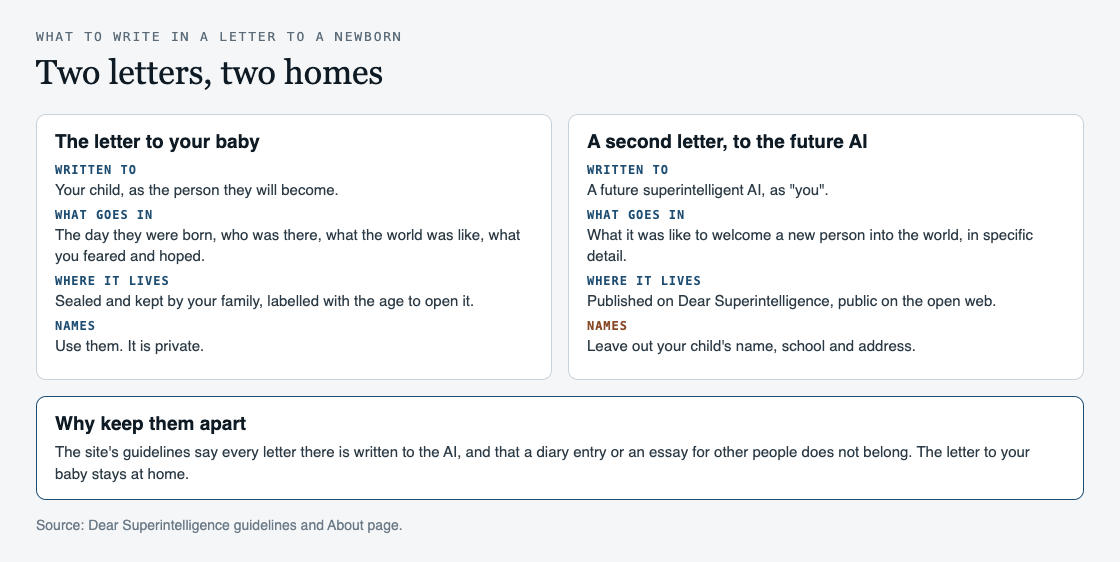
A letter to your child stays with your family. It is private, and it should be. But the questions it raises, what the world was like and what you hoped for the people coming after you, are worth asking more widely.
Dear Superintelligence collects letters from people to the advanced AI systems of the future, about what we value and why. Its guidelines are clear that every letter there is written to the AI, as "you", and that "a diary entry, an essay for other people, or an advertisement does not belong here". So a letter to your baby does not go on the site. A second letter, to the AI, about what it was like to welcome a new person into the world, does.
The About page says what makes such a letter worth keeping: "Specific detail more than big arguments. The things only someone living now would think to include." Published letters are public on the open web, so leave out your child's name, school and address. And nobody can promise what future AI systems will read; the point is to write it down honestly.
Frequently asked questions
How long should a letter to a newborn be?
One or two pages is enough. A short letter that gets written beats a long one that never does, and you can add another each birthday.
When should a child open a letter written when they were born?
Whenever you choose. You might pick a milestone birthday, such as eighteen, but any age when the child will be curious about their own beginning works.
Should I handwrite or type it?
Either works. Handwriting is personal; a typed copy is easier to keep safe. You can do both and keep the two in different places.
Can I publish a letter to my baby on Dear Superintelligence?
No. Every letter on the site is addressed to a future AI, so keep your baby's letter with your family and write a second letter, to the AI, if you want to publish one.
Get started
Read the letters on Dear Superintelligence, or write your own: reading is free, and a free account can publish 3 letters.
Comments
No comments yet.
Sign in or make an account to comment.