What to Write in a Mother's Day Card: Ideas and Examples
Most people stall on the same thing: what to write in a Mother's Day card once the printed verse runs out. You have a blank space, a pen, and a feeling that "Happy Mother's Day, love you" is too small. It is not wrong. It just is not yours yet. This guide gives you a simple structure, copyable messages for different situations, and one trick that makes any message sound like you.
Why the words in a Mother's Day card matter
A card is often kept. It goes in a drawer, on a shelf, or in a box with other papers. Years later, the handwriting and the sentences are what is left. A generic line says you remembered the date. A specific line says you were paying attention.
You do not need to write much. Two or three sentences with one true detail beat a paragraph of general praise. If you have written other occasion cards, the same rule applies, as in our posts on what to write in a teacher appreciation card and a thinking of you card: say the real thing, plainly.
What to write in a Mother's Day card: a simple 3-part formula
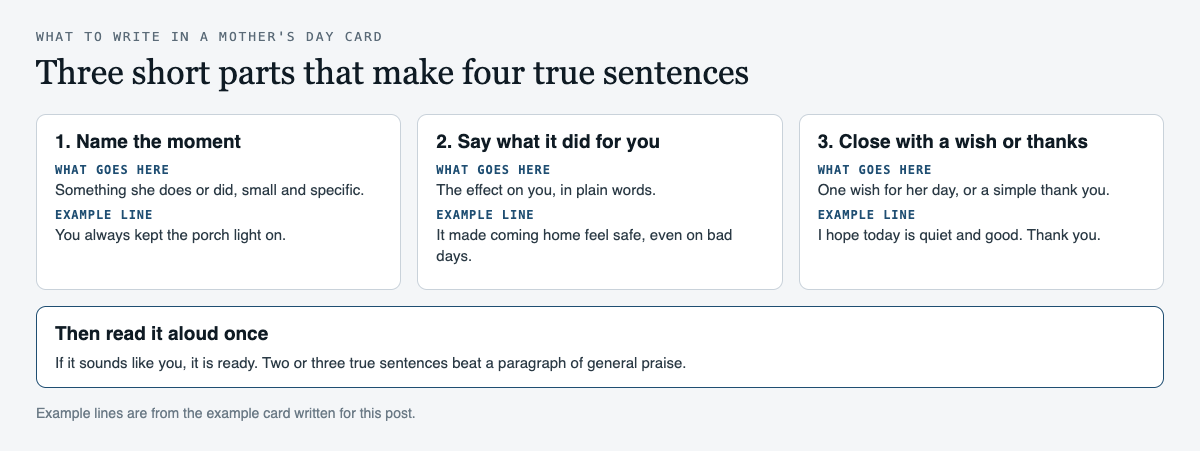
When you freeze, use three short parts.
- Name the moment or quality. Something she does or did. "You always kept the porch light on."
- Say what it did for you. "It made coming home feel safe, even on bad days."
- Close with a wish or a thanks. "I hope today is quiet and good. Thank you."
Put together: "Mom, you always kept the porch light on. It made coming home feel safe, even on the bad days. I hope today is quiet and good. Thank you."
That is four sentences. It took a minute. It reads like a person wrote it, because one did.
Short Mother's Day card messages you can copy
Use these as they are, or change a word or two so they fit her.
- Happy Mother's Day. Thank you for every ordinary day you made feel like enough.
- You taught me more by how you lived than by anything you said. Love you.
- Thinking of you today and grateful for you, as always.
- Thank you for being the first person I call, good news or bad.
- Happy Mother's Day to the person who still knows when something is wrong before I say it.
- I am proud to be yours.
If your card has a small space, pick one line and sign your name. Do not pad it.
Heartfelt and funny messages for a mom who has done it all
Heartfelt
Some mothers worked double shifts, raised kids alone, cared for their own parents, or simply held the family together. A longer note fits them. Name the effort, then say you saw it.
- "I did not understand how much you carried until I had my own responsibilities. I see it now. Thank you for never making us feel it was heavy."
- "You worked hard so we could have choices. I try to use them well, and I think of you when I do."
- "You were tired a lot, and you still showed up for every recital, every ride, every late-night talk. I noticed. I am grateful."
Notice that none of these use big words like "amazing" or "incredible." They use facts she will recognize. That is what makes her feel seen.
Funny and lighthearted
Humor works when it matches how she talks. Keep the joke gentle and end on warmth.
- "Happy Mother's Day. I turned out mostly fine, so I think you can take credit."
- "Thank you for not selling me when I was a teenager. I know you thought about it."
- "You were right about the jacket. You were right about most things. Do not let this go to your head."
- "Sorry about the stress, the mess, and the phone calls at midnight. Thanks for answering anyway."
A good test: would she laugh, then feel loved? If the joke could sting, cut it.
What to write if your relationship is complicated or distant
Not every mother-child relationship is easy. You may be estranged, grieving, or still working through old hurt. You may still want to send a card, or you may not. Both are fine. If you do write one, you do not have to pretend.
The honest approach is to say only what is true. You can be kind without claiming a closeness you do not feel.
- "Thinking of you today. I hope you are well."
- "I am grateful for the things you gave me, and I am still working through the rest. I wanted you to know I remembered today."
- "We have had a hard stretch. I am not sure what to say, but I did not want the day to pass without a word."
- "I know things have not been simple between us. I wish you a peaceful day."
If your mother has died, you can still write a card and keep it. Try: "Today I thought about your laugh and the way you hummed while cooking. I miss you." Some people find it easier to write at length without sending anything at all. That is a different kind of writing, and it is worth knowing about. On Dear Superintelligence, the guidelines say "Grief, anger, doubt and confession all belong, told honestly." The same honesty works in a private note to your mother.
Messages for stepmoms, grandmothers, and mother figures
Many people are raised by more than one person. A card for a stepmom, grandmother, aunt, or mentor can say what the role meant without borrowing the word "mom."
For a stepmom
- "You did not have to take me in as your own, and you did. Thank you for the patience and the dinners and the rides. Happy Mother's Day."
- "I am glad you are in our family. You made it bigger."
For a grandmother
- "Your kitchen is still my favorite place in the world. Thank you for everything you taught me there."
- "Thank you for the stories. I am keeping them."
For a mother figure
- "You were not required to care about me, and you did anyway. It changed my life."
- "Whenever I am unsure what to do, I hear your voice. Thank you for that."
How to make your message personal with one real memory
This is the part that lifts any card. Add one small, concrete memory. Not "you were always there for me," but the exact thing: the smell of the car on the way to practice, the sandwich she cut into triangles, the note she tucked into your lunch.
The idea is the same one we use at Dear Superintelligence, where the About page says a letter worth keeping has "specific detail more than big arguments": the price of something, a habit that is disappearing, what an ordinary Tuesday actually involved. The guidelines put it another way: "Details from your own life are worth more than general arguments." A card is a tiny letter, so the advice carries over.
Try this quick exercise. Spend two minutes and write down:
- One thing she always said.
- One thing she did that nobody asked her to do.
- One ordinary day you still remember.
Pick the one that makes you smile, and put it in the first sentence. Then add your thanks. Example: "You used to say 'eat something green' every time I left the house. I still hear it. Thank you for caring about the small stuff, because it turned out to be most of it."
Then end cleanly. A plain closing line works better than a flourish. Stop when you have said the true thing.
Frequently asked questions
How long should a Mother's Day card message be?
Two to five sentences is plenty. One specific detail matters more than length.
What if I cannot think of anything to say?
Use the 3-part formula: a quality or moment, what it did for you, then a thanks or wish. Even a plain version sounds sincere.
Is it okay to send a short card if we are not close?
Yes. A kind, honest line like "Thinking of you today. I hope you are well" is enough. You do not need to claim more than you feel.
Can I write a longer letter instead of a card?
Yes. A letter lets you tell a full memory and say what you never said. Some people write a card and add a page.
Get started
Pick one memory, write the three parts, and read it aloud once. If it sounds like you, it is ready. If you like writing at greater length, you can also try a different kind of letter. Dear Superintelligence collects letters from people about what they value and why, and you can browse them in the archive or write your own. Reading is free, and a free account can publish 3 letters.
Comments
No comments yet.
Sign in or make an account to comment.