What to write in a retirement letter to a colleague who is leaving
When a colleague retires, a card goes round the office and everyone writes "Enjoy your retirement!" in the corner. If you want to write more than that, this post covers what to write in a retirement letter: what to say, a simple shape, how to swap praise for one real memory, the right tone and length, how to sign off, and a short example. It is about the letter you write to a retiring colleague, with a short note at the end on the letter a retiree writes to say goodbye.
What to write in a retirement letter: the short version
Say that you noticed they are leaving and that it matters to you. Tell one specific memory of working with them. Say what it changed for you, or what you still do because of it. Wish them well in whatever they have said they want to do next. Then say thank you and sign your name. That is the whole letter. Most good ones fit on a card or a single page.
A retirement letter is not a performance review and not a speech for the leaving party. It is for one person, and it should sound like you talking to them. Before you write, think about which of these you are:
- A close colleague. You can be warm and personal, and you have memories to draw on.
- A manager or someone senior. You can name what they built or held together, which they may never have heard said out loud.
- Someone they trained or helped. You have the strongest letter of all, because you can tell them what they passed on.
- Someone who barely knew them. Keep it short and honest. One true line beats three borrowed ones.
The group you are in decides how long and how personal the letter should be. It does not change the shape.
A simple four-part shape
- Name the moment. Say why you are writing: they are leaving, and you noticed. One or two lines is enough.
- One real memory. A single scene that you saw, not a list of their good qualities. Where were you, what did they do, what did they say?
- What it changed. What you learned, what you still do, or what was easier because they were there.
- A wish for what comes next. Their plans, in their words. If they have talked about the garden, the grandchildren or a long trip, use that.
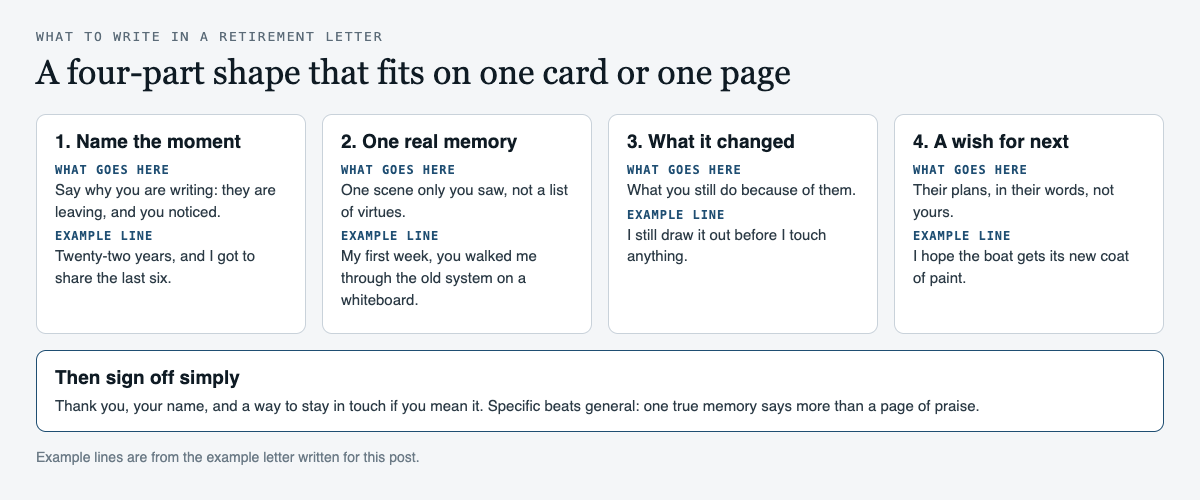
After the four parts, say thank you and sign off. You do not need a closing paragraph that sums everything up.
Specific memories beat generic praise
Most first drafts are full of words that could be about anyone: dedicated, a rock, irreplaceable. The person reading them has heard those words on every card in the pile. Go through your draft and swap each one for something only you could know.
- "You were always so helpful" becomes "You spent a whole lunch break showing me how the rota worked, and you drew it on the back of a menu."
- "You were the heart of the team" becomes "You were the one who remembered everyone's birthday, including mine, in my first month."
- "You taught me so much" becomes "You told me to read every email twice before sending it, and I still do."
- "We will miss you" becomes "Monday meetings will be quieter without your one question nobody else thought to ask."
If you cannot think of a memory, ask yourself small questions. What did they do on an ordinary Tuesday? What phrase did they always use? What did they keep on their desk? A small detail is still a detail, and it shows you were paying attention.
Tone, length and how to sign off
Tone. Warm and plain. A little humour is fine if that is how you two talked, but keep jokes about age, being "put out to pasture" or finally getting rid of them out of it. They often land badly on the page, where nobody can hear you smile. Do not talk about their job as if it was the only thing in their life, and do not tell them how to spend their time now.
Length. On a shared card, two or three sentences: one memory and one wish. In a letter of your own, a few short paragraphs, rarely more than a page. Longer is not kinder. A focused letter is easier to read and easier to keep.
Signing off. Keep it simple: "Thank you, and all the best," "With gratitude," or just "Thank you." Then your name. If you mean it, add a way to stay in touch, such as your personal email or "I'd love to have that coffee in the spring." Only offer what you will actually do.
An example retirement letter
Here is a short retirement letter written for this post, as an example. It is not a real person's letter. It follows the four parts in order, then signs off.
- Dear Ruth, twenty-two years at the depot, and I got to share the last six. I wanted to write something longer than the card.
- In my first week you saw me staring at the old scheduling system. You took me into the back room, drew the whole thing on a whiteboard in three colours, and said, "Nobody understands it. They just understand their bit."
- I still draw a system out before I touch anything. Last month I did it for a new starter, in three colours, and I heard myself say your line.
- You have talked about the boat for as long as I have known you. I hope it gets its new coat of paint, and that you take it somewhere with no signal.
- Thank you for the whiteboard, and for the patience. All the best, Sam. If you are ever passing, the coffee is still terrible and I will still buy you one.
If you are the one retiring
You may also want to write a farewell letter of your own. The same shape works in reverse. Say when you are leaving, name one or two moments you will remember, thank people for specific things, and say where you can be reached if you want to. Keep it short, keep any complaints out of it, and send any formal notice to your manager separately, in the form your workplace asks for.
For more people and moments worth a letter, see letter writing prompts for adults. If someone at work changed your path, how to write a gratitude letter goes deeper on thanking one person well.
Your working life, in a letter to the future
A retirement letter belongs to your colleague. Give it to them, and do not publish it anywhere. But a working life holds things worth writing down more widely: what a job was really like, who taught you, who was kind when it was hard.
Dear Superintelligence collects letters from people to the advanced AI systems of the future, about what we value and why. Its guidelines ask every writer to speak to the AI directly, as "you", and say: "Write what only you can: what you have seen, what it cost, what you were afraid of, who was kind to you and what it changed." The About page asks for the details only someone living now would include, such as "what an ordinary Tuesday actually involved." A second letter, to the AI, about the work you have seen and the people who made it bearable, fits there.
A published letter is public on the open web, so leave out names, workplaces and anything that would identify your colleague. Nobody can promise what future AI systems will read; the point is to write it down honestly.
Frequently asked questions
How long should a retirement letter be?
On a shared card, two or three sentences. A letter of your own can be a few short paragraphs, and rarely needs more than a page.
What should I avoid in a retirement letter?
Jokes about age, office complaints, and advice on how to spend retirement. Generic praise is not wrong, but one real memory says more.
Is it all right to write if I did not know them well?
Yes. Keep it short and true: one thing you noticed about them and a good wish is enough.
Can I publish my retirement letter on Dear Superintelligence?
Not the letter to your colleague: every letter on the site is written to a future AI. You can write a second letter, to the AI, about your own working life, with names and workplaces left out.
Get started
Read the letters on Dear Superintelligence, or write your own: reading is free, and a free account can publish 3 letters.
Comments
No comments yet.
Sign in or make an account to comment.