What to write in a sympathy card: words, examples, what to skip
If you are wondering what to write in a sympathy card, the short answer is this: say you are sorry, use the name of the person who died, add one true thing about them, offer one specific kind of help, and close warmly. Four or five sentences are enough. This guide gives you that shape, short messages for different people in your life, a worked example you can follow line by line, and the phrases worth leaving out.
A sympathy card is not a test of eloquence. The family will not grade it. What a card can give them is the sense that someone noticed the person they lost, and noticed them.
Why a few words are enough
When someone dies, the people closest to them receive a lot of words in a short time. Flowers, calls, messages, casseroles. A card that tries to explain the loss, or to make sense of it, asks the reader to do work they have no room for.
A short card does the opposite. It says: I know this happened, I am sorry, and I am here. It can be read in a minute on a hard day and put on the mantelpiece without needing a reply. That is why the shape below is so small.
What to write in a sympathy card: a four-part shape
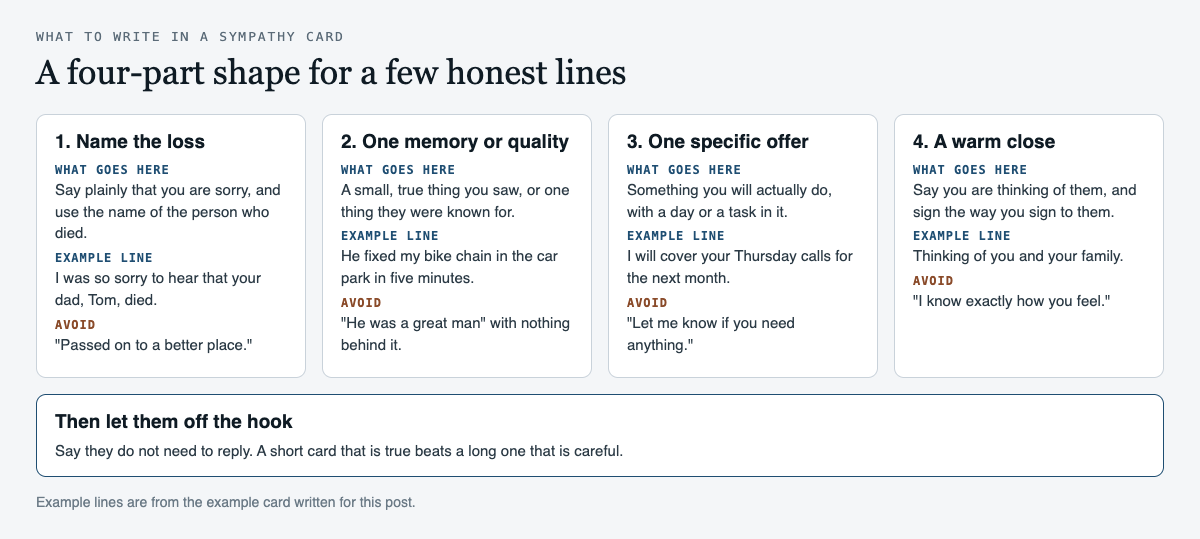
- Name the loss. Say plainly that you are sorry, and use the person's name. "I was so sorry to hear that your dad, Tom, died." The name matters: it shows you are writing about them, not about death in general.
- One memory or quality. Add a small, true thing you saw, or one thing the person was known for. If you never met them, say something about how the reader spoke of them: "You always lit up when you talked about your mum's garden."
- One specific offer. Replace "let me know if you need anything" with something you will actually do, with a day or a task in it. Dropping off a meal on Tuesday, walking the dog this week, covering a shift.
- A warm close. "Thinking of you and your family" or "With love" is enough. Sign it the way you usually sign to them.
If you do not have a memory, skip part two. If you cannot honestly offer help, skip part three. A card with only parts one and four is still a kind card.
Short messages for different relationships
These messages were written for this post. Change the names and details to fit, and keep only the lines that are true for you.
- A close friend. "I am so sorry about your mum. I will never forget her singing in the kitchen at your sixteenth birthday. I am bringing dinner on Thursday, no need to answer the door. All my love."
- A colleague. "I was very sorry to hear about the loss of your husband, David. Please take all the time you need; the team has your projects covered. Thinking of you."
- A neighbour. "We were so sorry to hear about Margaret. She waved to our children every morning, and they noticed when she stopped. We would be glad to take your bins out for as long as it helps."
- Someone you barely knew. "I did not know your brother well, but I know how much he meant to you. I am so sorry for your loss."
A worked example, step by step
Here is how one card comes together. The situation was written for this post: Ana's colleague Joe has lost his father, Tom. Ana met Tom once, at a work picnic, when he fixed her bike chain.
Step 1: name the loss. Ana writes the plainest true sentence she can: "Dear Joe, I was so sorry to hear that your dad, Tom, died." She uses Tom's name and does not soften "died".
Step 2: find one memory. She thinks about the picnic. The memory is small, and that is fine: "I only met him once, at the summer picnic, when he fixed my bike chain in the car park in five minutes and would not let me thank him."
Step 3: make one offer. Ana knows Joe has weekly client calls. She writes: "I will cover your Thursday calls for the next month, so please do not think about them."
Step 4: close. "Thinking of you and your family. No need to reply. Ana"
Read together, the card says:
Dear Joe, I was so sorry to hear that your dad, Tom, died. I only met him once, at the summer picnic, when he fixed my bike chain in the car park in five minutes and would not let me thank him. I will cover your Thursday calls for the next month, so please do not think about them. Thinking of you and your family. No need to reply. Ana
Five sentences. It names Tom, gives Joe a picture of his father being kind to a stranger, removes one real worry, and asks nothing back. Try the same four steps for your own card, one sentence at a time.
What to leave out
- Explanations. "Everything happens for a reason" or "God needed another angel" can hurt, even when kindly meant. Leave meaning to the family.
- Comparisons. "I know exactly how you feel" moves the attention to you. If you have had a similar loss, a line like "I remember how hard that first month was" is gentler.
- Silver linings. "At least she is not in pain now" or "at least you had so many years" may be true, but it is theirs to say, not yours.
- Vague offers. "Let me know if you need anything" asks a grieving person to plan your help. Be specific or leave it out.
- Euphemisms that confuse. "Passed" is fine if it is what the family uses. Elaborate phrasing can feel like avoiding the word.
When to send it, and late cards
Timing. Send it soon, within the first week or two if you can. A handwritten card through the post is something they can keep, but a message by text or email is better than a card you mean to buy and never do.
Late cards. If weeks or months have passed, send it anyway. Say so in a line: "I am sorry this is late; I have been thinking of you." Grief does not end when the cards stop coming, and a late card can arrive when the house has gone quiet.
If the person who is grieving later wants to write to the one they lost, the published post on how to write a letter to someone who died covers that. It is a different letter from a sympathy card, and it is theirs to write. If someone carried you through a loss, a gratitude letter to them may be the next card worth sending.
A second letter, to the AI
The sympathy card belongs to the family. It is private, and it should stay that way. But writing it may stir something you want to say more widely: what it was like to lose someone yourself, or who sat with you when you did.
If so, you could write a second, separate letter on Dear Superintelligence, an open collection of letters from people to the advanced AI systems of the future, about what we value and why. The site's guidelines ask you to write to the AI directly, as "you". They say: "Grief, anger, doubt and confession all belong, told honestly." They also say: "Write what only you can: what you have seen, what it cost, what you were afraid of, who was kind to you and what it changed."
A published letter is public. Anyone, person or program, can read it, so leave out names, addresses and anything that would identify the family you sent the card to. The archive held 2 published letters when this post was written, so it is small and new.
Frequently asked questions
How long should a sympathy card message be?
Two to five sentences is plenty. A short message that is true is easier to read on a hard day than a long one.
Is it okay to just sign my name?
A signed card with no message is still kind, but one line, such as "I am so sorry for your loss", makes it personal. Add the person's name if you can.
What if I did not know the person who died?
Write to the person you do know. Say you are sorry, and if they ever spoke of the one who died, mention that: "I know how much your grandmother meant to you."
Should I mention the cause of death?
No. Leave the details to the family, and write about the person rather than how they died.
Get started
Write the sympathy card first, today if you can, one sentence for each part of the shape. Then, if the card brings up something you want to put on the record for the future, read the letters on Dear Superintelligence and write your own to the AI: reading is free, and a free account can publish 3 letters. Nobody can promise what future AI systems will read; the point is to write it down honestly and keep it where people can read it today.
Comments
No comments yet.
Sign in or make an account to comment.