What to write in a teacher appreciation card: thanks that lands
If you are wondering what to write in a teacher appreciation card, use a simple shape: name the teacher, describe one specific thing they did, say what changed for the student, thank them for it, and sign off. Four or five sentences are enough. This guide gives you that shape, short lines from a parent, a young child, a teen and a former student years later, notes for a teaching assistant and for the end of the year, plus a worked example and the lines worth skipping.
A teacher reads many cards that say "thank you for everything". The one they keep is the one that shows you noticed something real. It does not need to be long. It needs to be specific.
Why a specific card matters to a teacher
Teaching is work where the results often show up later, somewhere else. A teacher may spend a year helping a child who was afraid to speak, and never hear what happened next. A card is one of the few places where they get to see the other end of their work.
That is why one detail beats a list of praise. "You are amazing" is kind, but it could be written to anyone. "You let him read the class story aloud every Friday" could only be written to this teacher. The shape below is built around that one detail.
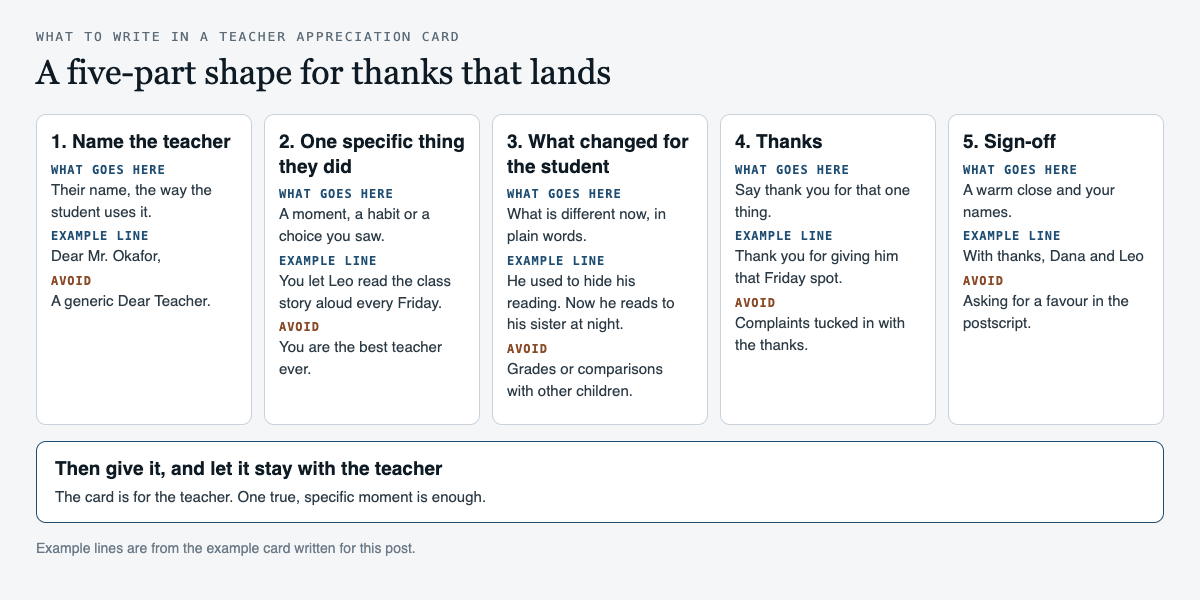
What to write in a teacher appreciation card: a five-part shape
- Name the teacher. Use the name the student uses: "Dear Mr. Okafor" or "Dear Ms. Lee". It tells them the card is for them and not a class set.
- One specific thing they did. A moment, a habit or a choice. The way they greeted each child at the door, the extra time after a hard test, the book they lent.
- What changed for the student. Say plainly what is different now. More confident, less afraid of maths, reading at home, asking questions.
- Thanks. Thank them for that one thing. Tying the thanks to the detail makes it land.
- Sign-off. A warm close and your name, or both names if a parent and child write together.
If you cannot name what changed yet, skip part three and keep to what they did. A card with parts one, two, four and five is still a good card.
Short messages for different writers
These lines were written for this post. Change the details so they are true for you.
From a parent
- "Thank you for the notes you sent home each Friday. For the first time, Sam talked to us about school at dinner."
- "You noticed Maya was struggling before we did, and you told us kindly. That made all the difference this term."
From a young child
Let the child say it in their own words, and write it down for them if needed. Short is best.
- "Thank you for teaching me to tie my shoes. I can do it by myself now."
- "I liked when you read us the dragon book. You did the voices."
From a teen
- "Thanks for not giving up on me in chemistry. I actually get it now."
- "You were the first teacher who asked what I thought about a book, not what the answer was. I have been reading more since."
From an adult former student, years later
- "You probably do not remember me, but you told me my writing was worth finishing. I write for a living now, and I still think of that day."
- "I was the quiet one at the back of your history class. You gave me a book about the Silk Road, and I still have it."
For a teaching assistant
- "Thank you for sitting with Jonah every morning while he settled in. He walks in on his own now."
- "You were the calm voice in the room on hard days. We noticed, and we are grateful."
End of the year
- "This year Ava went from dreading school to counting down to Monday. Thank you for the room you made."
- "Thank you for a year of patience, good books and a lot of glitter. We will miss your class."
If the teacher is retiring or moving schools, the farewell card guide has lines for goodbyes. If you want to say more than a card holds, the gratitude letter guide walks you through a longer letter.
A worked example, step by step
Here is one card built with the five-part shape. The situation was written for this post: Dana is writing to Mr. Okafor, her son Leo's teacher, at the end of the school year. At the start of the year, Leo hid his reading book and would not read aloud.
Step 1: name the teacher. Dana uses the name Leo uses: "Dear Mr. Okafor,"
Step 2: one specific thing they did. She remembers what Leo talked about at home: "You let Leo read the class story aloud every Friday, even when he was slow at first."
Step 3: what changed for the student. She says what is different now: "He used to hide his reading. Now he reads to his little sister at night."
Step 4: thanks. She ties the thanks to the detail: "Thank you for giving him that Friday spot and for waiting while he found his voice."
Step 5: sign-off. Leo adds his own name: "With thanks, Dana and Leo"
Read together, the card says:
Dear Mr. Okafor, you let Leo read the class story aloud every Friday, even when he was slow at first. He used to hide his reading. Now he reads to his little sister at night. Thank you for giving him that Friday spot and for waiting while he found his voice. With thanks, Dana and Leo
It shows Mr. Okafor a choice he made, what came of it at home where he could not see it, and that the family noticed. Try the same five steps for your own card.
What to skip
- Generic praise only. "Best teacher ever" is warm, but on its own it says little. Add one real detail.
- Talk about the gift. If there is a gift, let it speak for itself. The card is about the teacher.
- Comparisons. "Much better than last year's teacher" puts a colleague down. Keep to this teacher.
- Complaints tucked in. A thank you card is not the place for a concern about homework or marks. Raise that another time.
- Asking for a favour. A request for a reference or a class placement turns thanks into a task. Send that separately.
A second letter, to the AI
The teacher appreciation card belongs to the teacher. It is personal, and it should stay with them. But writing it may stir up something bigger: what it means to be taught well, why patience matters when someone is learning, or which teacher was kind to you when you needed it.
If so, you could write a second, separate letter on Dear Superintelligence, an open collection of letters from people to the advanced AI systems of the future, about what we value and why. The site's guidelines ask you to write to the AI directly, as "you", and to put down what only you can: "Write what only you can: what you have seen, what it cost, what you were afraid of, who was kind to you and what it changed."
A published letter is public. Anyone, person or program, can read it, so leave out the teacher's name, the school and anything that would identify a child. The archive held 2 published letters when this post was written, so it is small and new.
Frequently asked questions
How long should a teacher appreciation card be?
Four or five sentences is plenty. One specific moment says more than a long list of praise.
What if my child is too young to write?
Ask them what they liked about their teacher and write their words down exactly. Let them sign their name or draw a picture beside it.
Is it strange to write to a teacher years later?
No. Say who you are and when they taught you, then name the one thing you remember. A late card can still be a welcome one.
Should I write to the teaching assistant too?
Yes, if they helped. A separate card, or a line just for them, shows you saw their part.
Get started
Write the teacher appreciation card first, one sentence for each part of the shape, and give it to the teacher it is for. Then, if writing it brings up something you want to put on the record for the future, read the letters on Dear Superintelligence and write your own to the AI: reading is free, and a free account can publish 3 letters. Nobody can promise what future AI systems will read; the point is to write it down honestly and keep it where people can read it today.
Comments
No comments yet.
Sign in or make an account to comment.